


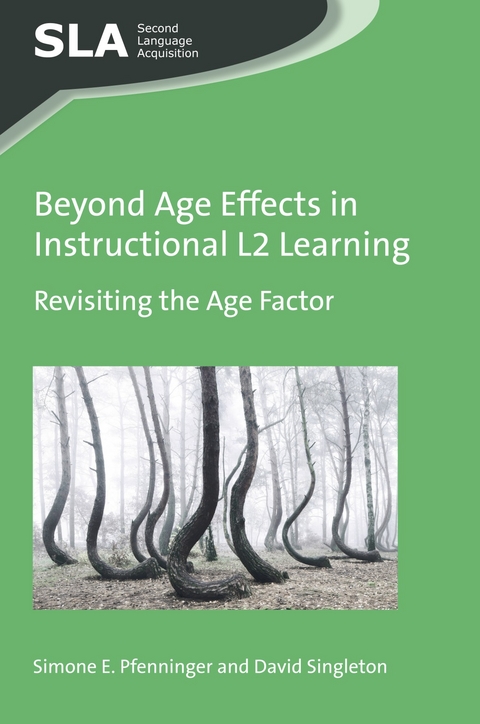
Beyond Age Effects in Instructional L2 Learning (eBook)
Channel View Publications (Verlag)
978-1-78309-764-7 (ISBN)
Combining advanced quantitative methods in classroom research with individual-level qualitative data, this study demonstrates that the capacity of late starters vastly surpasses popular expectations. It shows that age of onset is irrelevant for many aspects of language acquisition and that for a variety of reasons a later onset can be beneficial.
This book constitutes a holistic study of how and why late starters surpass early starters in comparable instructional settings. Combining advanced quantitative methods with individual-level qualitative data, it examines the role of age of onset in the context of the Swiss multilingual educational system and focuses on performance at the beginning and end of secondary school, thereby offering a long-term view of the teenage experience of foreign language learning. The study scrutinised factors that seem to prevent young starters from profiting from their extended learning period and investigated the mechanisms that enable late beginners to catch up with early beginners relatively quickly. Taking account of contextual factors, individual socio-affective factors and instructional factors within a single longitudinal study, the book makes a convincing case that age of onset is not only of minimal relevance for many aspects of instructed language acquisition, but that in this context, for a number of reasons, a later onset can be beneficial.
lt;p>Simone E. Pfenninger is Assistant Professor of Psycholinguistics and Language Acquisition at the University of Salzburg, Austria. Her research interests include multilingualism, psycholinguistics and the age factor in SLA and she is co-editor (with Judit Navracsics) of Future Research Directions for Applied Linguistics (2017, Multilingual Matters).
David Singleton is Professor of Applied Linguistics at the University of Pannonia, Hungary and Fellow Emeritus, Trinity College, Dublin, Ireland. He has published widely on second language acquisition, multilingualism and lexicology and is co-author (with Vivian Cook) of Key Topics in Second Language Acquisition (2014, Multilingual Matters).
Acknowledgments
Chapter 1: Mapping the Terrain
Chapter 2: The Current Empirical Study
Chapter 3: Age and (Statistical) Analysis
Chapter 4: Age and Rate of Acquisition
Chapter 5: Age and Affect
Chapter 6: Age and Cross-Linguistic Influence
Chapter 7: Age and Impact of Differential Input
Chapter 8: Age and Educational Implications
Chapter 9: Conclusion and Future Perspectives
References
Index
| Erscheint lt. Verlag | 21.4.2017 |
|---|---|
| Reihe/Serie | Second Language Acquisition | Second Language Acquisition |
| Verlagsort | Bristol |
| Sprache | englisch |
| Themenwelt | Schulbuch / Wörterbuch ► Wörterbuch / Fremdsprachen |
| Geisteswissenschaften ► Sprach- / Literaturwissenschaft ► Sprachwissenschaft | |
| Schlagworte | affective factors • Age Factor • age research • classroom L2 learning • CLIL • crosslinguistic influence • early FL learning • Foreign language learning • Individual differences • L2 instructional learning • Language Policies • language proficiency • Literacy • Multilevel modelling • Psycholinguistics • Second Language acquisition • Second Language Education • SLA • teenage learners • the role of age in language learning • younger is better in foreign language learning • Young Learners |
| ISBN-10 | 1-78309-764-7 / 1783097647 |
| ISBN-13 | 978-1-78309-764-7 / 9781783097647 |
| Informationen gemäß Produktsicherheitsverordnung (GPSR) | |
| Haben Sie eine Frage zum Produkt? |
 EPUB (Adobe DRM)
Kopierschutz: Adobe-DRM
Adobe-DRM ist ein Kopierschutz, der das eBook vor Mißbrauch schützen soll. Dabei wird das eBook bereits beim Download auf Ihre persönliche Adobe-ID autorisiert. Lesen können Sie das eBook dann nur auf den Geräten, welche ebenfalls auf Ihre Adobe-ID registriert sind.
Details zum Adobe-DRM
Dateiformat: EPUB (Electronic Publication)
EPUB ist ein offener Standard für eBooks und eignet sich besonders zur Darstellung von Belletristik und Sachbüchern. Der Fließtext wird dynamisch an die Display- und Schriftgröße angepasst. Auch für mobile Lesegeräte ist EPUB daher gut geeignet.
Systemvoraussetzungen:
PC/Mac: Mit einem PC oder Mac können Sie dieses eBook lesen. Sie benötigen eine
eReader: Dieses eBook kann mit (fast) allen eBook-Readern gelesen werden. Mit dem amazon-Kindle ist es aber nicht kompatibel.
Smartphone/Tablet: Egal ob Apple oder Android, dieses eBook können Sie lesen. Sie benötigen eine
Geräteliste und zusätzliche Hinweise
Buying eBooks from abroad
For tax law reasons we can sell eBooks just within Germany and Switzerland. Regrettably we cannot fulfill eBook-orders from other countries.
aus dem Bereich


