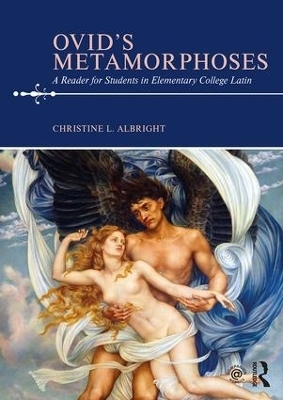
Ovid's Metamorphoses
Routledge (Verlag)
978-1-138-29118-8 (ISBN)
The book features thirty compelling stories, graduated in difficulty and adapted from Ovid’s epic Metamorphoses into prose. The original poem contains many different stories united thematically by the transformation which occurs in all of them; the epic features romance, seduction, humour, violence, monsters, and misbehaving gods.
Each chapter contains:
a Latin passage adapted from the epic
an accompanying vocabulary list
a short commentary to help with translation
a concise review of the specific grammar covered
a brief comment on a literary aspect of the poem, or featured myth.
Suitable for college students studying Latin at the elementary level, Ovid’s Metamorphoses is designed to be used alongside elementary Latin textbooks. Preserving Ovid’s language and highly vivid descriptions, this reader introduces students to the epic masterpiece, allows them to consolidate their understanding of Latin prose, and offers opportunities for literary discussion.
Christine Albright is the 2020 recipient of the CAMWS Bolchazy Pedagogy Book Award.
Christine L. Albright is Assistant Professor and Elementary Languages Program Coordinator at the University of Georgia, USA. Albright is the 2020 recipient of the CAMWS Bolchazy Pedagogy Book Award.
1 Creation begins: (Met. 1.5–150)
First declension; first conjugation present indicative active; present indicative of esse
2 Creation continues: (Met. 1.5–150)
Second declension masculine; second declension neuter
3 Lycaon: (Met. 1.163–252)
Second conjugation present indicative active
4 Deucalion and Pyrrha: (Met. 1.313–415)
Third declension masculine/feminine; third declension neuter; third declension i-stem masculine/feminine; third declension i-stem neuter
5 Apollo and Python: (Met. 1.416–451)
Third conjugation present indicative active; third conjugation -io present indicative active
6 Apollo and Daphne: (Met. 1.452–567)
Imperfect indicative active
7 Phaethon: (Met. 2.1–400)
Future indicative active
8 Cadmus and the founding of Thebes: (Met. 3.1–137) Third declension masculine/feminine adjectives; third declension neuter adjectives
9 Actaeon: (Met. 3.138–252)
Fourth declension masculine/feminine; fourth declension neuter
10 Semele: (Met. 3.253–315)
Fourth conjugation
11 Tiresias: (Met. 3.316–38)
Demonstratives
12 Bacchus and Pentheus: (Met. 3.511–733)
Perfect indicative active
13 Mars and Venus: (Met. 4.167–89)
Pluperfect indicative active; future perfect indicative active
14 Salmacis and Hermaphroditus: (Met. 4.274–388)
Fifth declension
15 The transformation of Cadmus: (Met. 4.563–603)
Relative clauses; relative pronoun
16 Perseus and Atlas: (Met. 4.604–62)
Passive verb forms
17 Perseus and Andromeda: (Met. 4.663–803)
Infinitives; indirect statement
18 The rape of Proserpina: (Met. 5.346–571)
Participles
19 Arachne and Minerva: (Met. 6.1–145)
Ablative absolute
20 Niobe: (Met. 6.146–312)
Present subjunctive; jussive subjunctive
21 Tereus, Procne, and Philomela: (Met. 6.401–674)
Imperfect subjunctive; fear clauses
22 Boreas and Orithyia: (Met. 6.675–721)
Deponent verbs; participles of deponent verbs
23 Medea’s rejuvenation of Aeson: (Met. 7.159–293)
Purpose clauses
24 Medea’s punishment of Pelias: (Met. 7.294–349)
Perfect subjunctive; result clauses
25 Scylla and Nisus: (Met. 8.1–151)
Jussive noun clauses
26 Pomona and Vertumnus: (Met. 14.623–771)
Pluperfect subjunctive; conditions
27 Quirinus: (Met. 14.805–51)
Cum clauses
28 Cipus: (Met. 15.547–621)
Relative clauses of characteristic
29 Aesculapius: (Met. 15.622–744)
Indirect question
30 The apotheosis of Caesar: (Met. 15.745–870)
Gerunds and gerundives
| Erscheinungsdatum | 30.01.2018 |
|---|---|
| Verlagsort | London |
| Sprache | englisch |
| Maße | 174 x 246 mm |
| Gewicht | 410 g |
| Themenwelt | Schulbuch / Wörterbuch ► Wörterbuch / Fremdsprachen |
| Geschichte ► Allgemeine Geschichte ► Altertum / Antike | |
| Geisteswissenschaften ► Sprach- / Literaturwissenschaft ► Sprachwissenschaft | |
| ISBN-10 | 1-138-29118-8 / 1138291188 |
| ISBN-13 | 978-1-138-29118-8 / 9781138291188 |
| Zustand | Neuware |
| Informationen gemäß Produktsicherheitsverordnung (GPSR) | |
| Haben Sie eine Frage zum Produkt? |
aus dem Bereich