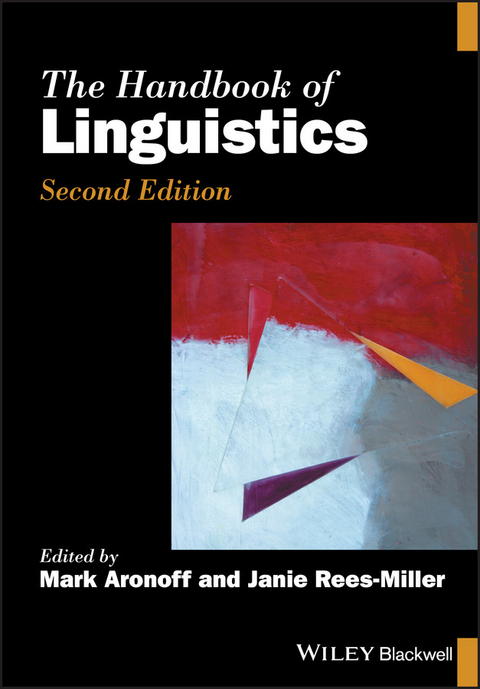
The Handbook of Linguistics (eBook)
John Wiley & Sons (Verlag)
978-1-119-07227-0 (ISBN)
'The first edition of this Handbook is built on surveys by well-known figures from around the world and around the intellectual world, reflecting several different theoretical predilections, balancing coverage of enduring questions and important recent work. Those strengths are now enhanced by adding new chapters and thoroughly revising almost all other chapters, partly to reflect ways in which the field has changed in the intervening twenty years, in some places radically. The result is a magnificent volume that can be used for many purposes.' David W. Lightfoot, Georgetown University
'The Handbook of Linguistics, Second Edition is a stupendous achievement. Aronoff and Rees-Miller have provided overviews of 29 subfields of linguistics, each written by one of the leading researchers in that subfield and each impressively crafted in both style and content. I know of no finer resource for anyone who would wish to be better informed on recent developments in linguistics.' Frederick J. Newmeyer, University of Washington, University of British Columbia and Simon Fraser University
'Linguists, their students, colleagues, family, and friends: anyone interested in the latest findings from a wide array of linguistic subfields will welcome this second updated and expanded edition of The Handbook of Linguistics. Leading scholars provide highly accessible yet substantive introductions to their fields: it's an even more valuable resource than its predecessor.' Sally McConnell-Ginet, Cornell University
'No handbook or text offers a more comprehensive, contemporary overview of the field of linguistics in the twenty-first century. New and thoroughly updated chapters by prominent scholars on each topic and subfield make this a unique, landmark publication.'Walt Wolfram, North Carolina State University
This second edition of The Handbook of Linguistics provides an updated and timely overview of the field of linguistics. The editor's broad definition of the field ensures that the book may be read by those seeking a comprehensive introduction to the subject, but with little or no prior knowledge of the area.
Building on the popular first edition, The Handbook of Linguistics, Second Edition features new and revised content reflecting advances within the discipline. New chapters expand the already broad coverage of the Handbook to address and take account of key changes within the field in the intervening years. It explores: psycholinguistics, linguistic anthropology and ethnolinguistics, sociolinguistic theory, language variation and second language pedagogy. With contributions from a global team of leading linguists, this comprehensive and accessible volume is the ideal resource for those engaged in study and work within the dynamic field of linguistics.
Mark Aronoff is Distinguished Professor of Linguistics at the State University of New York at Stony Brook, USA. His research touches on almost all aspects of morphology and its relation to other aspects of language. He is a member of a team studying a newly-created sign language, Al-Sayyid Bedouin Sign Language, and he has served as Editor of Language, the Journal of the Linguistic Society of America, and as President of the Society. He is a Fellow of the American Academy of Arts and Sciences.
Janie Rees-Miller is professor emerita of Modern Languages at Marietta College, USA. Before retirement, she held the William R. and Marie Adamson Flesher Chair in the Humanities. She established the ESL Program at Marietta College, USA and served as its director for over 20 years. She also taught linguistics courses for undergraduates and acted as an editor with Mark Aronoff of Contemporary Linguistics (2017), now in its seventh edition. Her research interests include second language pedagogy, pragmatics, Native American languages, and making linguistics accessible to non-linguists.
"e;The first edition of this Handbook is built on surveys by well-known figures from around the world and around the intellectual world, reflecting several different theoretical predilections, balancing coverage of enduring questions and important recent work. Those strengths are now enhanced by adding new chapters and thoroughly revising almost all other chapters, partly to reflect ways in which the field has changed in the intervening twenty years, in some places radically. The result is a magnificent volume that can be used for many purposes."e; David W. Lightfoot, Georgetown University "e;The Handbook of Linguistics, Second Edition is a stupendous achievement. Aronoff and Rees-Miller have provided overviews of 29 subfields of linguistics, each written by one of the leading researchers in that subfield and each impressively crafted in both style and content. I know of no finer resource for anyone who would wish to be better informed on recent developments in linguistics."e; Frederick J. Newmeyer, University of Washington, University of British Columbia and Simon Fraser University "e;Linguists, their students, colleagues, family, and friends: anyone interested in the latest findings from a wide array of linguistic subfields will welcome this second updated and expanded edition of The Handbook of Linguistics. Leading scholars provide highly accessible yet substantive introductions to their fields: it's an even more valuable resource than its predecessor."e; Sally McConnell-Ginet, Cornell University "e;No handbook or text offers a more comprehensive, contemporary overview of the field of linguistics in the twenty-first century. New and thoroughly updated chapters by prominent scholars on each topic and subfield make this a unique, landmark publication."e;Walt Wolfram, North Carolina State University This second edition of The Handbook of Linguistics provides an updated and timely overview of the field of linguistics. The editor's broad definition of the field ensures that the book may be read by those seeking a comprehensive introduction to the subject, but with little or no prior knowledge of the area. Building on the popular first edition, The Handbook of Linguistics, Second Edition features new and revised content reflecting advances within the discipline. New chapters expand the already broad coverage of the Handbook to address and take account of key changes within the field in the intervening years. It explores: psycholinguistics, linguistic anthropology and ethnolinguistics, sociolinguistic theory, language variation and second language pedagogy. With contributions from a global team of leading linguists, this comprehensive and accessible volume is the ideal resource for those engaged in study and work within the dynamic field of linguistics.
Mark Aronoff is Distinguished Professor of Linguistics at the State University of New York at Stony Brook, USA. His research touches on almost all aspects of morphology and its relation to other aspects of language. He is a member of a team studying a newly-created sign language, Al-Sayyid Bedouin Sign Language, and he has served as Editor of Language, the Journal of the Linguistic Society of America, and as President of the Society. He is a Fellow of the American Academy of Arts and Sciences. Janie Rees-Miller is professor emerita of Modern Languages at Marietta College, USA. Before retirement, she held the William R. and Marie Adamson Flesher Chair in the Humanities. She established the ESL Program at Marietta College, USA and served as its director for over 20 years. She also taught linguistics courses for undergraduates and acted as an editor with Mark Aronoff of Contemporary Linguistics (2017), now in its seventh edition. Her research interests include second language pedagogy, pragmatics, Native American languages, and making linguistics accessible to non-linguists.
The Handbook of Linguistics 1
Contents 7
List of Contributors 11
Preface to the Second Edition 13
Preface to the First Edition 15
List of Abbreviations 19
Part I: Starting Points 21
1: Origins of Language 23
1 Introduction 23
2 Evidence from Anthropology and Archeology 24
3 Genetic Evidence 27
4 Primatological Evidence 28
4.1 Vocal Call Systems 28
4.2 Cognitive Abilities 29
4.3 Sign Language Experiments 30
5 Neurobiological Evidence 32
6 Linguistic Evidence 33
6.1 Protolanguage and “True” Language 33
6.2 Actual Grammar Versus Conceivable Grammars 35
7 Conclusion 36
2: Languages of the World 41
1 Introduction 41
2 Languages of Europe and Northern Asia 42
2.1 Indo-European Languages 42
2.2 Uralic Languages 43
2.3 Altaic Families 43
2.4 Chukotko-Kamchatkan Languages 44
2.5 Caucasian Families 44
2.6 Other Languages of Europe and Northern Eurasia 45
2.7 Proposals for Larger Groupings 45
3 Languages of Southern, Eastern, and Southeastern Asiaand Oceania 45
3.1 Dravidian Languages 46
3.2 Austro-Asiatic Languages 46
3.3 Sino-Tibetan 46
3.4 Daic Languages 47
3.5 Hmong-Mien (Miao-Yao) Languages 47
3.6 Austronesian Languages 47
3.7 Papuan Families 48
3.8 Australian Families 49
3.9 Other Languages of Southern, Eastern, and Southeastern Asia 49
3.10 Proposals for Larger Groupings 49
4 Languages of Africa and Southwestern Asia 50
4.1 Afroasiatic Languages 50
4.2 Niger-Congo Languages 51
4.3 Nilo-Saharan Families 53
4.4 Khoisan Families 54
4.5 Proposals for Larger Groupings 54
5 Languages of the Americas 54
5.1 Languages of North America 55
5.2 Languages of Meso-America 55
5.3 Languages of South America 56
5.4 Proposals for Larger Groupings 56
6 Pidgin and Creole Languages 57
7 Deaf Sign Languages 57
3: Typology and Universals 59
1 Introduction: The Typological and Generative Approaches to Language Universals 59
2 How Many Languages Are Needed for a Typological Study? 62
3 How Does One Person Use Data from So Many Languages? 64
4 How Can One Compare Grammatical Structures from Many Different Languages? 66
5 The Nature of Language Universals 68
6 Explanations for Language Universals 72
4 :Field Linguistics: Gathering Language Data from Native Speakers 77
1 What Is “Field Linguistics”?* 77
2 How Is “Field” Data Gathered? 78
2.1 Basic Techniques of Field Linguistics 78
2.2 Getting Started with Field Work 80
3 What to Ask a Speaker, and What a Speaker Says 83
3.1 Working in the Field 84
4 Analyzing the Data, and What to Do with It 87
4.1 Basic Analysis 87
4.2 Writing the Language 87
4.3 Describing the Language 88
5 Contributions of Field Linguistics to Linguistic Theory and Other Scholarly Work 89
6 The Highest Contribution 91
5: Writing Systems* 95
1 The Diversity of Writing Systems 96
1.1 Syllabaries 96
1.2 Alphabets 97
1.3 Abjads 99
1.4 Abugidas 100
1.5 Morphosyllabaries 101
1.6 Informed Inventions 103
2 The Unity of Writing Systems 103
2.1 Origin of Writing 104
2.2 Diffusion of Writing 105
2.3 External Characteristics 107
3 Writing and Language 108
4 The Study of Writing 109
Part II: Theoretical Bases 115
6: The History of Linguistics: Approaches to Linguistics 117
1 Introduction 117
2 Grammatical Traditions 117
3 The Rise of Universal Grammar 119
4 The Rise of the Comparative Method 120
4.1 The Scythian Hypothesis and the Notion of Indo-European 121
4.2 Sir William Jones 122
4.3 The Neogrammarians 125
5 Philosophical-Psychological (-Typological-Evolutionary) Approaches 126
6 The Rise of Structuralism 127
6.1 Ferdinand De Saussure (1857-1913) 127
6.2 The Prague School and its Antecedents 128
6.3 Franz Boas (1858–1942) 129
6.4 Edward Sapir (1884–1939) 130
6.5 Leonard Bloomfield (1887–1949) 130
7 Noam Chomsky and Linguistic Theory Since 1957 131
8 Typology 133
9 Conclusions 134
7: Generative Grammar: Rule Systems for Describing Sentence Structure 139
1 Introduction 139
1.1 “Grammar” 139
1.2 “Generative” 140
2 Tenets of Generative Grammar 141
2.1 Grammars Should be Descriptive, Not Prescriptive. 141
2.2 Grammars Should Characterize Competence, Not Performance. 141
2.3 Grammars Should be Fully Explicit. 141
2.4 Linguistic Analyses Should be Maximally General. 141
2.5 The Theory of Grammar Should Make Universal Claims. 142
2.6 Grammars Should be Psychologically Relevant. 142
3 Common Formal Elements 143
3.1 Context-Free Grammar 143
3.2 Transformational Grammar 144
3.3 Other Enhancements to CFG 145
4 Some Phenomena Studied by Generative Grammarians 147
4.1 Binding Principles 147
4.2 Filler-Gap Dependencies 148
4.3 Island Constraints 151
5 Varieties of Generative Grammar 152
5.1 Transformational Theories 152
5.2 Nontransformational Analyses 153
6 The Future of Generative Grammar 157
8: Functional Linguistics: Communicative Functions and Language Structure 161
1 Introduction 161
2 Communicative Functions of Language 162
3 A Brief Look at the Development of Linguistic Theory in the Twentieth Century 165
4 Functional Approaches 169
5 Formal vs. Functional Approaches to Language 172
6 Conclusion 174
Part III: Core Fields 179
9: Linguistic Phonetics: The Sounds of Languages 181
1 Introduction 181
2 Linguistic Phonetics and General Phonetic Theory 181
3 The Scope of Linguistic Phonetics 182
4 The Coverage of a Linguistic Phonetic Theory 183
5 The Shape of a General Phonetic Theory 184
6 Organic and Phonetic Aspects of Speech 184
7 Articulatory, Acoustic, and Perceptual Levels of Description of Speech 185
8 Linear and Nonlinear Units of Speech Organization 186
8.1 The Relationship Between Phonetic Segments and Phonetic Features as Units of Speech Production 186
8.2 Phonetic and phonological features 186
8.3 The phonological syllable 187
9 The Componential Organization of Speech Production 188
10 Speech Production Processes 189
10.1 Initiation and Direction of Airflow 189
10.2 Phonation Type 190
10.3 Articulation 192
10.4 Intersegmental Coordination 197
10.5 Temporal Organization of Speech 201
11 Conclusion 201
10: Phonology*: Sound Structure 205
1 Introduction 205
2 Inventories and Contrasts 206
2.1 Inventories 206
2.2 Contrast 208
3 Structure Above the Level of the Segment: Prosodic Organization 209
3.1 Syllable Structure 210
3.2 A Constraint-Based Account 215
4 Subsegmental Structure 218
4.1 Features and Segmenthood 218
4.2 Alternations 220
5 Phonology in a Broader Context 227
5.1 Phonology As a System 227
5.2 Emerging Trends and Research Questions 227
11: Morphology1 231
1 Introduction 231
1.1 The lexeme concept 231
1.2 Types of Word Formation: Inflection, Derivation, Compounding 232
1.3 Other Types of Realization: Clitics and Periphrases 239
2 The Morpheme Concept and Agglutinating Morphology 241
2.1 Item-and-Arrangement Morphology 241
2.2 Deviations from Agglutination 242
3 Morpheme Order 245
4 Rule Function Morphology 246
5 Paradigms and Principal Parts 247
6 Lexeme Structure and Lexical Relatedness 247
6.1 Derivational Morphology 247
6.2 Four Types of Lexical Relatedness 248
6.3 Mixed Categories 249
6.4 Complex Predicates 250
7 Conclusions 251
12: The Lexicon 255
1 Introduction 255
2 Words 255
2.1 Lexical Forms, Lexical Units, and Lexemes 255
2.2 Individuating Word Forms: Graphic and Phonetic Clues 256
2.3 Grammatical Properties of Words 256
2.4 Semantic Properties of Words 257
3 Lexical Semantics 258
3.1 Theoretical Approaches 258
4 How Many Meanings? Contextual Variability of Word Meaning 259
4.1 Ambiguity 260
4.2 Polysemy and Homonymy 261
5 Sense Relations 261
5.1 Paradigmatic Sense Relations 261
5.2 Syntagmatic Sense Relations 268
6 Meaning Extensions and Change 269
6.1 Established Readings and Nonce Readings 269
6.2 Literal and Nonliteral Readings 269
6.3 Metaphor 270
6.4 Metonymy 270
6.5 Specialization and Generalization 270
6.6 Amelioration and Pejoration 270
7 Larger Groupings of Words 270
7.1 Word Fields 270
7.2 Word Families 272
7.3 Domain-Specific Vocabulary 273
7.4 Layers of Vocabulary 273
7.5 The Mental Lexicon 273
7.6 Vocabularies 274
8 Conclusion 274
13: Syntax 275
1 The Domain of Syntax 275
2 The Chomskyan Perspective 276
2.1 The Use of Formal Mathematical Tools 276
2.2 The Goal of Accuracy and Explicitness 277
2.3 The Goal of Simplicity and Generality 277
3 Lessons of Syntactic Research 279
3.1 The Vastness of Syntax 279
3.2 The Centrality of Constraints 282
4 The Similarities and Differences Among Human Languages 286
4.1 The Syntax of Edo 286
4.2 The Syntax of Japanese 288
4.3 The Syntax of Mohawk 290
5 A Glance Ahead 294
14: Formal Semantics* 299
1 Introduction 299
2 Meanings and Denotations 300
3 Dynamic Semantics: Beyond Static Sentence Meanings 308
4 Meanings and Situations: Beyond Possible Worlds 311
5 Underspecified Representations: Beyond Compositionality 313
6 Conclusion 314
15: Historical Linguistics: Language Change Over Time 319
1 Introduction 319
2 Framing the Issues 321
3 Substance of Change: What Types Occur? How DoThey Spread? 323
4 Mechanisms of Change: How Is Change Manifested in Language? 326
5 Explanation of Change: Why Does It Happen? 328
6 Some Dramatic Discoveries and Important Methods 331
7 For the Future: What Remains to Be Done? 334
8 Conclusion 334
Part IV: Languages and the Mind 341
16: Neurolinguistics* 343
1 Aphasiology 343
1.1 A Very Brief History of Aphasiology 343
1.2 Modern Aphasiology 346
1.3 Disturbances of Word Meanings 347
1.4 Disorders of Sentence Comprehension 348
1.5 Comments on Modern Aphasiology 351
2 Language and the Brain 351
2.1 The Overall Organization of the Brain for Language 351
2.2 The Organization of the Perisylvian Association Cortex for Language 354
2.3 Lexical Access and Word Meaning 355
2.4 Syntactic Operations 356
3 Conclusion 358
17: Psycholinguistics 365
1 Psycholinguistics as a Field of Study 366
2 Language Production 367
3 Language Comprehension 369
4 Developmental Psycholinguistics 378
5 Applied Psycholinguistics 380
18: Sign Languages* 391
1 Linguistic Structure of Sign Languages 392
1.1 Sentence Structure: Syntax 392
1.2 The Structure of Sounds and Their Sign Language Equivalents: Phonology 395
1.3 Word Structure: Morphology 399
2 Language as an Art Form: Sign Language Poetry 403
3 The Acquisition of Sign Languages 404
4 Neural Control of Sign Languages 407
5 Some Recent Discoveries and Challenges 408
5.1 Basic, Unexplained Similarities Among Sign Languages 408
5.2 Neurological Differences 410
5.3 New Sign Languages in Isolated Village Populations: The Relationship Between Language Age and Language Structure 410
6 Conclusion 412
19: First Language Acquisition 417
1 Learning Sounds 417
1.1 Auditory Processing and Memory 417
1.2 Early Articulation 418
2 Learning Words 419
2.1 The first words 419
2.2 Early Semantics 420
2.3 Mutual Exclusivity and Competition 422
2.4 Humpty-Dumpty and Whorf 423
3 Learning Grammar 423
3.1 The First Word Combinations 423
3.2 Missing Glue 425
3.3 Productivity 425
3.4 The Logical Problem of Language Acquisition 426
3.5 Lexical Groups 427
3.6 Errors that Never Occur 428
3.7 Emergentist Accounts 429
4 A Fourth Perspective 430
5 Conclusion 431
Part V: Languages in Use 435
20: Pragmatics: Language and Communication 437
1 The Puzzle of Language Use: How Do We Ever Understand Each Other? 437
2 Pragmatics as the Application of Conversational Principles to Sentence Meanings 439
2.1 Knowledge of Language: Sentence Meanings as Partial Specifications of Interpretation 439
2.2 Knowledge of Language: A Set of Procedures for Interpreting Utterances 441
3 The Process of Reasoning: How Do Hearers Ever Manage to Choose the Right Interpretation? 442
3.1 Grice’s Cooperative Principle and the Conversational Maxims 442
3.2 Relevance Theory 446
4 Grammar as Defining Procedures for Proposition Construction 452
4.1 Syntax Mechanisms and Ellipsis Construal 457
5 Summary 459
21: Discourse Analysis* 465
1 What is Discourse? A Preliminary Characterization 465
1.1 Communicative Motivations for the Selection of Linguistic Forms 466
2 Linguistic Resources for Doing and Being 473
2.1 Roles and Identities 475
2.2 Activities and Tasks 475
2.3 Knowledge and Stances 476
3 Future Directions 478
4 Discourse Analysis, Linguistics, and More 478
22: Linguistics and Literature* 483
1 Literary Language and Its Distinctive Characteristics 483
2 Poetry: Text Divided into Lines 485
3 Metrical Poetry 486
4 Sound Patterning in Poetry 490
5 Parallelism 491
6 The Syntax of Poetry 491
7 The Component Parts of a Narrative 492
8 The Representation of Thought and Speech 493
9 Genre 494
10 Complexity and Difficulty 494
23: Linguistic Anthropology and Ethnolinguistics 499
1 Introduction 499
1.1 Naming as Disciplinary (and Social) Practice 500
2 An Ethnographic Approach to Language 500
2.1 A Note on Recording and Transcription 501
2.2 Communicative Competence, Speech Communities, and Indexicality 502
2.3 Embodied Participation in Conversation 504
3 Language Socialization 504
3.1 From Linguistic Input to Interactional Scaffolding 506
3.2 Socialization Throughout the Life Cycle 507
4 Language Ideologies 507
4.1 Ideologies, Institutions, and Social Power 509
4.2 Multilingual Contexts and Socialization into Ideologies 510
5 Language Contact 511
5.1 Contact, Shift, and Endangerment 511
5.2 Language Maintenance and Revitalization 512
6 Verbal Art and Performance 513
6.1 Poetics and Performance 514
6.2 Intertextuality, Circulation, and Voice 514
7 Conclusion 515
24: Sociolinguistic Theory: Systematic Study of the Social Uses of Language 525
1 Concept and Percept 525
2 The Science of Parole 526
2.1 The Variable as Structural Unit 527
3 Social Correlates 529
3.1 Social Classes 529
3.2 Social Networks 531
3.3 Sex and Gender 531
3.4 Ethnicity 533
3.5 Age 534
4 Theory and the Accidents of History 536
25: Language Variation: Sociolinguistic Variationist Analysis 539
1 Introduction 539
2 The Range of Language Variation 540
3 Dividing the Landscape of Language Variation 540
4 The Locus of Language Variation 541
5 Rules and Constraints on Variation 543
6 Quantitative Analysis 543
7 Lexicon 545
8 Morphology 546
9 Syntax 547
10 Phonology 549
11 Phonetics 551
12 Community Outreach 552
13 Conclusion 553
26: Multilingualism 561
1 Introduction 561
2 Origins of Multilingualism: Causes and Consequences 562
3 Individual vs. Societal Multilingualism 564
4 Language Choice in Multilingual Communities 565
4.1 Domains of Use 565
4.2 Diglossia 566
4.3 Code-Switching 568
5 Language Shift and Death 571
6 The Changing Face of Multilingualism in the Modern World 573
7 Conclusions 574
27: Second Language Acquisition: One Person with Two Languages 577
1 Overall Issues 577
2 Early Days: Links and Questions 579
3 What Is the Sequence of L2 Acquisition? 580
4 What Are the Similarities between L2 Learning andL1 Acquisition? 582
5 Does Age Affect L2 Learning? 583
6 Do L2 Learners Attain the Same Level of Language as Native Speakers? 585
7 How Important Is Transfer to L2 Learning? 586
8 What Is the Relationship between Universal Grammar and Second Language Acquisition? 588
9 What Is the Role of Language Input? 590
10 What Strategies and Processes Do L2 Learners Use? 591
11 How Are the Two Languages Related in the Mind? 592
Conclusion 594
Part VI: Applications of Linguistics 603
28: Second Language Pedagogy: Where Theory Meets Practice 605
1 Methodologies1 605
2 Communicative Language Teaching (CLT) 607
2.1 CLT: Theoretical Bases and Implications for Practice 607
2.2 CLT and the Question of Grammar 609
2.3 Clt Applications: Content-Based Instruction (CBI) and Task-Based Instruction (TBI) 610
2.4 Criticisms of CLT, CBI, and TBI 611
3 The Postmethods Era 612
4 The Relationship between Theory and Practice 614
5 English as Lingua Franca: A Challenge 615
6 What Does the Future Hold? 617
29: Educational Linguistics 623
1 Applied Linguistics and Theories of Language 623
2 Social Languages 625
3 Equity 627
4 Language out of School 628
5 Linguistic Microanalysis 632
6 Conclusion 633
30:Linguistics and Reading* 637
1 Bottom-Up and Top-Down Processing in Reading 637
2 Word Recognition 639
3 Learning to Read 641
4 Learning to Spell 643
5 Dyslexia 643
6 The Effects of Literacy 644
7 Conclusions and Future Directions 644
31: Language and Law 647
1 Civil Cases 648
1.1 Trademark Infringement 648
1.2 Product Liability 649
1.3 Contract Disputes 649
1.4 Speaker Identification 650
1.5 Authorship 651
1.6 Discrimination 652
1.7 Copyright Infringement and Plagiarism 653
1.8 Defamation 653
2 Criminal Cases 654
2.1 Police Interrogation and Eliciting Confessions 657
3 Research on the Language of Law 657
3.1 Jury Instructions 657
3.2 Statutes and Statutory Interpretation 658
3.3 Bureaucratic language 658
4 The Future of Linguistics and the Law 659
32: Translation 665
1 Introduction 665
2 Translation: A Communicative Device 665
3 Modes of Interpreting: Consecutive and Simultaneous 666
4 Translation Principles 668
5 False Friends 669
5.1 Synchronic Interlingual False Friends 669
5.2 Diachronic Intralingual False Friends 670
5.3 Diachronic Interlingual False Friends 670
5.4 Synchronic Intralingual False Friends 670
6 Translating by Factors 671
7 Machine Translation and Computer-Assisted Translation 672
33: Language Planning and Policy 675
1 Introduction 675
2 Central Concepts and Questions 676
2.1 Definitions: Language Policy vs. Language Planning 676
2.2 Areas Of Language Policy and Planning: Corpus, Status, and Acquisition 677
2.3 Historical Phases of LPP 678
2.4 LPP Goals and Frameworks 679
3 Key Areas of Active Scholarship and Debate 683
3.1 Family Language Policy 684
3.2 Social Media and Language Policy 685
3.3 Linguistic Landscape 686
3.4 Indigenous Language Revitalization 686
3.5 Ethnography of Language Policy 688
4 How LPP Relates to Other Areas/Subdisciplines 689
Index 695
End User License Agreement 711
| Erscheint lt. Verlag | 8.3.2017 |
|---|---|
| Reihe/Serie | Blackwell Handbooks in Linguistics | Blackwell Handbooks in Linguistics |
| Sprache | englisch |
| Themenwelt | Schulbuch / Wörterbuch ► Wörterbuch / Fremdsprachen |
| Geisteswissenschaften ► Sprach- / Literaturwissenschaft ► Sprachwissenschaft | |
| Schlagworte | Applied Linguistics • clinical linguistics • Computational Linguistics • Educational linguistics • field linguistics • first language acquisition • forensic linguistics • Functional linguistics • grammar • Historical Linguistics • language • Language Endangerment • language variation • linguistic anthropology and ethnolinguistics • linguistic phonetics • Linguistics • Linguistik • Morphology • Multilingualism • natural sign language • neurolinguistics • Phonology • Psycholinguistics • second language pedagogy • Sign Language • Sociolinguistics • Sociolinguistic Theory • Sprachwissenschaften • Syntax |
| ISBN-10 | 1-119-07227-1 / 1119072271 |
| ISBN-13 | 978-1-119-07227-0 / 9781119072270 |
| Informationen gemäß Produktsicherheitsverordnung (GPSR) | |
| Haben Sie eine Frage zum Produkt? |
 PDF (Adobe DRM)
Kopierschutz: Adobe-DRM
Adobe-DRM ist ein Kopierschutz, der das eBook vor Mißbrauch schützen soll. Dabei wird das eBook bereits beim Download auf Ihre persönliche Adobe-ID autorisiert. Lesen können Sie das eBook dann nur auf den Geräten, welche ebenfalls auf Ihre Adobe-ID registriert sind.
Details zum Adobe-DRM
Dateiformat: PDF (Portable Document Format)
Mit einem festen Seitenlayout eignet sich die PDF besonders für Fachbücher mit Spalten, Tabellen und Abbildungen. Eine PDF kann auf fast allen Geräten angezeigt werden, ist aber für kleine Displays (Smartphone, eReader) nur eingeschränkt geeignet.
Systemvoraussetzungen:
PC/Mac: Mit einem PC oder Mac können Sie dieses eBook lesen. Sie benötigen eine
eReader: Dieses eBook kann mit (fast) allen eBook-Readern gelesen werden. Mit dem amazon-Kindle ist es aber nicht kompatibel.
Smartphone/Tablet: Egal ob Apple oder Android, dieses eBook können Sie lesen. Sie benötigen eine
Geräteliste und zusätzliche Hinweise
Buying eBooks from abroad
For tax law reasons we can sell eBooks just within Germany and Switzerland. Regrettably we cannot fulfill eBook-orders from other countries.
aus dem Bereich