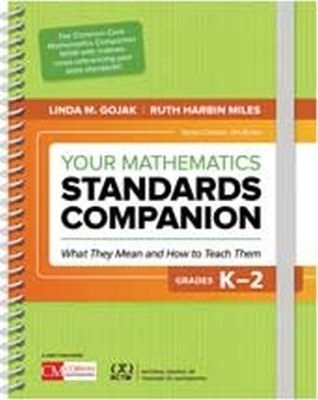
Your Mathematics Standards Companion: Grades K-2
Corwin Press Inc (Verlag)
978-1-5063-8223-4 (ISBN)
In this expansion of the original popular Common Core Mathematics Companions, you can see in an instant how teaching to your state standards should look and sound in the classroom. Under the premise that math is math, the authors provide a Cross-Referencing Index for states implementing their own specific mathematics standards, showing which of your standards are the same as CCSS-M, which differ and how—and which page number to turn to for standards-based teaching ideas.
It’s all here, page by page:
The mathematics embedded in each standard for a deeper understanding of the content
Examples of what effective teaching and learning look like in the classroom
Connected standards within each domain so teachers can better appreciate how they relate
Priorities within clusters so teachers know where to focus their time
The three components of rigor: conceptual understanding, procedural skills, and applications
Vocabulary and suggested materials for each grade-level band with explicit connections to the standards
Common student misconceptions around key mathematical ideas with ways to address them
Sample lesson plans and lesson planning templates
Cross-referenced index listing the standards in the following states, explaining what is unique to the standards of each state
Your Mathematics Standards Companion is your one-stop guide for teaching, planning, assessing, collaborating, and designing powerful mathematics curriculum.
Winner of the Presidential Award for Excellence in Science and Mathematics Teaching, Linda M. Gojak directed the Center for Mathematics and Science Education, Teaching, and Technology (CMSETT) at John Carroll University for 16 years. She has spent 28 years teaching elementary and middle school mathematics, and has served as the president of the National Council of Teachers of Mathematics (NCTM), the National Council of Supervisors of Mathematics (NCSM), and the Ohio Council of Teachers of Mathematics. Ruth Harbin Miles coaches rural, suburban, and inner-city school mathematics teachers. Her professional experiences include coordinating the K-12 Mathematics Teaching and Learning Program for the Olathe, Kansas, Public Schools for more than 25 years; teaching mathematics methods courses at Virginia’s Mary Baldwin College; and serving on the Board of Directors for the National Council of Teachers of Mathematics, the National Council of Supervisors of Mathematic, and both the Virginia Council of Teachers of Mathematics and the Kansas Association of Teachers of Mathematics. Ruth is a co-author of five Corwin books including A Guide to Mathematics Coaching, A Guide to Mathematics Leadership, Visible Thinking in the K-8 Mathematics Classroom, The Common Core Mathematics Standards, and Realizing Rigor in the Mathematics Classroom. As co-owner of Happy Mountain Learning, Ruth specializes in developing teachers’ content knowledge and strategies for engaging students to achieve high standards in mathematics.
Indexes Cross-Referencing Your State Standards
Quick Reference Guide
Acknowledgments
Letter to Grades K–2 Teachers
Letter to Elementary School Principals
Introduction
A Brief History of Current State Standards
College and Career Ready Standards for Mathematics
Instructional Shifts
Terminology Used in This Book
Effective Teaching Practices
How to Use This Book
Reflection Questions
Part 1. Counting and Cardinality
Domain Overview
Suggested Materials for This Domain
Key Vocabulary
Kindergarten
Cluster A: Know number names and the count sequence.
Cluster B: Count to tell the number of objects.
Cluster C: Compare numbers.
Sample Planning Page: Counting and Cardinality, Kindergarten, Cluster B
Planning Pages
Reflection Questions: Counting and Cardinality
Part 2. Operations and Algebraic Thinking
Domain Overview
Suggested Materials for This Domain
Key Vocabulary
Kindergarten
Cluster A: Understand addition as putting together and adding to, and understand subtraction as taking apart and taking from.
Sample Planning Page: Operations and Algebraic Thinking, Kindergarten, Cluster A
Planning Page
Grade 1
Cluster A: Represent and solve problems involving addition and subtraction.
Cluster B: Understand and apply properties of operations and the relationship between addition and subtraction.
Cluster C: Add and subtract within 20.
Cluster D: Work with addition and subtraction equations.
Sample Planning Page: Operations and Algebraic Thinking, Grade 1, Cluster C
Planning Pages
Grade 2
Cluster A: Represent and solve problems involving addition and subtraction.
Cluster B: Add and subtract within 20.
Cluster C: Work with equal groups of objects to gain foundations for multiplication.
Sample Planning Page: Operations and Algebraic Thinking, Grade 2, Cluster A
Planning Pages
Reflection Questions: Operations and Algebraic Thinking
Part 3. Number and Operations in Base Ten
Domain Overview
Suggested Materials for This Domain
Key Vocabulary
Kindergarten
Cluster A: Work with numbers 11–19 to gain foundation for place value.
Sample Planning Page: Number and Operations in Base Ten, Kindergarten, Cluster A
Planning Page
Grade 1
Cluster A: Extend the counting sequence.
Cluster B: Understand place value.
Cluster C: Use place value understanding and properties of operations to add and subtract.
Sample Planning Page: Number and Operations in Base Ten, Grade 1, Cluster C
Planning Pages
Grade 2
Cluster A: Understand place value.
Cluster B: Use place value understanding and properties of operations to add and subtract.
Sample Planning Page: Number and Operations in Base Ten, Grade 2, Cluster B
Planning Pages
Reflection Questions: Number and Operations in Base Ten
Part 4. Measurement and Data
Domain Overview
Suggested Materials for This Domain
Key Vocabulary
Kindergarten
Cluster A: Describe and compare measurable attributes.
Cluster B: Classify objects and count the number of objects in each category.
Sample Planning Page: Measurement and Data, Kindergarten, Cluster A
Planning Pages
Grade 1
Cluster A: Measure lengths indirectly and by iterating length units.
Cluster B: Tell and write time.
Cluster C: Represent and interpret data.
Sample Planning Page: Measurement and Data, Grade 1, Cluster C
Planning Pages
Grade 2
Cluster A: Measure and estimate lengths in standard units.
Cluster B: Relate addition and subtraction to length.
Cluster C: Work with time and money.
Cluster D: Represent and interpret data.
Sample Planning Page: Measurement and Data, Grade 2, Cluster D
Planning Pages
Reflection Questions: Measurement and Data
Part 5. Geometry
Domain Overview
Suggested Materials for This Domain
Key Vocabulary
Kindergarten
Cluster A: Identify and describe shapes.
Cluster B: Analyze, compare, create, and compose shapes.
Sample Planning Page: Geometry, Kindergarten, Cluster A
Planning Pages
Grade 1
Cluster A: Reason with shapes and their attributes.
Sample Planning Page: Geometry, Grade 1, Cluster A
Planning Page
Grade 2
Cluster A: Reason with shapes and their attributes.
Sample Planning Page: Geometry, Grade 2, Cluster A
Planning Page
Reflection Questions: Geometry
Resources
Table 1. Addition and Subtraction Situations
Table 2. Addition and Subtraction Fact Strategies
Table 3. Scaffolding Addition and Subtraction
Table 4. Sample Addition and Subtraction Strategies
Table 5. Standards for Mathematical Practice
Table 6. Effective Teaching Practices
Reproducibles
Reproducible 1. Five Frame
Reproducible 2. Ten Frame
Reproducible 3. Double Ten Frame
Reproducible 4. Hundreds Chart
Reproducible 5. Dot Cards
Reproducible 6. Numeral Cards
Reproducible 7. Number Line to 20
Reproducible 8. Open Number Line
Reproducible 9. Part-Part-Whole Chart
Reproducible 10. Place Value Chart (Tens/Ones)
Reproducible 11. Place Value Chart (Hundreds/Tens/Ones)
Reproducible 12. Comparison Cards
Additional Resources
About the Authors
| Erscheinungsdatum | 12.07.2017 |
|---|---|
| Verlagsort | Thousand Oaks |
| Sprache | englisch |
| Maße | 208 x 276 mm |
| Gewicht | 680 g |
| Themenwelt | Schulbuch / Wörterbuch |
| Sozialwissenschaften ► Pädagogik ► Allgemeines / Lexika | |
| Sozialwissenschaften ► Pädagogik ► Schulpädagogik / Grundschule | |
| Sozialwissenschaften ► Pädagogik ► Vorschulpädagogik | |
| ISBN-10 | 1-5063-8223-1 / 1506382231 |
| ISBN-13 | 978-1-5063-8223-4 / 9781506382234 |
| Zustand | Neuware |
| Informationen gemäß Produktsicherheitsverordnung (GPSR) | |
| Haben Sie eine Frage zum Produkt? |
aus dem Bereich