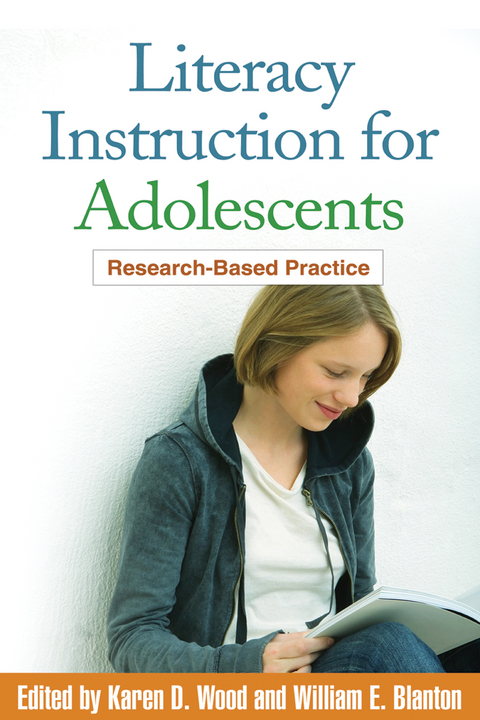
Literacy Instruction for Adolescents (eBook)
526 Seiten
The Guilford Press (Verlag)
978-1-60623-381-8 (ISBN)
Karen D. Wood, PhD, is Professor in the Department of Reading and Elementary Education at the University of North Carolina at Charlotte. A former middle school reading teacher and K-12 literacy specialist in the public schools, she is the author of over 200 articles, chapters, and books on such topics as integrating literacy across the curriculum, meeting the needs of diverse learners, vocabulary and comprehension development, and translating research and theory into classroom practice. Dr. Wood began writing the “Research into Practice” column for the Middle School Journal in 1986 and continues as its author today. She was a member of the authorship team of the McGraw-Hill Basal Reading Series from 1989 to 2004 and was the former coeditor, along with William E. Blanton, of the journal Reading Research and Instruction. William E. Blanton, EdD, is Professor in the Language and Literacy Learning in Multilingual Settings Program at the University of Miami in Coral Gables, Florida. He has held faculty appointments at Indiana University and Appalachian State University, where he was a cofounder of the Laboratory of Technology and Learning. Dr. Blanton has coauthored reading instruction programs, edited journals in reading education, served on editorial boards of major journals, and published numerous articles and book chapters. His current research studies the role of culture in development, with a dual focus on characterizing children’s development and the development of the social institutions in which this process occurs.
Introduction: The Case for Improving Adolescent Literacy Instruction, William E. Blanton and Karen D. Wood1. Advocating Reading Instruction in Middle and High School Classrooms, David W. MooreI. Literacy and the Adolescent Learner2. The "Adolescent" in Adolescent Literacy: A Preliminary Review, Thomas W. Bean and Helen J. Harper3. Enhancing Adolescent Self-Efficacy for Literacy, Patrick McCabe4. Content-Area Reading: Past, Present, and Future, Maryann Mraz, Robert J. Rickelman, and Richard T. Vacca5. Promoting Adolescent Literacy through Parental Involvement: Making It Happen, Timothy Rasinski, Nancy D. Padak, and Kristy Pytash6. Literacy Coaching in Middle and High Schools, Rita M. Bean and Ellen Eisenberg7. Meeting the Needs of English Language Learners in the Middle and Secondary Classroom, Paola Pilonieta and Adriana L. Medina8. Responsible Differentiated Instruction for the Adolescent Learner: Promises, Pitfalls, and Possibilities, Jeanne Shay Schumm and Mary A. Avalos9. Engaging Texts and Literacy Practices for Adolescent Boys, William G. Brozo and Courtney Gaskins10. Paying Attention to Girls’ Literacy Needs, Marsha M. Sprague and Kara K. Keeling11. Implications of Adolescents' Popular Culture Use for School Literacy, Alison Heron-Hruby and Donna E. Alvermann II. Teaching the Adolescent Learner: Research-Based Instructional Practices12. Research-Based Instructional Literacy Practices: Challenges and Opportunities, Patricia L. Anders13. Assessing Adolescent Literacy, William Dee Nichols, Barbara J. Walker, and Beverly K. McIntyre14. Motivating Adolescent Learners to Read, Pamela J. Dunston and Linda B. Gambrell 15. Using Picture Books with Older Learners, Miriam Martinez, Nancy Roser, and Janis M. Harmon16. Polysyllabic Words and Struggling Adolescent Readers: The Morphemic Link to Meaning, Reading, and Spelling "Big" Words, Patricia M. Cunningham17. Comprehension Is More Than a Strategy, Douglas Fisher, Nancy Frey, and Donna Ross18. Vocabulary Learning in the Content Areas: Research-Based Practices for Middle and Secondary School Classrooms, Janis M. Harmon, Karen D. Wood, and Adriana L. Medina19. Discussion-Based Instruction in the Middle and Secondary School Classroom, Thomas DeVere Wolsey and Diane Lapp20. Writing Instruction for Adolescent Learners, Jane Hansen and Brian Kissel21. Grouping in the Middle and Secondary Grades: Advancing Content and Literacy Knowledge, Jeanne R. Paratore and Rachel L. McCormack22. Promising Practices for Supporting Adolescents’ Online Literacy Development, Julie Coiro 23. Technology and Literacy: Current and Emerging Practices with Student 2.0 and Beyond, David G. O'Brien and Brock Dubbels24. Engaging Adolescents in Thoughtful Literacy Practices, Danielle V. Dennis, Evan Lefsky, and Richard L. Allington
| Erscheint lt. Verlag | 12.3.2009 |
|---|---|
| Sprache | englisch |
| Maße | 160 x 160 mm |
| Themenwelt | Schulbuch / Wörterbuch ► Erwachsenenbildung |
| Geisteswissenschaften ► Sprach- / Literaturwissenschaft ► Sprachwissenschaft | |
| Sozialwissenschaften ► Pädagogik ► Schulpädagogik / Grundschule | |
| Sozialwissenschaften ► Pädagogik ► Schulpädagogik / Sekundarstufe I+II | |
| Schlagworte | adolescents • Classrooms • Education • grades • Instructional • Literacies • Literacy • Methods • Middle • Practices • Readers • Reading • Research • schools • Secondary • struggling • students • "substance abuse, behavior change, psychotherapy, interventions, addictions, ambivalence, resistance, therapy, counseling field, counseling students, interviewing skills, meth addiction, life coaching, helping professionals, therapeutic relationship, helping professions, professional counselor, core concepts, social workers, transpersonal, rationales, person-centered, exam, cognitive-behavioral, court-ordered, modality, clinicians, evidence-based, revisions, trainers, therapists, counselors, seminar, exerci • Teaching • Technology • Writing |
| ISBN-10 | 1-60623-381-5 / 1606233815 |
| ISBN-13 | 978-1-60623-381-8 / 9781606233818 |
| Informationen gemäß Produktsicherheitsverordnung (GPSR) | |
| Haben Sie eine Frage zum Produkt? |
 EPUB (Adobe DRM)
Kopierschutz: Adobe-DRM
Adobe-DRM ist ein Kopierschutz, der das eBook vor Mißbrauch schützen soll. Dabei wird das eBook bereits beim Download auf Ihre persönliche Adobe-ID autorisiert. Lesen können Sie das eBook dann nur auf den Geräten, welche ebenfalls auf Ihre Adobe-ID registriert sind.
Details zum Adobe-DRM
Dateiformat: EPUB (Electronic Publication)
EPUB ist ein offener Standard für eBooks und eignet sich besonders zur Darstellung von Belletristik und Sachbüchern. Der Fließtext wird dynamisch an die Display- und Schriftgröße angepasst. Auch für mobile Lesegeräte ist EPUB daher gut geeignet.
Systemvoraussetzungen:
PC/Mac: Mit einem PC oder Mac können Sie dieses eBook lesen. Sie benötigen eine
eReader: Dieses eBook kann mit (fast) allen eBook-Readern gelesen werden. Mit dem amazon-Kindle ist es aber nicht kompatibel.
Smartphone/Tablet: Egal ob Apple oder Android, dieses eBook können Sie lesen. Sie benötigen eine
Geräteliste und zusätzliche Hinweise
Buying eBooks from abroad
For tax law reasons we can sell eBooks just within Germany and Switzerland. Regrettably we cannot fulfill eBook-orders from other countries.
aus dem Bereich