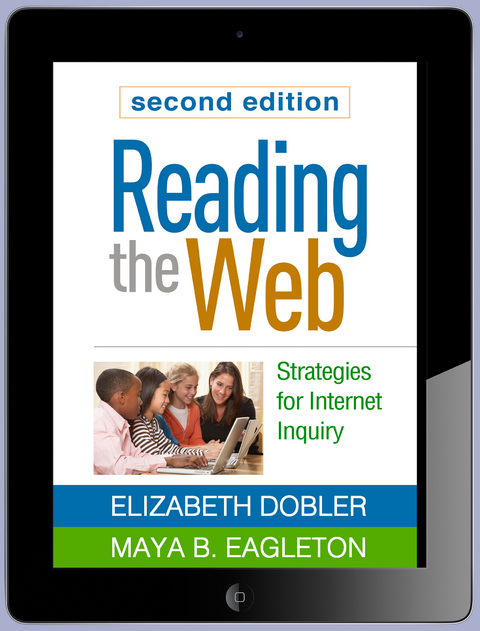
Reading the Web, Second Edition (eBook)
295 Seiten
Guilford Publications (Verlag)
978-1-4625-2281-1 (ISBN)
Elizabeth Dobler, PhD, is Professor of Literacy at Emporia State University in Kansas. She teaches undergraduate and graduate courses in information literacy, children's literature, and language arts and also supervises student interns in the Topeka Professional Development School program. A former classroom teacher, Dr. Dobler's research interests include web literacies and reading comprehension. Maya B. Eagleton, PhD, is Department Chair of the Teacher Education Program at Pima Community College in Arizona. She designs and teaches online and hybrid courses with a focus on elementary and middle school language arts, 21st-century literacies, and exceptional learners. Dr. Eagleton has extensive K-12 classroom experience as a Title I coordinator, reading interventionist, instructional coach, and learning supports coordinator. She has also worked as a research scientist, instructional software designer, and educational consultant.
1. Opportunities and Challenges Oh, What a Tangled Web We Weave Driving without a License: Gen Zs on the Web Roadblocks on the Way to the Information Superhighway Research Is Not a Four-Letter Word Internet Inquiry: The Sweet Spot A Web Literacy Curriculum Summary 2. Learning How to Learn Learning by Doing: Constructivism Learning with Others: Socioculturalism Learning through Symbols: Semiotics Universal Design for Learning Elements of Effective Instruction Outcomes of Effective Instruction The Educator's Role Summary 3. Becoming Literate Literacy Family Tree Cueing Systems Theory Transactional Theory Reading Comprehension Strategies Foundational Reading Skills Informational Text The Reciprocal Nature of Learning Summary 4. Preparing for the QUEST The QUEST Model of Internet Inquiry Technical Preparation Conceptual Preparation Assessing Internet Inquiry Strategies Summary Handouts 5. Questioning Why Is Questioning Important? What Characterizes "Good" Questions? How Do We Teach Questioning Strategies? Summary Handouts 6. Understanding Resources Why Is It Important to Understand Resources? When Do We Need to Use Resources? What Characterizes Effective Use of Resources? How Do We Teach Strategies for Understanding Resources? Summary Handouts 7. Evaluating Why Is It Important to Evaluate? When Do We Evaluate? What Characterizes Evaluation? How Do We Teach Evaluation Strategies? Summary Handouts 8. Synthesizing Why Is It Important to Synthesize? When Do We Synthesize? What Characterizes Synthesis? How Do We Teach Synthesis Strategies? Summary Handouts 9. Transforming Why Is It Important to Transform Information? When Do We Transform Information? What Characterizes Information Transformation? How Do We Teach Transformation Strategies? Summary Handouts 10. Reflecting on the QUEST Reflecting: What Have I Learned as a Teacher? What Have My Students Learned? What Have We Learned as Authors? Final Thoughts References Index
| Erscheint lt. Verlag | 2.6.2015 |
|---|---|
| Vorwort | Donald J. Leu |
| Sprache | englisch |
| Maße | 200 x 200 mm |
| Themenwelt | Schulbuch / Wörterbuch ► Schulbuch / Allgemeinbildende Schulen |
| Schulbuch / Wörterbuch ► Unterrichtsvorbereitung ► Unterrichts-Handreichungen | |
| Sozialwissenschaften ► Pädagogik | |
| Schlagworte | Assessments • CCSS • Common Core Standards • Common Core State Standards • Computers • differentiated instruction • digital literacy skills • Educational technology • Ela • elementary grades • English Language Arts • informational texts • Internet inquiry • middle grades • Mobile Devices • Online • Reading Comprehension • Smart phones • Social Media • "substance abuse, behavior change, psychotherapy, interventions, addictions, ambivalence, resistance, therapy, counseling field, counseling students, interviewing skills, meth addiction, life coaching, helping professionals, therapeutic relationship, helping professions, professional counselor, core concepts, social workers, transpersonal, rationales, person-centered, exam, cognitive-behavioral, court-ordered, modality, clinicians, evidence-based, revisions, trainers, therapists, counselors, seminar, exerci • Tablets • Teaching • Universal Design • web learning • Websites |
| ISBN-10 | 1-4625-2281-5 / 1462522815 |
| ISBN-13 | 978-1-4625-2281-1 / 9781462522811 |
| Informationen gemäß Produktsicherheitsverordnung (GPSR) | |
| Haben Sie eine Frage zum Produkt? |
 EPUB (Adobe DRM)
Kopierschutz: Adobe-DRM
Adobe-DRM ist ein Kopierschutz, der das eBook vor Mißbrauch schützen soll. Dabei wird das eBook bereits beim Download auf Ihre persönliche Adobe-ID autorisiert. Lesen können Sie das eBook dann nur auf den Geräten, welche ebenfalls auf Ihre Adobe-ID registriert sind.
Details zum Adobe-DRM
Dateiformat: EPUB (Electronic Publication)
EPUB ist ein offener Standard für eBooks und eignet sich besonders zur Darstellung von Belletristik und Sachbüchern. Der Fließtext wird dynamisch an die Display- und Schriftgröße angepasst. Auch für mobile Lesegeräte ist EPUB daher gut geeignet.
Systemvoraussetzungen:
PC/Mac: Mit einem PC oder Mac können Sie dieses eBook lesen. Sie benötigen eine
eReader: Dieses eBook kann mit (fast) allen eBook-Readern gelesen werden. Mit dem amazon-Kindle ist es aber nicht kompatibel.
Smartphone/Tablet: Egal ob Apple oder Android, dieses eBook können Sie lesen. Sie benötigen eine
Geräteliste und zusätzliche Hinweise
Buying eBooks from abroad
For tax law reasons we can sell eBooks just within Germany and Switzerland. Regrettably we cannot fulfill eBook-orders from other countries.
aus dem Bereich