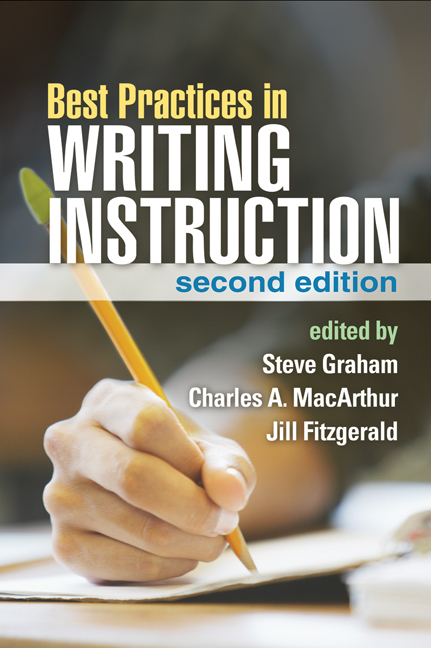
Best Practices in Writing Instruction, Second Edition (eBook)
444 Seiten
Guilford Publications (Verlag)
978-1-4625-1010-8 (ISBN)
Steve Graham, EdD, is the Warner Professor in the Division of Educational Leadership and Innovation at Mary Lou Fulton Teachers College, Arizona State University. He is also Research Professor in the Learning Science Institute at the Australian Catholic University in Brisbane. Dr. Graham is editor of the Journal of Educational Psychology. He has coedited several books, including Handbook of Writing Research, Second Edition; Handbook of Learning Disabilities, Second Edition; and Best Practices in Writing Instruction, Second Edition; and is the coauthor of three influential Carnegie Corporation reports: Writing Next, Writing to Read, and Informing Writing. Dr. Graham has received numerous awards, including the Career Research Award from the Council for Exceptional Children (CEC), the Kauffman–Hallahan Distinguished Researcher Award from the CEC Division of Research, the Samuel A. Kirk Award from the CEC Division of Learning Disabilities, the Distinguished Researcher Award from the special education interest group of the American Educational Research Association (AERA), and the Wiederholt Distinguished Lecturer Award from the Council of Learning Disabilities. He is a fellow of the AERA and the International Academy for Research in Learning Disabilities. Charles A. MacArthur, PhD, is Professor of Special Education and Literacy in the School of Education at the University of Delaware. His major research interests include writing development and instruction for struggling writers, development of self-regulated strategies, adult literacy, and applications of technology to support reading and writing. Currently he is coprincipal investigator of a research project evaluating a curriculum for college developmental writing courses based on self-regulated strategy instruction. He is coeditor of the Journal of Writing Research and serves on the editorial boards of several other journals. Dr. MacArthur has published over 100 articles and book chapters and coedited or coauthored several books, including Best Practices in Writing Instruction, Second Edition; Handbook of Writing Research, Second Edition; and Developing Strategic Writers through Genre Instruction. Jill Fitzgerald, PhD, is Research Professor and Professor Emerita at The University of North Carolina at Chapel Hill. A former primary-grades teacher and reading specialist, she conducts research on literacy issues for multilingual learners, understanding text complexity, and vocabulary measurement. Dr. Fitzgerald is a member of the Reading Hall of Fame, a Fellow of the American Educational Research Association (AERA), and a recipient of research awards from Phi Delta Kappa, the International Reading Association, and the AERA. With more than 100 publications, she is associate editor of the Journal of Educational Psychology and serves on the editorial boards of several other journals. She has also been a review panelist for the Office of Education, the Institute of Education, the National Institutes of Health, and the National Institute for Literacy.
I. Designing Writing Programs1. Designing an Effective Writing Program, Steve Graham and Karen R. Harris2. Writing Instruction in Preschool and Kindergarten, David L. Coker, Jr.3. Best Practices in Teaching Writing for College and Career Readiness, Dolores PerinII. Types and Purposes of Writing4. A Developmental Approach to Teaching Narrative Composition, Anne McKeough5. Best Practices in Teaching Argumentative Writing, Ralph P. Ferretti and William E. Lewis6. Best Practices in Teaching Informative Writing from Sources, George E. Newell, Jennifer VanDerHeide, and Melissa Wilson7. Best Practices in Writing to Learn, Perry D. Klein and Amy Meichi YuIII. Strategies for Teaching and Learning in Writing8. Best Practices in Teaching Planning for Writing, Cindy Lassonde and Janet C. Richards9. Best Practices in Teaching Evaluation and Revision, Charles A. MacArthur 10. Best Practices in Sentence Construction Skills, Bruce Saddler 11. Best Practices in Spelling and Handwriting, Bob Schlagal 12. Best Practices in Promoting Motivation for Writing, Pietro Boscolo and Carmen Gelati13. Best Practices in Using Technology to Support Writing, Rachel Karchmer-Klein 14. Best Practices in Writing about Text, Timothy Shanahan 15. Best Practices in Writing Assessment for Instruction, Robert C. Calfee and Roxanne Greitz Miller IV. Special Populations16. Best Practices in Teaching Writing to English Learners: Reducing Constraints to Facilitate Writing Development, Carol Booth Olson, Robin Scarcella, and Tina Matuchniak17. Writing Instruction within a Response-to-Intervention Framework: Prospects and Challenges for Elementary and Secondary Classrooms, Gary A. Troia
| Erscheint lt. Verlag | 26.3.2013 |
|---|---|
| Sprache | englisch |
| Maße | 150 x 150 mm |
| Themenwelt | Schulbuch / Wörterbuch |
| Geisteswissenschaften ► Sprach- / Literaturwissenschaft ► Literaturwissenschaft | |
| Geisteswissenschaften ► Sprach- / Literaturwissenschaft ► Sprachwissenschaft | |
| Sozialwissenschaften ► Pädagogik | |
| Schlagworte | Assessments • CCSS • Common Core State Standards • Composition • Curriculum • Elementary • English Language Learners • Literacy • Methods • Response to Intervention • RTI • Secondary • struggling writers • "substance abuse, behavior change, psychotherapy, interventions, addictions, ambivalence, resistance, therapy, counseling field, counseling students, interviewing skills, meth addiction, life coaching, helping professionals, therapeutic relationship, helping professions, professional counselor, core concepts, social workers, transpersonal, rationales, person-centered, exam, cognitive-behavioral, court-ordered, modality, clinicians, evidence-based, revisions, trainers, therapists, counselors, seminar, exerci • Teaching • writing difficulties • Writing instruction • writing programs |
| ISBN-10 | 1-4625-1010-8 / 1462510108 |
| ISBN-13 | 978-1-4625-1010-8 / 9781462510108 |
| Informationen gemäß Produktsicherheitsverordnung (GPSR) | |
| Haben Sie eine Frage zum Produkt? |
 EPUB (Adobe DRM)
Kopierschutz: Adobe-DRM
Adobe-DRM ist ein Kopierschutz, der das eBook vor Mißbrauch schützen soll. Dabei wird das eBook bereits beim Download auf Ihre persönliche Adobe-ID autorisiert. Lesen können Sie das eBook dann nur auf den Geräten, welche ebenfalls auf Ihre Adobe-ID registriert sind.
Details zum Adobe-DRM
Dateiformat: EPUB (Electronic Publication)
EPUB ist ein offener Standard für eBooks und eignet sich besonders zur Darstellung von Belletristik und Sachbüchern. Der Fließtext wird dynamisch an die Display- und Schriftgröße angepasst. Auch für mobile Lesegeräte ist EPUB daher gut geeignet.
Systemvoraussetzungen:
PC/Mac: Mit einem PC oder Mac können Sie dieses eBook lesen. Sie benötigen eine
eReader: Dieses eBook kann mit (fast) allen eBook-Readern gelesen werden. Mit dem amazon-Kindle ist es aber nicht kompatibel.
Smartphone/Tablet: Egal ob Apple oder Android, dieses eBook können Sie lesen. Sie benötigen eine
Geräteliste und zusätzliche Hinweise
Buying eBooks from abroad
For tax law reasons we can sell eBooks just within Germany and Switzerland. Regrettably we cannot fulfill eBook-orders from other countries.
aus dem Bereich