


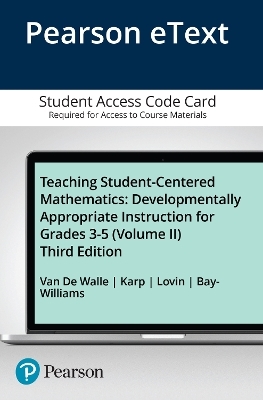
Teaching Student-Centered Mathematics
Pearson (Hersteller)
978-0-13-455640-6 (ISBN)
- Titel z.Zt. nicht lieferbar
- Versandkostenfrei
- Auch auf Rechnung
- Artikel merken
Teaching Student-Centered Mathematics helps students connect mathematics to their worlds and use math in their daily lives. It focuses on specific grade bands and covers creating an effective classroom environment, aligning teaching to various standards and practices, and engaging families.
For courses in Elementary Mathematics Methods (Curriculum & Instruction) and for classroom teachers.
Pearson eText is an easy-to-use digital textbook that you can purchase on your own or instructors can assign for their course. The mobile app lets you keep on learning, no matter where your day takes you, even offline. You can also add highlights, bookmarks, and notes in your Pearson eText to study how you like.
NOTE: This ISBN is for the Pearson eText access card. Pearson eText is a fully digital delivery of Pearson content. Before purchasing, check that you have the correct ISBN. To register for and use Pearson eText, you may also need a course invite link, which your instructor will provide. Follow the instructions provided on the access card to learn more.
The late John A. Van de Walle was a professor emeritus at Virginia Commonwealth University. He was a mathematics education consultant who regularly gave professional development workshops for K–8 teachers in the United States and Canada. He visited and taught in elementary school classrooms and worked with teachers to implement studentcentered math lessons. He coauthored the Scott ForesmanAddison Wesley Mathematics K–6 series and contributed to the Pearson School mathematics program, enVisionMATH. In addition, he wrote numerous chapters and articles for the National Council of Teachers of Mathematics (NCTM) books and journals and was very active in NCTM, including serving on the Board of Directors, as the chair of the Educational Materials Committee, and as a frequent speaker at national and regional meetings. Karen S. Karp is at the School of Education at Johns Hopkins University-Baltimore, MD. Previously, she was a professor of mathematics education at the University of Louisville for more than twenty years. Prior to entering the field of teacher education she was an elementary school teacher in New York. She is also coauthor of Elementary and Middle School Mathematics: Teaching Developmentally, Developing Essential Understanding of Addition and Subtraction for Teaching Mathematics in PreK–Grade 2, and numerous book chapters and articles. She is a former member of the Board of Directors of NCTM and a former president of the Association of Mathematics Teacher Educators (AMTE). She continues to work in classrooms to support teachers of students with disabilities in their mathematics instruction. LouAnn H. Lovin is a professor of mathematics education at James Madison University (Virginia). She coauthored the first edition of the Teaching StudentCentered Mathematics Professional Development Series with John A. Van de Walle as well as Teaching Mathematics Meaningfully: Solutions for Reaching Struggling Learners, 2nd Edition with David Allsopp and Sarah Vaningen. LouAnn taught mathematics to middle and high school students before transitioning to preK–grade 8. For almost twenty years, she has worked in preK through grade 8 classrooms and engaged with teachers in professional development as they implement a studentcentered approach to teaching mathematics. She has published articles in Teaching Children Mathematics, Mathematics Teaching in the Middle School, and Teaching Exceptional Children and has served on NCTM’s Educational Materials Committee. LouAnn’s research on teachers’ mathematical knowledge for teaching has focused most recently on the developmental nature of prospective teachers’ fraction knowledge. Jennifer M. Bay-Williams is a professor of mathematics education at the University of Louisville (Kentucky). Jennifer has published many articles on teaching and learning in NCTM journals. She has also coauthored numerous books, including Mathematics Coaching: Resources and Tools for Coaches and Leaders, K–12; Developing Essential Understanding of Addition and Subtraction for Teaching Mathematics in PreK–Grade 2; Math and Literature: Grades 6–8; Math and Nonfiction: Grades 6–8; and Navigating through Connections in Grades 6–8. Jennifer taught elementary, middle, and high school in Missouri and in Peru, and continues to work in classrooms at all levels with students and with teachers. Jennifer served as member of Board of Directors for TODOS: Equity for All, as president of AMTE, and as editor for the 2012 NCTM Yearbook.
Brief Table of Contents
Part 1: Establishing a Student-Centered Environment
1. Setting a Vision for Learning High-Quality Mathematics
2. Teaching Mathematics through Problem Solving
3. Creating Assessments for Learning
4. Differentiating Instruction
5. Teaching Culturally and Linguistically Diverse Students
6. Teaching and Assessing Students with Exceptionalities
7. Collaborating with Families and Other Stakeholders
Part 2: Teaching Student-Centered Mathematics
8. Exploring Number and Operation Sense
9. Developing Basic Fact Fluency
10. Developing Whole-Number Place-Value Concepts
11. Building Strategies for Whole-Number Computation
12. Exploring Fraction Concepts
13. Building Strategies for Fraction Computation
14. Developing Decimal and Percent Concepts and Decimal Computation
15. Promoting Algebraic Thinking
16. Building Measurement Concepts
17. Developing Geometric Thinking and Concepts
18. Representing and Interpreting Data
Appendix ACommon Core State Standards: Standards for Mathematical Practice
Appendix BCommon Core State Standards: Grades 3-5 Critical Content Areas and Overviews
Appendix C Mathematics Teaching Practices: NCTM Principles to Action (2014)
Appendix D Activities at a Glance: Volume II
Appendix E Guide to Blackline Masters
References
Index
Detailed Table of Contents
Part 1: Establishing a Student-Centered Environment
1. Setting a Vision for Learning High-Quality Mathematics
Understanding and Doing Mathematics
How Do Students Learn?
Teaching for Understanding
The Importance of Students’ Ideas
Mathematics Classrooms That Promote Understanding
2. Teaching Mathematics through Problem Solving
Teaching through Problem Solving: An Upside-Down Approach
Mathematics Teaching Practices for Teaching through Problem Solving
Using Worthwhile Tasks
Orchestrating Classroom Discourse
Representations: Tools for Problem Solving, Reasoning, and Communication
Lessons in the Problem-Based Classroom
Life-Long Learning: An Invitation to Learn and Grow
3. Creating Assessments for Learning
Assessment That Informs Instruction
Observations
Questions
Interviews
Tasks
Students’ Self-Assessment and Reflection
Rubrics and Their Uses
4. Differentiating Instruction
Differentiation and Teaching Mathematics through Problem Solving
The Nuts and Bolts of Differentiating Instruction
Differentiated Tasks for Whole-Class Instruction
Tiered Lessons
Flexible Grouping
5. Teaching Culturally and Linguistically Diverse Students
Culturally and Linguistically Diverse Students
Culturally Responsive Mathematics Instruction
Teaching Strategies That Support Culturally and Linguistically Diverse Students
Assessment Considerations for ELLs
6. Planning, Teaching, and Assessing Students with Exceptionalities
Instructional Principles for Diverse Learners
Implementing Interventions
Teaching and Assessing Students with Learning Disabilities
Adapting for Students with Moderate/Severe Disabilities
Planning for Students Who Are Mathematically Gifted
7. Collaborating with Families and Other Stakeholders
Sharing the Message with Stakeholders
Administrator Engagement and Support
Family Engagement
Homework Practices and Parent Coaching
Part 2: Teaching Student-Centered Mathematics
8. Exploring Number and Operation Sense
Developing Addition and Subtraction Operation Sense
Developing Multiplication and Division Operation Sense
Multiplication and Division Problem Structures
Teaching Multiplication and Division
Properties of Multiplication and Division
Strategies for Solving Contextual Problems
Multistep Word Problems
9. Developing Basic Fact Fluency
Developmental Phases for Learning the Basic Fact Combinations
Teaching and Assessing the Basic Fact Combinations
Reasoning Strategies for Addition Facts
Reasoning Strategies for Subtraction Facts
Reasoning Strategies for Multiplication and Division Facts
Reinforcing Basic Fact Mastery
10. Developing Whole-Number Place-Value Concepts
Extending Number Relationships to Larger Numbers
Important Place-Value Concepts
Extending Base-Ten Concepts
Oral and Written Names for Numbers
Patterns and Relationships with Multidigit Numbers
Numbers beyond 1000
11. Building Strategies for Whole-Number Computation
Toward Computational Fluency
Development of Invented Strategies in Addition and Subtraction
Standard Algorithms for Addition and Subtraction
Invented Strategies for Multiplication
Standard Algorithms for Multiplication
Invented Strategies for Division
Standard Algorithms for Division
Computational Estimation
12. Exploring Fraction Concepts
Meanings of Fractions
Models for Fractions
Fractional Parts of a Whole
Equivalent Fractions
Comparing Fractions
Teaching Considerations for Fraction Concepts
13. Building Strategies for Fraction Computation
Understanding Fraction Operations
Addition and Subtraction
Multiplication
Division
14. Developing Decimal and Percent Concepts and Decimal Computation
Developing Concepts of Decimals
Connecting Fractions and Decimals
Developing Decimal Number Sense
Computation with Decimals
Introducing Percents
15. Promoting Algebraic Thinking
Strands of Algebraic Thinking
Generalized Arithmetic
Meaningful Use of Symbols
Making Structure in the Number System Explicit
Patterns and Functional Thinking
16. Building Measurement Concepts
The Meaning and Process of Measuring
The Role of Estimation and Approximation
Length
Area
Volume
Weight and Mass
Angles
Time
Money
17. Developing Geometric Thinking and Concepts
Geometry Goals for Your Students
Developing Geometric Thinking
Shapes and Properties
Learning about Transformations
Learning about Location
Learning about Visualizations
18. Representing and Interpreting Data
What Does It Mean to Do Statistics?
Formulating Questions
Data Collection
Data Analysis: Classification
Data Analysis: Graphical Representations
Interpreting Results
Appendix ACommon Core State Standards: Standards for Mathematical Practice
Appendix BCommon Core State Standards: Grades 3-5 Critical Content Areas and Overviews
Appendix C Mathematics Teaching Practices: NCTM Principles to Action (2014)
Appendix D Activities at a Glance: Volume II
Appendix E Guide to Blackline Masters
References
Index
| Erscheint lt. Verlag | 31.7.2018 |
|---|---|
| Sprache | englisch |
| Themenwelt | Schulbuch / Wörterbuch |
| Sozialwissenschaften ► Pädagogik ► Schulpädagogik / Grundschule | |
| ISBN-10 | 0-13-455640-2 / 0134556402 |
| ISBN-13 | 978-0-13-455640-6 / 9780134556406 |
| Zustand | Neuware |
| Informationen gemäß Produktsicherheitsverordnung (GPSR) | |
| Haben Sie eine Frage zum Produkt? |


