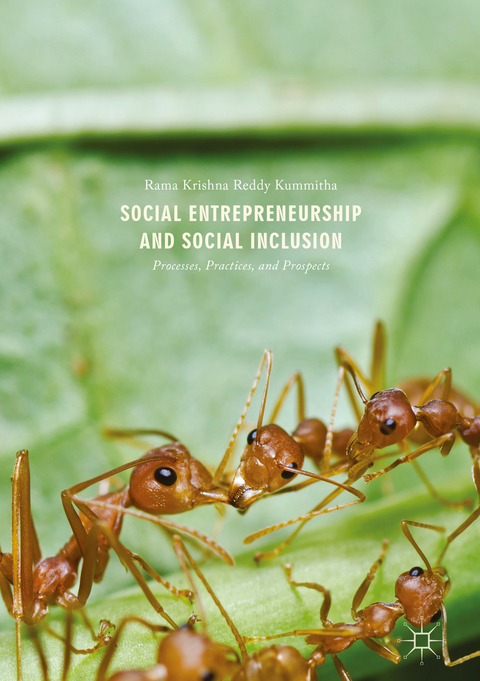
Social Entrepreneurship and Social Inclusion (eBook)
XXI, 178 Seiten
Springer Singapore (Verlag)
978-981-10-1615-8 (ISBN)
Rama Krishna Reddy Kummitha is currently associated with the School of Management, Politechnico di Milano, Italy. He was earlier associated with the Institute for the Advanced Study of Sustainability, United Nations University, Japan as a JSPS researcher, National Graduate Institute for Policy Studies, Tokyo as a Visiting Researcher and University of Liege, Belgium as a postdoctoral researcher. Further, he was also an Assistant Professor at the Center for Social Entrepreneurship, Tata Institute of Social Sciences, India. He is the author of Social Entrepreneurship: Working towards Greater Inclusiveness, having published extensively on social entrepreneurship and social innovation.
This book argues that embeddedness and community participation bring unique propositions for social entrepreneurship to foster social inclusion. It uncovers the role of local knowledge and grassroots level innovations to create necessary environment for the positive social change to roll. Social enterprises have proven to reduce drudgery of poor and excluded by offering creative and innovative solutions for long standing social problems. The grassroots level creative problem solving mechanisms they initiate travel through a variety of local dynamics and cultural contexts. However, social innovations quite often do not achieve their intended results, especially when they fail to understand the local contexts and embed themselves in such dynamism. In this background, the book attempts to understand and analyse the 'connect' between the social innovations and local dynamism. It argues that the community-driven innovation management which is based on local knowledge inspires the social entrepreneurial process and builds capacities and infrastructure to foster social inclusion. Each chapter in this book offers development scholars rich narration about how social problems have been approached, addressed, and altered through rich insights from communities and the social entrepreneurial teams.
Rama Krishna Reddy Kummitha is currently associated with the School of Management, Politecnico di Milano, Italy. He was earlier associated with the Institute for the Advanced Study of Sustainability, United Nations University, Japan as a JSPS researcher, National Graduate Institute for Policy Studies, Tokyo as a Visiting Researcher and University of Liege, Belgium as a postdoctoral researcher. Further, he was also an Assistant Professor at the Center for Social Entrepreneurship, Tata Institute of Social Sciences, India. He is the author of Social Entrepreneurship: Working towards Greater Inclusiveness, having published extensively on social entrepreneurship and social innovation.
Preface 6
Acknowledgements 9
Contents 12
Acronyms 13
List of Figures 15
List of Table 16
Chapter 1: Introduction 17
Social Exclusion 21
Social Inclusion 28
Social Entrepreneurship 31
How Do They Relate To Each Other? 37
Research Background 39
Methodology 41
Data Analysis 42
Notes 43
References 44
Chapter 2: Social Entrepreneurship, Community Participation, and Embeddedness 49
Community Participation 51
Social Capital and Geographical Dimensions 52
Critical Approach to Community Participation 56
Embeddedness and Social Entrepreneurship 60
References 64
Chapter 3: Barefoot College: Philosophy and Governance 69
Barefoot College 70
Origin of the Concept 70
History of the College 71
During Transition 74
Post-transition 77
The Working of the Social Enterprise 80
How Employment Is Offered 82
Community Participation 84
Second Level Social Entrepreneurs 89
Notes 90
References 91
Chapter 4: Barefoot Approach and Its Practice 92
The Work Style 94
Solar Technologies 96
Education 101
Rain Water Harvesting 108
Communication and Crafts 110
Women Empowerment 113
Notes 116
References 116
Chapter 5: Implications of the Barefoot Approach on the Rural Poor 117
Who Do They Train and Employ? 119
Recruiting Night School Students as Employees 119
The Physically Challenged 121
Other Adverse Circumstances 123
Financial Background of the Respondents 124
How Is the Training? 125
Transformation Towards Inclusion 126
Promotion of Social Equity 130
The Salary Structure 137
Financial Inclusion 142
Social Capital 145
Notes 147
References 148
Chapter 6: Barefoot as a Social Enterprise 149
Sources Within India 153
Foreign Sources 155
Sustainable Sources 156
Organisational Pillar 160
Opportunities 160
Mission and Vision 161
Ideology 161
Unorthodox 162
Dreamers 163
Non-negotiability 163
Innovation 164
Resourcefulness 165
Pioneer 165
Risk-Taking 165
Unlearning 166
Learning by Doing 167
Social Value Pillar 168
Employment 168
Capacity Building 168
Triple Bottom Line 169
System Change 169
Scalability 169
Cultural Change 170
Sustainable Pillar 170
Survival 171
Self-Sufficiency 171
Local Resources 172
Sustainable Value 173
References 174
Chapter 7: Conclusion 175
Social Entrepreneurship and Community Participation 176
Embeddedness and Social Entrepreneurship 179
Social Exclusion, Social Entrepreneurship and Social Inclusion 180
Unique Organisational Existence 181
Existing Gaps in Practice and Suggestions for Improvements 184
References 186
Index 187
| Erscheint lt. Verlag | 23.11.2016 |
|---|---|
| Zusatzinfo | XXI, 178 p. 4 illus. in color. |
| Verlagsort | Singapore |
| Sprache | englisch |
| Themenwelt | Schulbuch / Wörterbuch ► Unterrichtsvorbereitung ► Unterrichts-Handreichungen |
| Geisteswissenschaften | |
| Naturwissenschaften | |
| Sozialwissenschaften ► Pädagogik ► Sozialpädagogik | |
| Sozialwissenschaften ► Politik / Verwaltung | |
| Sozialwissenschaften ► Soziologie | |
| Wirtschaft ► Betriebswirtschaft / Management ► Unternehmensführung / Management | |
| Wirtschaft ► Volkswirtschaftslehre | |
| Schlagworte | Development • Entrepreneurship • Micro-finance • NGOs • Southeast Asia |
| ISBN-10 | 981-10-1615-1 / 9811016151 |
| ISBN-13 | 978-981-10-1615-8 / 9789811016158 |
| Informationen gemäß Produktsicherheitsverordnung (GPSR) | |
| Haben Sie eine Frage zum Produkt? |
 PDF (Wasserzeichen)
DRM: Digitales Wasserzeichen
Dieses eBook enthält ein digitales Wasserzeichen und ist damit für Sie personalisiert. Bei einer missbräuchlichen Weitergabe des eBooks an Dritte ist eine Rückverfolgung an die Quelle möglich.
Dateiformat: PDF (Portable Document Format)
Mit einem festen Seitenlayout eignet sich die PDF besonders für Fachbücher mit Spalten, Tabellen und Abbildungen. Eine PDF kann auf fast allen Geräten angezeigt werden, ist aber für kleine Displays (Smartphone, eReader) nur eingeschränkt geeignet.
Systemvoraussetzungen:
PC/Mac: Mit einem PC oder Mac können Sie dieses eBook lesen. Sie benötigen dafür einen PDF-Viewer - z.B. den Adobe Reader oder Adobe Digital Editions.
eReader: Dieses eBook kann mit (fast) allen eBook-Readern gelesen werden. Mit dem amazon-Kindle ist es aber nicht kompatibel.
Smartphone/Tablet: Egal ob Apple oder Android, dieses eBook können Sie lesen. Sie benötigen dafür einen PDF-Viewer - z.B. die kostenlose Adobe Digital Editions-App.
Buying eBooks from abroad
For tax law reasons we can sell eBooks just within Germany and Switzerland. Regrettably we cannot fulfill eBook-orders from other countries.
aus dem Bereich