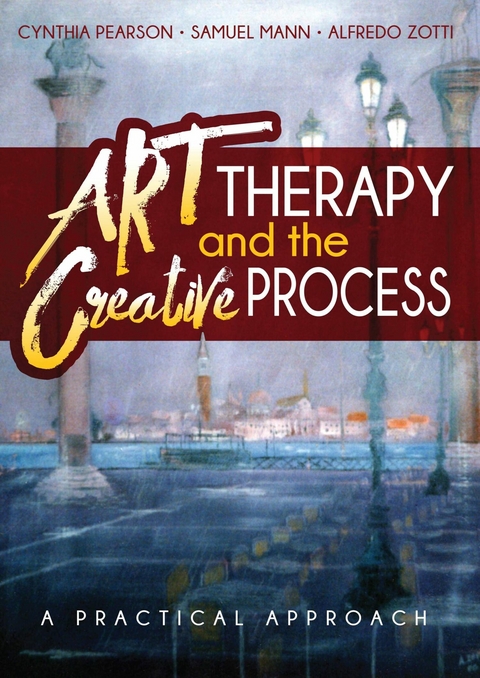
Art Therapy and the Creative Process (eBook)
152 Seiten
Loving Healing Press (Verlag)
978-1-61599-298-0 (ISBN)
International voices from across the globe come together in Art Therapy and the Creative Process to share their perspectives on art, the artist's process, and how art has been therapeutic for them.
In the first section, the three primary contributors--Alfredo Zotti, Samuel Mann, and Cynthia Pearson--create a triple commentary on a piece of art. Zotti paints a picture, Mann analyzes it, and Pearson writes a poem to complement it. In later sections, various artists share why they write, paint, play music, or take photographs, including what their individual mediums mean to them, what they may mean to others, why they have chosen various art forms, how art allows them an opportunity to escape from the world, and how it can also help them heal.
Artists will find kindred spirits in these pages. Lovers of literature, music, and art in all its forms will gain insight into artists' souls, how they view the world a little differently, and why. Art Therapy and the Creative Process gives art a purpose beyond what most of us usually think of it having--that art is a way to keep us all sane in a maddening world and it gives us the opportunity to create something to heal that same world that wounds us.
'Art Therapy and the Creative Process is a fascinating, multi-perspective look at art. I found myself resonating with many of the pieces here. Art allows us to take control of the uncontrollable and make meaning out of chaos. Viewing art as therapy opens the door to a new understanding between art, science, and psychology.'
--Tyler R. Tichelaar, Ph.D. and award-winning author of The Best Place and Narrow Lives
'Creative activities heal. They lift us out of suffering for awhile. They validate us when we feel damaged and worthless. And, over time, they can transform our perception of our world, so that we change from sufferers to survivors, and even joyful surmounters. Art Therapy and the Creative Process can be a shining example for those who want a way out of a personal hell.'
--Bob Rich, PhD, psychologist and author
'The book is a beautiful piece of work and all concerned should be very proud. The human dimension is enhanced through art and expressive approaches should be a much stronger part of mental health care .'
--Professor Patrick McGorry, AO MD PhD, Executive Director, OYH Research Centre, University of Melbourne
International voices from across the globe come together in Art Therapy and the Creative Process to share their perspectives on art, the artist's process, and how art has been therapeutic for them. In the first section, the three primary contributors--Alfredo Zotti, Samuel Mann, and Cynthia Pearson--create a triple commentary on a piece of art. Zotti paints a picture, Mann analyzes it, and Pearson writes a poem to complement it. In later sections, various artists share why they write, paint, play music, or take photographs, including what their individual mediums mean to them, what they may mean to others, why they have chosen various art forms, how art allows them an opportunity to escape from the world, and how it can also help them heal. Artists will find kindred spirits in these pages. Lovers of literature, music, and art in all its forms will gain insight into artists' souls, how they view the world a little differently, and why. Art Therapy and the Creative Process gives art a purpose beyond what most of us usually think of it having--that art is a way to keep us all sane in a maddening world and it gives us the opportunity to create something to heal that same world that wounds us. "e;Art Therapy and the Creative Process is a fascinating, multi-perspective look at art. I found myself resonating with many of the pieces here. Art allows us to take control of the uncontrollable and make meaning out of chaos. Viewing art as therapy opens the door to a new understanding between art, science, and psychology."e; --Tyler R. Tichelaar, Ph.D. and award-winning author of The Best Place and Narrow Lives "e;Creative activities heal. They lift us out of suffering for awhile. They validate us when we feel damaged and worthless. And, over time, they can transform our perception of our world, so that we change from sufferers to survivors, and even joyful surmounters. Art Therapy and the Creative Process can be a shining example for those who want a way out of a personal hell."e; --Bob Rich, PhD, psychologist and author "e;The book is a beautiful piece of work and all concerned should be very proud. The human dimension is enhanced through art and expressive approaches should be a much stronger part of mental health care ."e; --Professor Patrick McGorry, AO MD PhD, Executive Director, OYH Research Centre, University of Melbourne
Carol’s Story
by Alfredo Zotti
During the 1930s and the Great Depression, most of the industrialized countries found themselves in a financial crisis caused by the collapse of the world market. Carol, then a young woman, decided to settle and work as a waitress in Sydney, Australia. She was born in Tasmania and had lived there all of her life before coming to Sydney. Given that it was still possible for some people to afford a cup of tea and some cake, she managed to find a little part-time job in a tea cake shop.
One evening as Carol was going home, she encountered the unusual sight of a well-dressed man sleeping on a park bench with his face covered by an old newspaper. As she quickly walked by to pass unnoticed, the man suddenly woke up and caused her to trip, hurting her leg in the process. She was terrified, but the man understood and said, with a strong European accent, “No fear, no fear, Miss. I will not hurt you. Let me help you up.”
Carol felt a sense of relief. With the help of the nice man, she got up and they both headed towards the park bench where they sat together. At first, there was silence as Carol came to terms with her excruciating pain. Soon she asked the man, “Where are you from?”
“I come from Yugoslavia,” the man said. Yugoslavia is today known as Serbia, but back in those days, it was still Yugoslavia. “They promised me lots of work, and that is why I decided to come here, but now I cannot find any work,” he continued. “I wait each morning, in line, hoping for some work down at the construction sites, but I have to be lucky to get some part-time work, and I cannot afford a place, so I sleep in the streets and use the public toilets to wash.”
Carol looked at him and noticed his kind eyes. She said, “It looks like you are in luck for tonight. You will have to help me home. You can stay for the night. I will let you sleep on the lounge.”
The days went by fast. Carol came to trust Paul (this was the name of the nice Yugoslavian man) so much so that she asked him to stay with her for a while till he had a roof over his head. She cared for him and did not want him to sleep out in the rough.
Paul was not your average man. He was extremely caring and gentle, and he respected Carol very much. He treated her like a real person, not like how some men treat women as inferior sexual objects. He was a real friend to Carol and really appreciated her kindness and desire to help him.
Paul would work occasionally part-time because he was a good worker. But the competition for work was fierce during the depression because many people were willing to work hard. Carol and Paul had a friendly relationship. They had had no sex yet, but they cared for each other. The ingredients for a great relationship were certainly there. Unfortunately for Carol, as soon as Paul got some money together, he went to visit some people he knew to borrow enough money to buy some land that was suitable for a tomato farm. He always wanted to grow tomatoes and make a living as a tomato farmer.
He borrowed thirty pounds (which would be the equivalent of about 12,000 dollars today) and went up to a place called Kariong, situated on the Central Coast of New South Wales, to buy a piece of land. The first thing he did was to build his house while he slept in a tent that he had made with recycled materials, and he worked with the local council, part-time, to earn a living. The land was quite big, forty acres, ideal for growing tomatoes, or so he thought.
Carol and Paul kept seeing each other on weekends. Paul would catch the train to Sydney, which was a couple of hours away from Kariong. Sometimes, Carol would visit Paul and sleep in the tent. By now, their relationship was complete and Carol and Paul were thinking about their future. They planned to get married.
Paul learned that Carol had two sons, Cyril, who was twenty-four, and John, age twenty-six, who lived independently at the time. Carol had been married twice, but she had never known a man like Paul—a real equal partner who treated her like a real person.
Paul continued to work with the council, and this was just as well because as soon as he built the house and started to plant the tomatoes, he discovered that the land flooded quite frequently. Twice he lost his tomato crop. Realizing that the tomato farm was not possible, Paul continued to work until he got a permanent job with the local council. It was not easy to work in those days because migrants were discriminated against in all sorts of ways. But Paul was such a good worker that he soon became the gang leader and was in charge of nine men who worked with him to build roads and he took care of the workers.
Carol continued to work as a waitress and visit Paul every weekend. Eventually, Paul built a house, and Carol and Paul decided to get married. They got married in 1937 and continued to struggle until the end of the depression, two years later, in 1939. The years went on into the 1950s. Paul continued to work for the council while Carol travelled to Sydney to work in a coffee shop. Life was busy and the days went by fast. But something terrible was about to happen to Carol and, fortunately, Paul was there to ensure that she survived the ordeal.
Of course, this story is mostly true, but there are always parts that contain some fiction because it is impossible to tell an accurate story of past events. Carol and Paul had survived the Great Depression and the Second World War, and although news of terrible things came to them via the old valve radio and newspapers, Kariong was a reasonably quiet place. Most of the inhabitants were almost self-sufficient.
Paul had been able to find bore water (water that is stored naturally underground). Kariong was famous for it. With that endless supply of water located on his land only twenty meters away from the house, Paul was able to grow all sorts of vegetables. This time he made sure to plant his crops on a hill so the floods would not kill the plants. He had been able to grow potatoes, zucchini, watermelons, strawberries, carrots, celery, beans, and many other vegetables. Near the house there were fruit trees. This abundance was incredible and the soil very fertile. He used what vegetables he could, and the rest he would sell with Carol at the local markets, on a Sunday, or give some away to friends and visitors. And, of course, there were chickens for eggs. It was a self-sufficient little farm that Paul had established on his property. In addition, Paul loved dogs and he had a couple of miniature fox terriers running around the land, for alarm and protection.
Kariong was, and is, a beautiful place. The air was pure up to the 1980s when I, the writer of this story, and my wife, went to live with Carol in Kariong. By then, Paul had died and Carol was left alone with her memories. But this is for later.
The name Kariong, once believed to mean “Meeting Place,” and after, “Place of the Cold Winds,” was just a typographical error from the old script “Karrong.” The second “r” was mistaken for an “i,” giving the name Kariong. The first British settler was W.H. Parry, who arrived in 1901. And the name Kariong was not given until 1947. Prior to that, Paul had called the land Penang Mountain
Mount Penang training mountain opened in 1911 and was a kind of correction and training centre for young boys who had lost their way or young convicts who arrived from England. Paul had met Bill Dibden, who worked as an officer at the centre where he took care of the young boys and was like a father figure to them. Bill was a wonderful man who cared for the youths, all of whom he helped to became good men and hard workers with family. I met Bill in the late ‘80s, but for now, let’s go on with the description of Kariong.
Kariong still has some of the most unique plants and flowers. The Brisbane National Park was only a few meters away from Paul’s House. I remember when I lived there for a while I used to go into the National Park and either take photos of that beautiful natural and wild place or just sit there among the ancient aboriginal drawings. I would often spot a wallaby (small kangaroo), and sometimes there were other little animals that were not afraid of me but simply minded their own business. Of course, there were snakes (the red belly snake) and spiders (funnel web spiders), but they did not bother me if I left them alone. And also there were plenty of birds. Kookaburras, magpies, and craws were plentiful, but also the other rare smaller birds. I always had my way of getting on with all sorts of animals.
Kariong was a beautiful place where natural resources were abundant. For example, Kariong is the original place where the original Waratah flower comes from; it then spread to other areas of New South Wales. Carol and Paul lived in this beautiful area, a paradise that had plenty of natural resources to offer. Every day, they thanked God for having made it possible for them to live in such a paradise and to have each other. And, of course, they went to church every Sunday before going to the markets.
But their beautiful, clean, and simple life was about to be disrupted by a terrible event that affected Carol for the rest of her life. It was near Christmas and the afternoon was very hot. The beautiful Christmas bells had grown all along Paul’s road. It was a natural spectacle of red and yellow colours. The road was quite wide and right in the middle of a dense bushy area. The people of Kariong knew no danger, and even women could freely walk in the middle of the night, knowing they were very safe. Everyone knew...
| Erscheint lt. Verlag | 1.10.2016 |
|---|---|
| Sprache | englisch |
| Themenwelt | Literatur ► Briefe / Tagebücher |
| Kunst / Musik / Theater ► Allgemeines / Lexika | |
| Kunst / Musik / Theater ► Malerei / Plastik | |
| Schulbuch / Wörterbuch | |
| Medizin / Pharmazie ► Medizinische Fachgebiete ► Psychiatrie / Psychotherapie | |
| Sozialwissenschaften ► Pädagogik | |
| Schlagworte | ART • Arts in Education • Education • Essays • General • Individual artists • Psychology • psychotherapy |
| ISBN-10 | 1-61599-298-7 / 1615992987 |
| ISBN-13 | 978-1-61599-298-0 / 9781615992980 |
| Informationen gemäß Produktsicherheitsverordnung (GPSR) | |
| Haben Sie eine Frage zum Produkt? |
 EPUB (Ohne DRM)
Digital Rights Management: ohne DRM
Dieses eBook enthält kein DRM oder Kopierschutz. Eine Weitergabe an Dritte ist jedoch rechtlich nicht zulässig, weil Sie beim Kauf nur die Rechte an der persönlichen Nutzung erwerben.
Dateiformat: EPUB (Electronic Publication)
EPUB ist ein offener Standard für eBooks und eignet sich besonders zur Darstellung von Belletristik und Sachbüchern. Der Fließtext wird dynamisch an die Display- und Schriftgröße angepasst. Auch für mobile Lesegeräte ist EPUB daher gut geeignet.
Systemvoraussetzungen:
PC/Mac: Mit einem PC oder Mac können Sie dieses eBook lesen. Sie benötigen dafür die kostenlose Software Adobe Digital Editions.
eReader: Dieses eBook kann mit (fast) allen eBook-Readern gelesen werden. Mit dem amazon-Kindle ist es aber nicht kompatibel.
Smartphone/Tablet: Egal ob Apple oder Android, dieses eBook können Sie lesen. Sie benötigen dafür eine kostenlose App.
Geräteliste und zusätzliche Hinweise
Buying eBooks from abroad
For tax law reasons we can sell eBooks just within Germany and Switzerland. Regrettably we cannot fulfill eBook-orders from other countries.
aus dem Bereich