


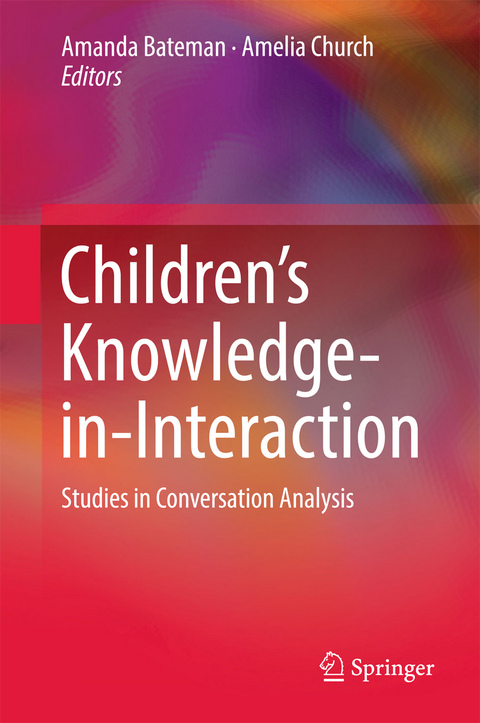
Children’s Knowledge-in-Interaction (eBook)
XVIII, 369 Seiten
Springer Singapore (Verlag)
978-981-10-1703-2 (ISBN)
This book is a collected volume that brings together research from authors working in cross-disciplinary academic areas including early childhood, linguistics and education, and draws on the shared interests of the authors, namely understanding children's interactions and the co-production of knowledge in everyday communication. The collection of studies explores children's interactions with teachers, families and peers, showing how knowledge and learning are co-created, constructed and evident in everyday experiences.
Amanda Bateman currently works at the University of Waikato, New Zealand as a senior lecturer in early childhood education. She has led various research projects using conversation analysis to explore peer-peer relationships and teacher-child interactions, and is currently Principal Investigator on a project exploring children's storytelling in early childhood through to primary school. Her book Conversation Analysis and Early Childhood Education: The Co-Production of Knowledge and Relationships discusses findings from her project investigating teacher-child interactions in New Zealand early childhood education.
Amelia Church is a lecturer at the Melbourne Graduate School of Education at The University of Melbourne, where she teaches courses in research methods in early childhood education and applied conversation analysis as well as qualitative research methods. She holds a PhD in linguistics from Monash University and published this research as part of the Ashgate series Directions in Ethnomethodology and Conversation Analysis, which is included in the book Preference Organisation and Peer Disputes: How young children resolve conflict. Her current research involves children's talk, classroom interactions, and how misunderstanding is resolved in talk-in-interaction.
This book is a collected volume that brings together research from authors working in cross-disciplinary academic areas including early childhood, linguistics and education, and draws on the shared interests of the authors, namely understanding children's interactions and the co-production of knowledge in everyday communication. The collection of studies explores children's interactions with teachers, families and peers, showing how knowledge and learning are co-created, constructed and evident in everyday experiences.
Amanda Bateman currently works at the University of Waikato, New Zealand as a senior lecturer in early childhood education. She has led various research projects using conversation analysis to explore peer-peer relationships and teacher-child interactions, and is currently Principal Investigator on a project exploring children’s storytelling in early childhood through to primary school. Her book Conversation Analysis and Early Childhood Education: The Co-Production of Knowledge and Relationships discusses findings from her project investigating teacher-child interactions in New Zealand early childhood education.Amelia Church is a lecturer at the Melbourne Graduate School of Education at The University of Melbourne, where she teaches courses in research methods in early childhood education and applied conversation analysis as well as qualitative research methods. She holds a PhD in linguistics from Monash University and published this research as part of the Ashgate series Directions in Ethnomethodology and Conversation Analysis, which is included in the book Preference Organisation and Peer Disputes: How young children resolve conflict. Her current research involves children’s talk, classroom interactions, and how misunderstanding is resolved in talk-in-interaction.
1 Children's Knowledge-in-interaction: An introduction.- 2 Epistemic Trajectories in the Classroom: How children respond in informing sequences.- 3 Questions and Answers, a Seesaw and Embodied Action: How a preschool teacher and children accomplish educational practice.- 4 Web searching as a context to build on young children's displayed knowledge.- 5 Mathematics Knowledge in Early Childhood: Intentional teaching in the third turn.- 6 Pursuing a Telling: Managing a multi-unit turn in children's storytelling.- 7 Co-producing Cultural Knowledge: Children telling tales in the school playground.- 8 Don't laugh! Socialization of laughter and smiling in pre-school and school settings.- 9 Schoolyard Suspect: Blame negotiations, category work and conflicting versions among children and teachers.- 10 The Preschool Entrance Hall: A bilingual transit zone for preschoolers.- 11 Sparkling, Wrinkling, Softly Tinkling: On poetry and word meaning in a bilingual primary classroom.- 12 Relating with an Unborn Baby: Expectant mothers socializing their toddlers in Japanese families.- 13 Young children's initial assessments in Japanese.- 14 Learning how to use the word 'Know': Examples from a single-case study.- 15 The emergence of Story-telling.- 16 "What does it say about it?": Doing reading and doing writing as part of family mealtime.- 17 Producing knowledge with digital technologies in sibling interaction.- 18 "You can get cyberbullied by your friends": Claiming authority to categorise a past event as bullying.- 19 'It's gonna work': Spontaneous activity and knowledge management by a child with Asperger's Syndrome.
| Erscheint lt. Verlag | 25.10.2016 |
|---|---|
| Zusatzinfo | XVIII, 369 p. 63 illus. |
| Verlagsort | Singapore |
| Sprache | englisch |
| Themenwelt | Schulbuch / Wörterbuch ► Wörterbuch / Fremdsprachen |
| Geisteswissenschaften ► Psychologie ► Entwicklungspsychologie | |
| Geisteswissenschaften ► Sprach- / Literaturwissenschaft ► Sprachwissenschaft | |
| Sozialwissenschaften ► Pädagogik ► Allgemeines / Lexika | |
| Sozialwissenschaften ► Pädagogik ► Bildungstheorie | |
| Sozialwissenschaften ► Pädagogik ► Vorschulpädagogik | |
| Schlagworte | bilingual primary classrooms • childhood studies • children's contribution to learning • conversation analysis • digital literacy in early childhood • early childhood curriculum frameworks • Early childhood education • Education in Australia • Education in Sweden • Epistemics • ethnomethodological frameworks • Knowledge-in-action • Language in early childhood • Mathematics knowledge in early childhood • membership categorisation analysis • methodology of conversation analysis • New Zealand education • peer relationships and children • quality of learning interactions • sociology of childhood |
| ISBN-10 | 981-10-1703-4 / 9811017034 |
| ISBN-13 | 978-981-10-1703-2 / 9789811017032 |
| Informationen gemäß Produktsicherheitsverordnung (GPSR) | |
| Haben Sie eine Frage zum Produkt? |
 PDF (Wasserzeichen)
DRM: Digitales Wasserzeichen
Dieses eBook enthält ein digitales Wasserzeichen und ist damit für Sie personalisiert. Bei einer missbräuchlichen Weitergabe des eBooks an Dritte ist eine Rückverfolgung an die Quelle möglich.
Dateiformat: PDF (Portable Document Format)
Mit einem festen Seitenlayout eignet sich die PDF besonders für Fachbücher mit Spalten, Tabellen und Abbildungen. Eine PDF kann auf fast allen Geräten angezeigt werden, ist aber für kleine Displays (Smartphone, eReader) nur eingeschränkt geeignet.
Systemvoraussetzungen:
PC/Mac: Mit einem PC oder Mac können Sie dieses eBook lesen. Sie benötigen dafür einen PDF-Viewer - z.B. den Adobe Reader oder Adobe Digital Editions.
eReader: Dieses eBook kann mit (fast) allen eBook-Readern gelesen werden. Mit dem amazon-Kindle ist es aber nicht kompatibel.
Smartphone/Tablet: Egal ob Apple oder Android, dieses eBook können Sie lesen. Sie benötigen dafür einen PDF-Viewer - z.B. die kostenlose Adobe Digital Editions-App.
Buying eBooks from abroad
For tax law reasons we can sell eBooks just within Germany and Switzerland. Regrettably we cannot fulfill eBook-orders from other countries.
aus dem Bereich


