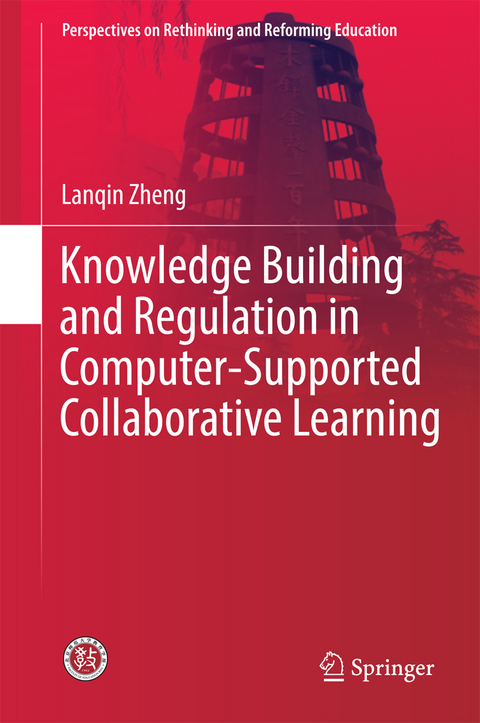
Knowledge Building and Regulation in Computer-Supported Collaborative Learning (eBook)
XVII, 161 Seiten
Springer Singapore (Verlag)
978-981-10-1972-2 (ISBN)
Dr. Lanqin Zheng currently works as an assistant professor and supervisor for postgraduate at the School of Educational Technology in Beijing Normal University. She received her PhD from Beijing Normal University, China. Dr. Lanqin Zheng is also a postdoctoral fellow at Athabasca University, Canada. Her research interests include computer supported collaborative learning, learning analytics, smart learning environment, and instructional design.
Dr. Lanqin Zheng has published about 50 refereed journal papers, book, book chapters, and international conference papers. Now, she serves as an assistant editor of Smart Learning Environment journal. She also serves as program committee members of many international conferences, such as ICALT2015 and ICSLE2015, ICSLE2014, and so on. Before, she was scientific committee member of international workshop on learning analytics (IWLA 2013) and finical chair of ICALT2013. She was also organization committee secretary of many international conferences, such as TEL2011, CSCL Post-Conference 2011, summer school for doctor candidates in educational technology in 2011, ICHL2010, ADMA2009, WMUTE2008, CATE2007, ICCE2006, and GCCCE/NEIF2002.
This book proposes and validates an information flow approach to analyzing knowledge co-construction and predicting group performance in the context of collaborative learning. In addition, it highlights the importance of socially shared regulation in collaborative learning, and illustrates in detail how it can be analyzed and promoted.The book investigates several innovative examples, including: Methodological approaches to studying and analyzing knowledge building and regulation in collaborative learning; Social software tools for capturing the dynamics of knowledge building and regulation in collaborative learning; Collective regulatory mechanisms to scaffold socially shared regulation in real-life collaborative learning; and Scripts and interventions to facilitate effective and productive collaborative learning on the basis of several case studies.The original methodological contributions to the analysis of knowledge buildingand scaffolding socially shared regulation make this an essential read for anyone interested in collaborative learning. This book will also be of interest to a wide audience of researchers, teachers, and students in the field of collaborative learning, as well as the rapidly growing community of people investigating how collaborative learning can be effectively used in education.
Dr. Lanqin Zheng currently works as an assistant professor and supervisor for postgraduate at the School of Educational Technology in Beijing Normal University. She received her PhD from Beijing Normal University, China. Dr. Lanqin Zheng is also a postdoctoral fellow at Athabasca University, Canada. Her research interests include computer supported collaborative learning, learning analytics, smart learning environment, and instructional design.Dr. Lanqin Zheng has published about 50 refereed journal papers, book, book chapters, and international conference papers. Now, she serves as an assistant editor of Smart Learning Environment journal. She also serves as program committee members of many international conferences, such as ICALT2015 and ICSLE2015, ICSLE2014, and so on. Before, she was scientific committee member of international workshop on learning analytics (IWLA 2013) and finical chair of ICALT2013. She was also organization committee secretary of many international conferences, such as TEL2011, CSCL Post-Conference 2011, summer school for doctor candidates in educational technology in 2011, ICHL2010, ADMA2009, WMUTE2008, CATE2007, ICCE2006, and GCCCE/NEIF2002.
Introduction.- Part 1 Analysis of Collaborative Knowledge Construction.- Chapter 1 Analysis of Collaborative Knowledge Construction: An Information Flow Approach.- Chapter 2 Analysis of Knowledge Elaboration based on the Knowledge Map Analytical Approach.- Chapter 3 Assess of Knowledge Convergence Based on a Novel approach in CSCL.- Part 2 Socially Shared Regulation in Collaborative Learning.- Chapter 4 Self-regulation, Co-regulation, and Socially Shared Regulation in Computer Supported Collaborative Learning.- Chapter 5 Analysis of Socially Shared Regulation in CSCL.- Chapter 6 Promoting Socially Shared Regulation through Dynamic Scaffolds.- Part 3 Case Studies in CSCL: Facilitation and Reflection.- Chapter 7 Script Collaborative Learning through Role Assignment.- Chapter 8 Facilitating Collaborative Learning through Cross-age Peer-tutors.- Chapter 9 Promoting Productive Collaborative Learning through Teachers’ Guidance.- Chapter 10 Support Collaborative Learning by Tablet PC: A Case Study.
| Erscheint lt. Verlag | 14.10.2016 |
|---|---|
| Reihe/Serie | Perspectives on Rethinking and Reforming Education | Perspectives on Rethinking and Reforming Education |
| Zusatzinfo | XVII, 161 p. 44 illus., 38 illus. in color. |
| Verlagsort | Singapore |
| Sprache | englisch |
| Themenwelt | Schulbuch / Wörterbuch ► Unterrichtsvorbereitung ► Unterrichts-Handreichungen |
| Geisteswissenschaften | |
| Sozialwissenschaften ► Pädagogik ► Schulpädagogik / Grundschule | |
| Schlagworte | computer-supported collaborative learning • Co-regulation • interaction analysis • Knowledge Construction • Knowledge Convergence • Knowledge Elaboration • Learning and Instruction • Peer-tutor • Role Assignment • Socially Shared Regulation • Teachers’ Guidance |
| ISBN-10 | 981-10-1972-X / 981101972X |
| ISBN-13 | 978-981-10-1972-2 / 9789811019722 |
| Informationen gemäß Produktsicherheitsverordnung (GPSR) | |
| Haben Sie eine Frage zum Produkt? |
 PDF (Wasserzeichen)
DRM: Digitales Wasserzeichen
Dieses eBook enthält ein digitales Wasserzeichen und ist damit für Sie personalisiert. Bei einer missbräuchlichen Weitergabe des eBooks an Dritte ist eine Rückverfolgung an die Quelle möglich.
Dateiformat: PDF (Portable Document Format)
Mit einem festen Seitenlayout eignet sich die PDF besonders für Fachbücher mit Spalten, Tabellen und Abbildungen. Eine PDF kann auf fast allen Geräten angezeigt werden, ist aber für kleine Displays (Smartphone, eReader) nur eingeschränkt geeignet.
Systemvoraussetzungen:
PC/Mac: Mit einem PC oder Mac können Sie dieses eBook lesen. Sie benötigen dafür einen PDF-Viewer - z.B. den Adobe Reader oder Adobe Digital Editions.
eReader: Dieses eBook kann mit (fast) allen eBook-Readern gelesen werden. Mit dem amazon-Kindle ist es aber nicht kompatibel.
Smartphone/Tablet: Egal ob Apple oder Android, dieses eBook können Sie lesen. Sie benötigen dafür einen PDF-Viewer - z.B. die kostenlose Adobe Digital Editions-App.
Buying eBooks from abroad
For tax law reasons we can sell eBooks just within Germany and Switzerland. Regrettably we cannot fulfill eBook-orders from other countries.
aus dem Bereich