


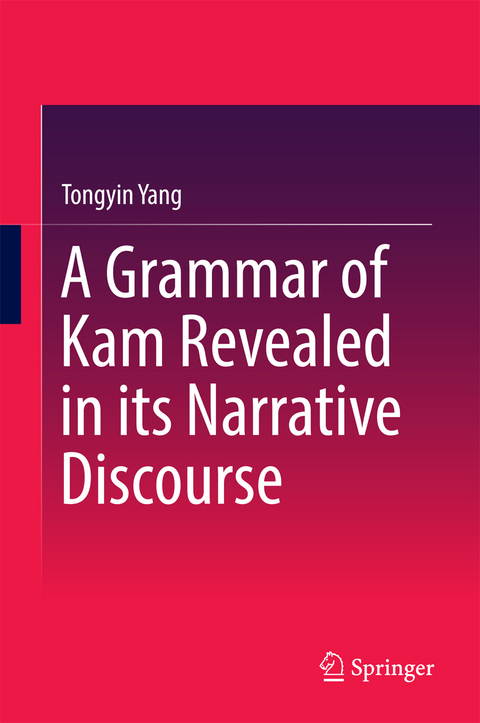
A Grammar of Kam Revealed in Its Narrative Discourse (eBook)
VIII, 314 Seiten
Springer Singapore (Verlag)
9789811022630 (ISBN)
Tongyin Yang, born March 21, 1966, a native Kam speaker from Tongdao, Hunan Province of China, is a linguist whose work spans five subdisciplines: Kam-Tai languages, field linguistics, discourse analysis, language contact, and the interface between language and music. He has done extensive fieldwork in Kam-Tai languages such as Kam, Mak, Jin, Sui , Buyei, and Hlai. His publications include four books and about twenty academic articles. He received his BA and MA from MINZU University of China and his doctorate in linguistics from the University of Texas at Arlington in 2004. He was an assistant researcher at the Institute of Anthropology and Ethnography of the Chinese Academy of Social Sciences from 1992 to 1996 and is a professor at the School of Linguistic Sciences and executive dean at the International College, Jiangsu Normal University, China.
The Kam language of China possesses fifteen tones - more than any other language. Yet it has long been neglected as an area of research, especially from the perspective of discourse analysis. This study initiates the exploration of the interface between grammar and discourse by examining various aspects of Kam narrative discourse, and using a functional approach to reveal its structural properties. It also introduces the mechanism for phonological and syntactic variations, as well as classifier variants and sentence-final particles (SFPs) in discourse and word order variations. Finally, it discusses the influence of social setting on narrative structure and offers the most up-to-date ethnological and social information about the community.
Tongyin Yang, born March 21, 1966, a native Kam speaker from Tongdao, Hunan Province of China, is a linguist whose work spans five subdisciplines: Kam-Tai languages, field linguistics, discourse analysis, language contact, and the interface between language and music. He has done extensive fieldwork in Kam-Tai languages such as Kam, Mak, Jin, Sui , Buyei, and Hlai. His publications include four books and about twenty academic articles. He received his BA and MA from MINZU University of China and his doctorate in linguistics from the University of Texas at Arlington in 2004. He was an assistant researcher at the Institute of Anthropology and Ethnography of the Chinese Academy of Social Sciences from 1992 to 1996 and is a professor at the School of Linguistic Sciences and executive dean at the International College, Jiangsu Normal University, China.
Contents 5
Abbreviations 7
1 Introduction 9
1.1 Aspects in Discussion and Their Respective Salience 9
1.2 The Kam People, Language, and Their Homeland 10
1.3 The Kam Autonym and Kam History 11
1.4 Religion 13
1.5 Kam Language and Orthography 14
1.5.1 Genetic Affiliation 14
1.5.2 Dialectology 14
1.5.3 Phonology 16
1.5.3.1 Rhymes 16
1.5.3.2 Tones 17
1.5.4 Phrase Structure and Syntax 18
1.5.5 Kam Orthography 18
1.6 Summary 20
2 Research Questions and Framework 21
2.1 Scope of This Present Research 21
2.2 Literature Review 22
2.3 Schiffrin’s Five-Plane Discourse Model 24
2.4 Summary 25
3 Data and Data Collection 26
3.1 Yutou Kam Community 26
3.1.1 Geographical and Administrative Information 26
3.1.2 History and Internal Clan Structure 27
3.1.3 As a Major Historical and Cultural Sites Under National Protection 28
3.1.4 Language Use 29
3.1.5 Oral Literature 30
3.2 Storytelling Events 30
3.2.1 Location and Time—the Where and When 30
3.2.2 Participants: The Narrators and the Hearers—the Who 32
3.2.3 Stages of Folktale Narrating—the How and What 33
3.2.4 The Social and Cultural Functions of Folktale Narrating—the Why 34
3.2.5 The Decoys on Scene 35
3.2.5.1 Who Could Be a Decoy? 35
3.2.5.2 The Functions of Decoys 36
3.3 Data Collecting and Processing 37
3.4 The Salience of the Two Selected Narratives 38
3.5 Summary of the Recorded Narrative Data in LINGUALINKS 39
3.5.1 Summary of the Three Friends (TF) 39
3.5.2 Summary of the Sky Repairing (SR) 39
3.6 Summary 40
4 Analysis 41
4.1 Analysis of Discourse Conditioned Phonological and Grammatical Variations 41
4.1.1 Introduction 41
4.1.2 A New Phoneme /?/ 42
4.1.2.1 Some Phonological Features of /?/ 43
4.1.2.2 Allomorph Particles with Rhyme/i and /e/ 44
4.1.3 Discourse Induced Reduction of Directional Verbs 45
4.1.3.1 The Structures of the Directional Verbs 46
4.1.3.2 Analysis of Mechanism of the Variation 48
4.1.4 Classifier Variants and Pronoun Modifiers of Kinship Terms in Discourse 53
4.1.4.1 Classifier Initial and Tonal Variations 53
4.1.4.2 Discourse Functions of Classifiers and Their Variants 54
4.1.4.3 Why pu31 lau55 ‘Our Father’ Is Right but pu31 lau11 ‘My Father’ Is Wrong? 59
4.1.5 Word Order Variations in Discourse 66
4.1.5.1 The Three Kam Major Parameters in Word Order 67
4.1.5.2 Word Order Variations 69
4.1.5.3 Topicalization 70
4.1.5.4 Phrase Internal Variations 71
4.1.5.5 Head-Noun and Relative Clause 73
4.2 Sentence-Final Particles (SFP) in Narrative Discourse 74
4.2.1 Introduction 74
4.2.2 The Inventory of Kam SFPs 75
4.2.3 Phonological and Syntactic Features of SFPs 79
4.2.3.1 Tonal and Other Syllabic Structural Characteristics of SFPs 79
4.2.3.2 Syntactic Characteristics of SFPs 83
4.2.4 Functions of Individual SFPs in Discourse 87
4.2.4.1 Weakener SFPs 88
a11—Request, Suggestion, and Question Indicators 88
e11—Inquiry, Doubt, and Acknowledgment 90
he11—Certainty 90
ho11, hu11, wu11—Seeking Agreement 90
i11—A Pause, Conceding, and Rhythmic Balancer 91
la11, l?u11, lu11—Perfective or Completive Aspect Indicators 91
le11—Fact or Truth Indicator, Factuality 93
li11—Weak Confirmer 93
ma11—Recommendation Indicator and Agreement Signer 94
4.2.4.2 Strengtheners 94
a31—Strong Questioning, Demanding, and Direct Demanding 95
a11 a323/a11 ha323—Polite Instruction 96
t?u31, ta31—Perfective Action on Background or Participation Framework 96
h?i35—Questioner, Confirmation Seeker 98
h?i35, h?i35 i11—Appealer and Comforter 98
hi31—Surprise, Resignation in the Face of an Unpreferred Situation 99
i11 i323, i11 hi323—Seek Repetition 99
la323—Suggestion, Seek Ideas 99
le35—Disappointment 100
le323—Concession 100
lja31—Communication Operator and Universal Discourse Marker 100
li323—Surprise 100
lu31, lu323—Dissuading and Warning 101
4.2.4.3 Neutralizers 101
e55—Supplementary Question 101
li33—Confirmer with Sense of Humor, Informality 101
lu33, hu31—Attention Drawer 102
4.2.5 SFPs and Discourse Markers (DM) 102
4.2.5.1 Discourse Markers 103
4.2.5.2 Discourse Markers Found in Narrative 104
4.2.5.3 The Comparison Between Discourse Markers and SFPs 105
4.3 Structure of Narrative and Functions of Repetition 106
4.3.1 Labov’s Six-Part Model of Narrative and Application in Kam 106
4.3.1.1 Labov’s Study in Personal Experience Narrative 106
4.3.1.2 Abstract 108
4.3.1.3 Orientation 109
4.3.1.4 Complication and Evaluation 110
4.3.1.5 Resolution 112
4.3.1.6 Coda 112
4.3.2 Some Discourse Grammatical Characteristics of Narrative 113
4.4 Communicative Aspects of Narrating 119
4.4.1 Narrating as Communicational Social Interaction 120
4.4.1.1 Monologue in Which Everyone Can Say Something 120
4.4.1.2 The Floor Control and Social Power Realization 121
4.4.2 Input from Non-decoy Audience 122
4.4.3 Communication Operator lja31 123
4.4.3.1 lja31 in Sentence-Final Positions 124
4.4.3.2 lja31 in Non-sentence-Final Positions 124
4.4.3.3 Time Realization, Narrator Privilege, and Metrical Expedient 125
4.5 Summary 127
5 Conclusion 128
5.1 Stated Goals and Findings 128
5.2 Strengths, Weaknesses, and Limitations of the Present Study 129
5.3 Recommendations for Future Research 130
Full Lingualinks Version of Sky Repairing 132
Full Lingualinks Version of Three Friends 227
Postscripts 311
References 312
| Erscheint lt. Verlag | 29.9.2016 |
|---|---|
| Zusatzinfo | VIII, 314 p. 13 illus., 2 illus. in color. |
| Verlagsort | Singapore |
| Sprache | englisch |
| Themenwelt | Schulbuch / Wörterbuch ► Wörterbuch / Fremdsprachen |
| Geisteswissenschaften ► Sprach- / Literaturwissenschaft ► Sprachwissenschaft | |
| Sozialwissenschaften ► Ethnologie | |
| Sozialwissenschaften ► Soziologie | |
| Schlagworte | Discourse analysis • Dong Language • Functional Approach • Kam Culture • Kam Language • Sentence-final Particle • Syntactic structure |
| ISBN-13 | 9789811022630 / 9789811022630 |
| Informationen gemäß Produktsicherheitsverordnung (GPSR) | |
| Haben Sie eine Frage zum Produkt? |
 PDF (Wasserzeichen)
DRM: Digitales Wasserzeichen
Dieses eBook enthält ein digitales Wasserzeichen und ist damit für Sie personalisiert. Bei einer missbräuchlichen Weitergabe des eBooks an Dritte ist eine Rückverfolgung an die Quelle möglich.
Dateiformat: PDF (Portable Document Format)
Mit einem festen Seitenlayout eignet sich die PDF besonders für Fachbücher mit Spalten, Tabellen und Abbildungen. Eine PDF kann auf fast allen Geräten angezeigt werden, ist aber für kleine Displays (Smartphone, eReader) nur eingeschränkt geeignet.
Systemvoraussetzungen:
PC/Mac: Mit einem PC oder Mac können Sie dieses eBook lesen. Sie benötigen dafür einen PDF-Viewer - z.B. den Adobe Reader oder Adobe Digital Editions.
eReader: Dieses eBook kann mit (fast) allen eBook-Readern gelesen werden. Mit dem amazon-Kindle ist es aber nicht kompatibel.
Smartphone/Tablet: Egal ob Apple oder Android, dieses eBook können Sie lesen. Sie benötigen dafür einen PDF-Viewer - z.B. die kostenlose Adobe Digital Editions-App.
Buying eBooks from abroad
For tax law reasons we can sell eBooks just within Germany and Switzerland. Regrettably we cannot fulfill eBook-orders from other countries.
aus dem Bereich


