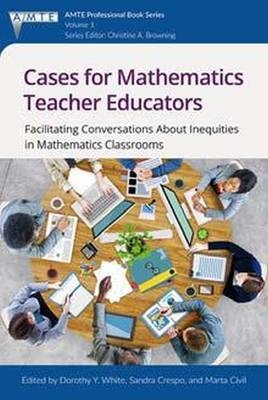
Cases for Mathematics Teacher Educators: Facilitating Conversations about Inequities in Mathematics Classrooms provides an excellent resource to start conversations describing the enactment of these actions. The book is organized into three main sections: (1) Conversations About Inequities in Mathematics Methods Courses, (2) Conversations About Inequities in Mathematics Content Courses, and (3) Conversations about Inequities in Graduate and Professional Development Contexts. Across these sections there are 19 cases and 57 corresponding commentaries focused on dilemmas that arise when mathematics teacher educators foreground equity in their work. This book of cases provides a needed resource for MTEs to engage prospective teachers, practicing teachers, and future teacher educators in discussions about inequities, privilege, and oppression in society, in schools, and in the mathematics classroom. It is the product of the thinking and experiences of 87 authors who are committed to the improvement of mathematics teacher education.
The Association of Mathematics Teacher Educators (AMTE) in its 2015 position paper on Equity in Mathematics Teacher Education provides a list of actions for mathematics teacher educators (MTE's) to help them develop and implement equitable practices. The position paper states it is critical that mathematics teacher educators: "e;Model equitybased pedagogy that emphasizes rich and rigorous mathematics; elicit and build on children's and young adults' mathematical thinking; connect to P12 students' cultural/linguistic knowledge and backgrounds as well as individual interests; facilitate mathematical discourse; minimize status issues by expanding broader participation and engagement where varied mathematical strengths are valued; and promote positive mathematical identity and agency (p. 2)"e;.Cases for Mathematics Teacher Educators: Facilitating Conversations about Inequities in Mathematics Classrooms provides an excellent resource to start conversations describing the enactment of these actions. The book is organized into three main sections: (1) Conversations About Inequities in Mathematics Methods Courses, (2) Conversations About Inequities in Mathematics Content Courses, and (3) Conversations about Inequities in Graduate and Professional Development Contexts. Across these sections there are 19 cases and 57 corresponding commentaries focused on dilemmas that arise when mathematics teacher educators foreground equity in their work. This book of cases provides a needed resource for MTEs to engage prospective teachers, practicing teachers, and future teacher educators in discussions about inequities, privilege, and oppression in society, in schools, and in the mathematics classroom. It is the product of the thinking and experiences of 87 authors who are committed to the improvement of mathematics teacher education.
Cover 1
Series 2
Cases for Mathematics Teacher Educators 4
Library of Congress Cataloging-in-Publication Data 5
Dedication 6
Contents 8
Foreword 18
Foreword 22
Preface 24
CHAPTER 1: Facilitating Conversations About Inequities in Mathematics Classrooms 26
PART I: CONVERSATIONS ABOUT INEQUITIES IN MATHEMATICS METHODS COURSES 32
CHAPTER 2: Addressing Deficit Language in Math Methods 38
COMMENTARY 1: Providing Respectful and Ability-Oriented Feedback to Parents 48
COMMENTARY 2: Missing in the Numbers: Examination of Teacher and Racial Identities 52
COMMENTARY 3: Critical Dialogues to Promote Transformative Learning 58
CHAPTER 3: Understanding White Privilege 64
COMMENTARY 1: Acknowledging Personal Perspectives to Build Mathematical Understandings 72
COMMENTARY 2: The Importance of Context and Nuance in Designing Learning Experiences 78
COMMENTARY 3: Supporting Novice Mathematics Teachers’ Racial Consciousness 82
CHAPTER 4: Why Are You Asking For These Impossible Math Lessons? 88
COMMENTARY 1: Identifying and Supporting the Next Small Step Together 96
COMMENTARY 2: Equitable Mathematics Teaching for All Students 100
COMMENTARY 3: Turning Disappointing Student Emails into Teachable Moments 104
CHAPTER 5: Problematizing Gender 110
COMMENTARY 1: Using Media to Problematize Gender Stereotypes in the Mathematics Classroom 120
COMMENTARY 2: Problematizing Gender: Learning to Embrace Uncertainty 126
COMMENTARY 3: Gender ? Sex ? Sexual Orientation 132
CHAPTER 6: Challenging and Disrupting Deficit Notions in Our Work With Early Childhood and Elementary Teachers 138
COMMENTARY 1: Weakening Deficit Perspectives with Collective Agency 146
COMMENTARY 2: Building Partnerships to Challenge and Disrupt Deficit Views of Students and Communities 150
COMMENTARY 3: Creating Invitations to Disrupt Deficit Discourses 156
CHAPTER 7: Case X 160
COMMENTARY 1: The Delicate Balance of a Three-Legged Stool 168
COMMENTARY 2: Validating and Contextualizing Preservice Teachers’ Resistance to Social Justice Pedagogy in Mathematics 174
COMMENTARY 3: Conceptions of Equity and Their Impact on Students’ Opportunities to Learn Mathematics 180
CHAPTER 8: HEARING MATHEMATICALCOMPETENCE EXPRESSEDIN EMERGENT LANGUAGE 186
COMMENTARY 1: Teaching Preservice Teachers to Successfully Position English Learners 196
COMMENTARY 2: Preparing Our New Teachers to “Hear Mathematical Competence” 202
COMMENTARY 3: Positioning, Status, and Power: Framin the Participation of EL Students in Mathematics Discussions for Prospective Teachers 208
CHAPTER 9: Tracking in a Local Middle School 214
COMMENTARY 1: Unpacking Expectations and Lenses in Mathematics Classroom Observations 222
COMMENTARY 2: Seeing Isn’t Always Believing: Recognizing Race Dysconciousness in the Preservice Teacher Context 228
COMMENTARY 3: Identity, Context, and Conversations About Racism 234
PART II: CONVERSATIONS ABOUT INEQUITIES IN MATHEMATICS CONTENT COURSES 240
CHAPTER 10: “This Is Nice But They Need to Learn to Do Things the U.S. Way” 244
COMMENTARY 1: When the “U.S. Way” Is Not the Standard! 252
COMMENTARY 2: Noticing Student Thinking 258
COMMENTARY 3: Valorization of Knowledge as a Component of Understanding and Building Upon Students’ Thinking 262
CHAPTER 11: Using Mathematics to Investigate Social and Political Issues 268
COMMENTARY 1: Tensions and Opportunities When Implementing Social Justice Mathematics Tasks 276
COMMENTARY 2: The Need to Be Intentional in the Integration of Social Justice in Mathematics Content Courses 280
COMMENTARY 3: “Strategic Intrusion” 286
CHAPTER 12: Searching for Cohesion in a Mathematics Course for Social Analysis 292
COMMENTARY 1: Embracing Tensions 300
COMMENTARY 2: Less is More 306
COMMENTARY 3: Responding to Students’ Needs 310
CHAPTER 13: Not Called to Action (or Called Upon to Act) 314
COMMENTARY 1: Becoming Political in Mathematics Education Class 322
COMMENTARY 2: Teaching Mathematics for Social Justice as Engaging in Joint Action With Students 326
COMMENTARY 3: Mathematics and Activism 332
CHAPTER 14: Who Counts as a Mathematician? 336
COMMENTARY 1: Buttons and Mathematicians 344
COMMENTARY 2: Broadening Perspectives Through Purposeful Reflection 350
COMMENTARY 3: Doing Mathematics and Being a Mathematician, These May Be Different 354
PART III: CONVERSATIONS ABOUT INEQUITIES IN GRADUATE AND PROFESSIONAL DEVELOPMENT CONTEXTS 358
CHAPTER 15: Are These Two Sides of the Same Coin? 364
COMMENTARY 1: Responding to Mathematics Teachers’ Deficit Perspectives About Economically Disadvantaged Students and Their Families 372
COMMENTARY 2: Teaching Privilege About Equity 378
COMMENTARY 3: What Are We Doing When Understanding Culture Is Not Enough? 384
CHAPTER 16: How Do I Learn To Like This Child So I Can Teach Him Mathematics 390
COMMENTARY 1: Examining Interest Convergence and Identity 398
COMMENTARY 2: Supporting a Teacher’s Shift from Deficits to Funds of Knowledge 404
COMMENTARY 3: A Commentary on Foote’s Case 408
CHAPTER 17: Challenging Deficit Language 414
COMMENTARY 1: Adjusting Perspectives 420
COMMENTARY 2: Supporting Strength-Based Perspectives and Understandings 426
COMMENTARY 3: Challenging Mathematics Teachers’ Deficit-Language Use 432
CHAPTER 18: Moving from Addressing One’s Target Identity to One’s Nontarget Identities 438
COMMENTARY 1: Anticipating the Unexpected: Managing a Dilemma During Facilitation of a Social Justice Mathematics Task 446
COMMENTARY 2: Challenging PSTs’ Views and the Inherent Subjectivity While Doing So 452
COMMENTARY 3: On Denial and the Search for Explanation 456
CHAPTER 19: Learning About Students and Communities Using Data and Maps 460
COMMENTARY 1: The Frog in the Pan: Developing Critical Awareness in Mathematics Teachers 470
COMMENTARY 2: Can Mathematics Pave the Road to Social Justice? 476
COMMENTARY 3: Being Students and Teachers of Math and Social Justice 482
CHAPTER 20: “Let Me Be Your Cultural Resource” 488
COMMENTARY 1: Opening Spaces in Mathematics Teacher Education 494
COMMENTARY 2: Nosotras Spaces: Cobuilding Transformational Bridges 500
COMMENTARY 3: Seeing the Problem Before Attempting to Solve It 504
About the Editors 510
| Erscheint lt. Verlag | 1.10.2016 |
|---|---|
| Sprache | englisch |
| Themenwelt | Schulbuch / Wörterbuch ► Lexikon / Chroniken |
| Geisteswissenschaften | |
| Mathematik / Informatik ► Mathematik | |
| Sozialwissenschaften ► Pädagogik ► Schulpädagogik / Grundschule | |
| Technik | |
| ISBN-10 | 1-68123-627-3 / 1681236273 |
| ISBN-13 | 978-1-68123-627-8 / 9781681236278 |
| Informationen gemäß Produktsicherheitsverordnung (GPSR) | |
| Haben Sie eine Frage zum Produkt? |
 PDF (Adobe DRM)
Größe: 3,6 MB
Kopierschutz: Adobe-DRM
Adobe-DRM ist ein Kopierschutz, der das eBook vor Mißbrauch schützen soll. Dabei wird das eBook bereits beim Download auf Ihre persönliche Adobe-ID autorisiert. Lesen können Sie das eBook dann nur auf den Geräten, welche ebenfalls auf Ihre Adobe-ID registriert sind.
Details zum Adobe-DRM
Dateiformat: PDF (Portable Document Format)
Mit einem festen Seitenlayout eignet sich die PDF besonders für Fachbücher mit Spalten, Tabellen und Abbildungen. Eine PDF kann auf fast allen Geräten angezeigt werden, ist aber für kleine Displays (Smartphone, eReader) nur eingeschränkt geeignet.
Systemvoraussetzungen:
PC/Mac: Mit einem PC oder Mac können Sie dieses eBook lesen. Sie benötigen eine
eReader: Dieses eBook kann mit (fast) allen eBook-Readern gelesen werden. Mit dem amazon-Kindle ist es aber nicht kompatibel.
Smartphone/Tablet: Egal ob Apple oder Android, dieses eBook können Sie lesen. Sie benötigen eine
Geräteliste und zusätzliche Hinweise
Buying eBooks from abroad
For tax law reasons we can sell eBooks just within Germany and Switzerland. Regrettably we cannot fulfill eBook-orders from other countries.
 EPUB (Adobe DRM)
Kopierschutz: Adobe-DRM
Adobe-DRM ist ein Kopierschutz, der das eBook vor Mißbrauch schützen soll. Dabei wird das eBook bereits beim Download auf Ihre persönliche Adobe-ID autorisiert. Lesen können Sie das eBook dann nur auf den Geräten, welche ebenfalls auf Ihre Adobe-ID registriert sind.
Details zum Adobe-DRM
Dateiformat: EPUB (Electronic Publication)
EPUB ist ein offener Standard für eBooks und eignet sich besonders zur Darstellung von Belletristik und Sachbüchern. Der Fließtext wird dynamisch an die Display- und Schriftgröße angepasst. Auch für mobile Lesegeräte ist EPUB daher gut geeignet.
Systemvoraussetzungen:
PC/Mac: Mit einem PC oder Mac können Sie dieses eBook lesen. Sie benötigen eine
eReader: Dieses eBook kann mit (fast) allen eBook-Readern gelesen werden. Mit dem amazon-Kindle ist es aber nicht kompatibel.
Smartphone/Tablet: Egal ob Apple oder Android, dieses eBook können Sie lesen. Sie benötigen eine
Geräteliste und zusätzliche Hinweise
Buying eBooks from abroad
For tax law reasons we can sell eBooks just within Germany and Switzerland. Regrettably we cannot fulfill eBook-orders from other countries.
aus dem Bereich