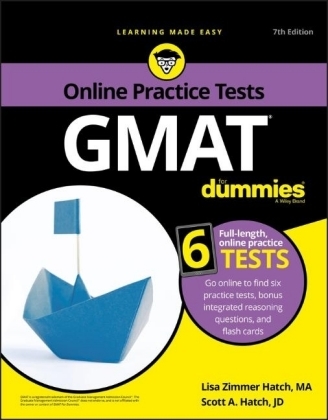
GMAT For Dummies
For Dummies (Verlag)
978-1-119-37414-5 (ISBN)
- Titel erscheint in neuer Auflage
- Artikel merken

Designed to measure your mastery of verbal, mathematical, analytical, and writing skills, the GMAT serves as the gatekeeper of world-class graduate degrees in business, finance, management, accountancy, and economy. With this book and companion website as your guide, you'll find all the helpful tips and tricks you need to brush up on each section of the exam, chart your progress, and focus your study on the areas where you need more help.
Includes a plain-English explanation of the test's format
Provides reviews of foundational concepts for every section
Offers complete explanations of every question type
Includes two full-length practice tests in the book, plus three more online
Even if the big day is just around the corner, GMAT For Dummies makes it faster and easier than ever to outsmart the competition and get on the road to acquiring that coveted MBA!
Lisa Zimmer Hatch, MA is president of College Primers, where she applies her expertise to guiding high school students through the college admissions process. Scott A. Hatch, JD has prepared thousands of individuals for standardized tests and legal careers since 1980.
Introduction 1
Part 1: Getting Started with the GMAT 5
Chapter 1: Getting the Lowdown on the GMAT 7
Knowing Why the GMAT Is Important 7
Timing It Perfectly: When to Take the GMAT (And What to Bring) 8
When to register for and take the GMAT 8
Things to take to the GMAT (and things to leave at home) 10
Forming First Impressions: The Format of the GMAT 10
Getting familiar with what the GMAT tests 10
Understanding the computerized format 11
Honing your computer skills for the GMAT 12
Knowing Where You Stand: Scoring Considerations 13
How the GMAT testers figure your score 13
How the GMAT testers report your score 13
Why you should (almost) never cancel your GMAT score 14
Repeating the Process: Retaking the GMAT 15
Chapter 2: Maximizing Your Score on the GMAT 17
Discovering Strategies for Successful Guessing 17
Forcing yourself to guess so you can move on 18
Understanding the importance of completing each section 18
Winning the Race against the Clock 19
Giving each question equal treatment 19
Making time for the last ten questions 19
Keeping track of your pace 20
Getting Rid of Wrong Answers 20
Keeping track of eliminated answer choices for the computer test format 20
Recognizing wrong answers 21
Playing It Smart: A Few Things You Shouldn’t Do When Taking the Test 25
Don’t lose your focus 25
Don’t read questions at lightning speed 25
Don’t waste all your time on the hardest questions 25
Don’t cheat 26
Tackling a Case of Nerves with Relaxation Techniques 26
Devising a Plan of Attack 27
Chapter 3: Mastering Business-School Admissions 29
Choosing a Business School 29
Lining Up Your Ducks — Applying to Business Schools 31
When to apply 32
What to submit 32
Crafting Effective Business-School Essays 33
Part 2: Vanquishing the Verbal Section 35
Chapter 4: Applying What You Learned (We Hope) in Grammar Class: Sentence Correction 37
Building a Solid Foundation: Grammar Basics 38
Getting wordy: The parts of speech 38
Pulling together: The parts of a sentence 40
Pointing Out Mistakes: Common Sentence-Correction Errors 42
Can’t we all just get along? Errors in subject-verb and noun-pronoun agreement 43
Building code violations: Faulty construction 45
Follow the idiom: Correct use of standard expressions 49
Implementing an Approach to Sentence-Correction Questions 51
Spotting the error 52
Eliminating answers that don’t correct errors 52
Eliminating choices that create new errors 53
Rereading the sentence 53
Reviewing the process and guessing on sentence corrections 53
Sentence-Correction Practice Problems with Answer Explanations 53
Practice problems 54
Answer explanations 56
Chapter 5: Not as Enticing as a Bestseller: Reading Comprehension 59
Judging by Appearances: What Reading-Comprehension Questions Look Like 59
Approaching Reading Passages 60
Mastering the message: The main point 60
Absorbing the ambiance: Author’s tone 61
Finding the framework: The passage’s outline 61
Sticking to the Subject: Types of Passages 62
Experimenting with natural science passages 62
Gathering in social circles: Social science passages 62
Getting down to business passages 63
Approaching Reading-Comprehension Questions 63
Identifying the question type 63
Eliminating answer choices 66
Dealing with exception questions 67
Reading-Comprehension Practice Questions with Answer Explanations 70
Reading-comprehension practice questions 70
Answer explanations 74
Chapter 6: Let’s Think This Through Logically: Critical Reasoning 79
Focusing on “Critical” Concepts: An Overview 79
Understanding the structure of the questions 80
Figuring out how to answer the questions 80
Making a Case: Essentials of Informal Logic 81
Fighting fair: The elements of an argument 81
Getting from Point A to Point B: Types of reasoning 81
Thinking Inside the Box: Question Types 83
Stalking Your Prey: How to Approach Each Question Type 84
Strengthening or weakening arguments 84
Delving into drawing conclusions 88
Spotting those sneaky assumptions 89
Using your noggin to make inferences 91
Making your way through method-of-reasoning questions 92
Critical-Reasoning Practice Questions and Answer Explanations 94
Critical-reasoning practice questions 94
Answer explanations 98
Chapter 7: Bringing It Together: A Mini Practice Verbal Section 103
Working Through Verbal Reasoning Practice Questions 104
Understanding What’s Right with Answer Explanations 113
Part 3: Acing the Analytical-Writing Section 121
Chapter 8: Analyze This: What to Expect from the Analytical Writing Assessment 123
Fitting in the AWA with the Rest of the GMAT 123
Calling 411: Your AWA Writing Tools 124
Analyzing an Argument 124
Racking Up the Points: How the GMAT Scores Your Essay 125
Getting to know your readers 125
Interpreting the scores 126
Requesting your essay be rescored 126
Chapter 9: Present Perfect Paragraphs: How to Write a GMAT Essay 127
Avoiding Grammar, Punctuation, and Mechanics Errors 127
Punctuation errors 128
Sentence-structure problems 129
Faulty forming of possessives 129
Spelling issues 129
More dos and don’ts 130
Practice makes perfect! 130
Building a Better Essay: Ten Steps to a Higher Score 131
Chapter 10: Deconstructing Sample GMAT Essays 133
Defining GMAT AWA Scores 133
Taking a Look at Sample Essays 134
Sample essay #1 135
Discussion of sample essay #1 136
Sample essay #2 136
Discussion of sample essay #2 137
Sample essay #3 138
Discussion of sample essay #3 139
Sample essay #4 139
Discussion of sample essay #4 140
Chapter 11: Sampling a Series of Writing Prompts 143
Sample Prompt #1 143
Sample response to essay #1 144
Dissection of essay #1 144
Sample Prompt #2 145
Sample response to essay #2 145
Dissection of essay #2 146
Sample Prompt #3 146
Sample response to essay #3 147
Dissection of essay #3 147
Sample Prompt #4 148
Sample response to essay #4 148
Dissection of essay #4 148
Part 4: Conquering the Quantitative Section 151
Chapter 12: Getting Back to Basics: Numbers and Operations 153
Just Your Type: Kinds of Numbers 153
It’s Not Brain Surgery: Basic Operations 155
Adding, subtracting, multiplying, and dividing 155
Checking out the real estate: Properties of real numbers 157
Using Little Numbers for Big Values: Bases and Exponents 160
Adding and subtracting with exponents 160
Multiplying and dividing with exponents 160
Figuring out the powers of 0 and 1 161
Dealing with fractional exponents 161
Working with negative exponents 161
Checking Out the Ancestry: Roots 162
Order of Operations: Please Excuse My Dear Aunt Sally 164
Splitting Up: Fractions, Decimals, and Percentages 164
Defining numerators, denominators, and other stuff you need to know about fractions 165
Adding and subtracting fractions 167
Multiplying and dividing fractions 167
Calculating percent change 169
Taking it further: Repeated percent change 170
Making Comparisons: Ratios and Proportions 171
Playing the Numbers: Scientific Notation 172
Chapter 13: Considering All the Variables: Algebra 175
Defining the Elements: Algebraic Terms 175
Braving the unknowns: Variables and constants 175
Coming together: Terms and expressions 176
Knowing the nomials: Kinds of expressions 176
Maintaining an Orderly Fashion: Algebraic Operations 177
Adding to and taking away 177
Multiplying and dividing expressions 179
Extracting Information: Factoring Polynomials 181
Something in common: Finding common factors 182
Two by two: Factoring quadratic polynomials 182
Minding Your Ps and Qs: Functions 183
Standing in: Understanding function terminology 184
Taking it to the limit: Domain and range of functions 185
Putting On Your Thinking Cap: Problem-Solving 188
Isolating the variable: Linear equations 188
Bringing in the substitution: Simultaneous equations 189
Not playing fair: Inequalities 191
Solving quadratic equations 193
Reading between the lines: Word problems 194
Burning the midnight oil: Work problems 196
Going the distance: Distance problems 197
Chapter 14: Getting the Angle on Geometry: Planes and Solids 199
Fishing for the Answers: Lines and Angles 199
Trusting Triangles 202
Triple treat: Types of triangles 202
The area of a triangle 204
The Pythagorean theorem and other cool stuff about right triangles 204
A striking resemblance: Similar triangles 207
Playing Four Square: Quadrilaterals 208
Drawing parallels: Parallelograms 209
Raising the roof: Trapezoids 210
Showing Their Good Sides: Other Polygons 211
Eating Up Pieces of Pi: Circles 212
Ring measurements: Radius, diameter, and circumference 212
Blueprints for Noah: Arcs 212
Line ’em up: Chords, inscribed and circumscribed figures, and tangents 213
Getting a Little Depth Perception: Three-Dimensional Geometry 215
Chipping off the old block: Rectangular solids 215
Sipping from soda cans and other cylinders 217
Chapter 15: Keeping in Step: Coordinate Geometry 219
Taking Flight: The Coordinate Plane 219
Line dancing: Understanding coordinate geometry 219
What’s the point? Finding the coordinates 220
On all fours: Identifying quadrants 220
Slip-Sliding Away: Slope and Linear Equations 221
Taking a peak: Defining the slope of a line 221
Using the slope-intercept form to graph lines 223
Meeting in the middle 225
Going the distance 226
Considering other shapes on the coordinate plane 227
Fully Functioning: Graphing Functions 228
Passing the vertical line test 228
Feeling at home with domain and range 230
Chapter 16: Manipulating Numbers: Statistics and Sets 233
Joining a Clique: Groups 233
Setting Up Sets 235
Set terminology 235
Getting a visual: Venn diagrams 235
Making Arrangements: Permutations and Combinations 237
Positioning with permutations 237
Coming together: Combinations 239
Meeting in the Middle: Mean, Median, and Mode 241
Straying from Home: Range and Standard Deviation 243
Scouting out the range 243
Watching out for wanderers: Standard deviation 243
Predicting the Future: Probability 245
Finding the probability of one event 245
Finding the probability of many events 246
Chapter 17: It’s All in the Presentation: GMAT Quantitative Question Types 249
Enough’s Enough: Data-Sufficiency Questions 249
You don’t need the solution to find the answer 250
Steps to approaching data-sufficiency problems 250
Taking a Look at Data-Sufficiency Practice Problems 253
Practice questions 253
Answer explanations 255
Houston, We Have a Problem: Problem-Solving Questions 259
Trying Out Some Problem-Solving Practice Problems 261
Practice questions 261
Answer explanations 263
Chapter 18: All Together Now: A Mini Practice Quantitative Section 267
Tackling GMAT Math Practice Questions 267
Checking Out the Answer Explanations 274
Part 5: Excelling on the Integrated-Reasoning Section 285
Chapter 19: Best of Both Worlds: The Integrated-Reasoning Section 287
Understanding What the IR Section Is All About 287
Skills tested 288
Question format 288
Figuring Out How the IR Section Is Scored 290
Making the Most of Your Time 290
Approaching Each Question Type 291
Table analysis 291
Two-part analysis 294
Graphics interpretation 297
Multi-source reasoning 298
Chapter 20: Deciphering Data in Charts and Graphs 303
Approaching Integrated-Reasoning Data in Five Easy Steps 303
Translating Information in Tables 304
Making Comparisons with Bar Graphs 305
Simple bar graphs 305
Graphs with many bars 305
Segmented bar graphs 306
Evaluating Line Graphs 308
Basic line graphs 308
Scatter plots 308
Complex scatter plots 309
Clarifying Circle Graphs (Also Known as Pie Charts) 310
Extracting Data from Venn Diagrams 311
Part 6: Practice Makes Perfect 315
Chapter 21: GMAT Practice Test 317
Chapter 22: Practice Test Answers and Explanations 347
Part 7: The Part of Tens 379
Chapter 23: Ten Question Types You’ve Got a Good Shot At 381
Chapter 24: Ten Writing Errors to Avoid 385
Chapter 25: Ten Ways to Increase Your Chances of Getting into Business School 387
Index 391
| Erscheinungsdatum | 30.01.2018 |
|---|---|
| Sprache | englisch |
| Maße | 213 x 274 mm |
| Gewicht | 590 g |
| Themenwelt | Schulbuch / Wörterbuch |
| Sozialwissenschaften ► Pädagogik | |
| Wirtschaft ► Betriebswirtschaft / Management ► Allgemeines / Lexika | |
| ISBN-10 | 1-119-37414-6 / 1119374146 |
| ISBN-13 | 978-1-119-37414-5 / 9781119374145 |
| Zustand | Neuware |
| Informationen gemäß Produktsicherheitsverordnung (GPSR) | |
| Haben Sie eine Frage zum Produkt? |
aus dem Bereich