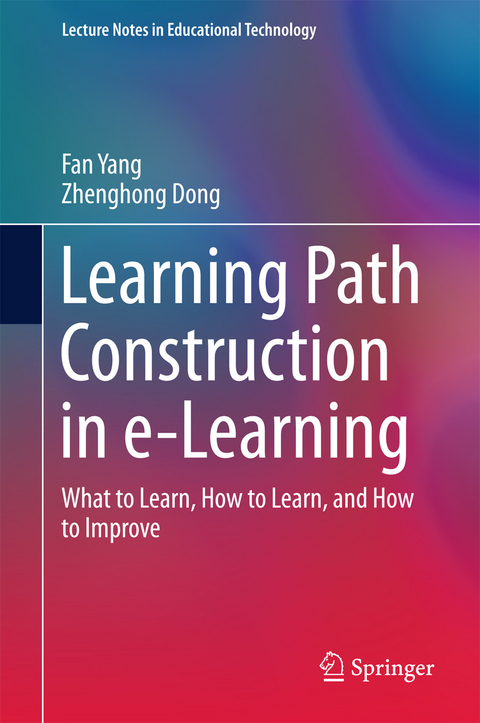
Learning Path Construction in e-Learning (eBook)
XIII, 153 Seiten
Springer Singapore (Verlag)
978-981-10-1944-9 (ISBN)
Also, this book introduces a method about how to generate adaptive learning approach to learn learning resources for different students. Finally, this book introduces a method to monitor and control learning quality. The adaptive learning path expresses well-structured learning contents, using which approach to access those learning contents, and in which sequence to carry out the learning process. The learning path comes with a monitoring tool to control the learning progress, which helps to make students having a balanced development on different knowledge and abilities.
Researchers who worked in E-learning area, both education and computer sciences people.Educators who worked in educational institutes, such as Universities, Schools, etc. They would like to use or study E-learning tools/technologies/methods in their own work.And technicians who run/design educational websites will understand the appeal of this work.
Dr. Fan Yang received a Bachelor degree from Northwestern Polytechnical University in 2007, China, and PhD degree from Durham University, UK in 2013, and funded by Doctoral Fellowship. She is currently a lecturer of Academy of Equipment. Since 2009 to 2011, she was a research assistant of City University of Hong Kong. In 2011, she was a visiting student of Shanghai University. She has published 1 monograph and 19 papers. In 2010, she got the 'Best student paper award' for ICWL2010. In 2011, she was the session chair of ICWL2011. In 2015, she was the paper reviewer of KMO2015. Her research interests include E-learning, and Information System.
This book focuses on developing methods for constructing learning paths in terms of "e;learning resources"e; (learning contents), "e;learning approaches"e; (learning method), and "e;learning quality"e; (learning performance) to support learning. This book defines different teaching approaches for learning activities and organizes them into a learning path which indicates the learning sequence. This book introduces how to automatically generate well-structured learning resources for different students. Also, this book introduces a method about how to generate adaptive learning approach to learn learning resources for different students. Finally, this book introduces a method to monitor and control learning quality. The adaptive learning path expresses well-structured learning contents, using which approach to access those learning contents, and in which sequence to carry out the learning process. The learning path comes with a monitoring tool to control the learning progress, which helps tomake students having a balanced development on different knowledge and abilities. Researchers who worked in E-learning area, both education and computer sciences people.Educators who worked in educational institutes, such as Universities, Schools, etc. They would like to use or study E-learning tools/technologies/methods in their own work.And technicians who run/design educational websites will understand the appeal of this work.
Dr. Fan Yang received a Bachelor degree from Northwestern Polytechnical University in 2007, China, and PhD degree from Durham University, UK in 2013, and funded by Doctoral Fellowship. She is currently a lecturer of Academy of Equipment. Since 2009 to 2011, she was a research assistant of City University of Hong Kong. In 2011, she was a visiting student of Shanghai University. She has published 1 monograph and 19 papers. In 2010, she got the “Best student paper award” for ICWL2010. In 2011, she was the session chair of ICWL2011. In 2015, she was the paper reviewer of KMO2015. Her research interests include E-learning, and Information System.
Preface 6
Contents 8
List of Figures 12
List of Tables 14
1 Introduction 15
1.1 Overview 15
1.2 Motivation 16
1.3 Related Work 17
1.3.1 Student Attributes 17
1.3.2 Student Assessment 18
1.3.3 Student Grouping 19
1.3.4 Learning Resources Construction 20
1.3.5 Learning Path Generation Algorithm 21
1.3.6 Test Generation 21
1.4 Challenges 22
1.5 Research Objectives 24
1.6 Contributions 25
References 25
2 Educational Theory 28
2.1 Learning Theory 28
2.2 e-Learning 29
2.2.1 Types of?Learning 30
2.2.1.1 Traditional Learning 30
2.2.1.2 Web-Based Learning 30
2.2.1.3 Blended Learning 31
2.2.2 Types of?e-Learning 31
2.2.2.1 Traditional e-Learning System 32
2.2.2.2 Adaptive e-Learning System 32
2.2.2.3 Instructional Design System 32
2.2.2.4 Intelligent Tutoring System 33
2.2.2.5 Service-Oriented e-Learning System 34
2.3 Learning Taxonomy 34
2.3.1 Bloom’s Taxonomy 35
2.3.2 Gagne’s Taxonomy 35
2.3.3 SOLO Taxonomy 36
2.3.4 Finks Taxonomy 36
2.3.5 Subsection Summary 36
2.4 Learning Styles 37
2.5 Learning Modes 38
2.6 Student Assessment 38
References 40
3 Technical Definition and?Concepts 43
3.1 Terminologies Definition in?the Proposed Research 43
3.1.1 Learning Outcomes 43
3.1.2 Learning Resources 44
3.1.3 Unit of?Learning 44
3.1.4 Learning Activity 44
3.1.5 Learning Path 45
3.1.6 Learning Progress 46
3.2 Concepts Proposed in?the Monograph 47
3.2.1 Teachers’ Teaching Experience 47
3.2.2 Teachers’ Knowledge Discipline 47
3.2.3 Teachers’ Satisfaction Score 47
3.2.4 Importance of?a Learning Path 47
3.2.5 Learning Performance on?a Learning Path 48
3.2.6 Stability of?Learning Performance 48
3.2.7 Student Learning Performance 48
3.2.8 Student Development Balance Degree 49
3.2.9 State Value of?a Student Attribute 49
References 49
4 Fundamental Theories and?Development Tools 51
4.1 General Research Methodology 51
4.1.1 Qualitative Research Method [Wiki4, Schu03, Shie03] 51
4.1.2 Quantitative Research Method [Wiki5, Schu03, Shie03] 52
4.2 Math Modeling Method for?Learning Contents—Association Link Network 53
4.3 Math Modeling Method for?Improving Learning Quality—Performance Inference Algorithm 54
4.4 Data Analysis Related Method for?Experimental Verification 56
4.4.1 One-Way ANOVA [Chan14, Wiki1] 56
4.4.2 Two Sample T-Test [Wiki2, Zhan14] 57
4.4.3 Likert Scale [Wiki3] 58
4.5 System Development Tools 59
4.5.1 Development Tools for?Learning Path System 59
4.5.2 Development Tools for?Learning Resources Generation 60
4.5.3 Tool for?Experimental Results Presentation 61
References 61
5 How to?Learn? 63
5.1 Introduction 63
5.2 Overview of?the Learning Path Model 65
5.3 Formal Definitions 67
References 73
6 What to?Learn? 75
6.1 Introduction 76
6.2 The Teacher Knowledge Model 77
6.3 Student Knowledge Model and?Personalized Learning Path 81
6.4 Student Assessment Against Learning Resources 85
References 89
7 How to?Improve Learning Quality? 90
7.1 Introduction 90
7.2 Mathematical Model 91
7.2.1 Modeling of?Student Attribute Descriptors 91
7.2.2 Student Progress Indicators 96
References 98
8 Implementation and?Results 99
8.1 Implementation for?Method for?Constructing a Fine-Grained Outcome-Based Learning Path Model 99
8.1.1 Instrument 99
8.1.1.1 Implementation 100
8.1.1.2 User Study 100
8.1.2 Participation 100
8.1.3 Data Analysis 100
8.1.4 Implementation 101
8.1.5 Experiment Results 106
8.1.6 Summary 111
8.2 Implementation for?Learning Path Construction Based on?Association Link Network 112
8.2.1 Instrument 112
8.2.1.1 Implementation 112
8.2.1.2 Comparison Study 112
8.2.2 Participation 113
8.2.3 Data Analysis 113
8.2.4 Evaluation Results and?Analysis 114
8.2.4.1 Compare the Importance of?Manually Selected and?System Recommended Learning Paths 114
8.2.4.2 Comparison of?Performance on?Two Groups of?Students 115
8.2.5 Summary 119
8.3 Implementation for?Fuzzy Cognitive Map Based Student Progress Indicators 120
8.3.1 Instrument (Questionnaires) 120
8.3.2 Participation 120
8.3.3 Data Analysis 121
8.3.4 Evaluation 121
8.3.5 Summary 122
References 123
9 Conclusion and?Prospect 125
9.1 Introduction 125
9.2 Research Contribution 125
9.2.1 A Fine-Grained Outcome-Based Learning Path Model 125
9.2.2 Learning Path Construction Based on?Association Link Network 126
9.2.3 Fuzzy Cognitive Map-Based Student Learning Progress Indicators 127
9.3 Limitations and?Prospect 129
9.4 Conclusion 130
References 130
Appendix A 131
Appendix B 141
Appendix C 152
| Erscheint lt. Verlag | 16.8.2016 |
|---|---|
| Reihe/Serie | Lecture Notes in Educational Technology | Lecture Notes in Educational Technology |
| Zusatzinfo | XIII, 153 p. 54 illus. |
| Verlagsort | Singapore |
| Sprache | englisch |
| Themenwelt | Schulbuch / Wörterbuch ► Unterrichtsvorbereitung ► Unterrichts-Handreichungen |
| Geisteswissenschaften ► Psychologie ► Pädagogische Psychologie | |
| Sozialwissenschaften ► Pädagogik ► Schulpädagogik / Grundschule | |
| Schlagworte | Association Link Network • Fuzzy Cognitive Map • Intelligent tutoring e-Learning system • Learning abilities • Learning Activity • Learning and Instruction • Learning Outcome • Learning path • learning performance • learning resources • Student learning progress |
| ISBN-10 | 981-10-1944-4 / 9811019444 |
| ISBN-13 | 978-981-10-1944-9 / 9789811019449 |
| Informationen gemäß Produktsicherheitsverordnung (GPSR) | |
| Haben Sie eine Frage zum Produkt? |
 PDF (Wasserzeichen)
DRM: Digitales Wasserzeichen
Dieses eBook enthält ein digitales Wasserzeichen und ist damit für Sie personalisiert. Bei einer missbräuchlichen Weitergabe des eBooks an Dritte ist eine Rückverfolgung an die Quelle möglich.
Dateiformat: PDF (Portable Document Format)
Mit einem festen Seitenlayout eignet sich die PDF besonders für Fachbücher mit Spalten, Tabellen und Abbildungen. Eine PDF kann auf fast allen Geräten angezeigt werden, ist aber für kleine Displays (Smartphone, eReader) nur eingeschränkt geeignet.
Systemvoraussetzungen:
PC/Mac: Mit einem PC oder Mac können Sie dieses eBook lesen. Sie benötigen dafür einen PDF-Viewer - z.B. den Adobe Reader oder Adobe Digital Editions.
eReader: Dieses eBook kann mit (fast) allen eBook-Readern gelesen werden. Mit dem amazon-Kindle ist es aber nicht kompatibel.
Smartphone/Tablet: Egal ob Apple oder Android, dieses eBook können Sie lesen. Sie benötigen dafür einen PDF-Viewer - z.B. die kostenlose Adobe Digital Editions-App.
Buying eBooks from abroad
For tax law reasons we can sell eBooks just within Germany and Switzerland. Regrettably we cannot fulfill eBook-orders from other countries.
aus dem Bereich