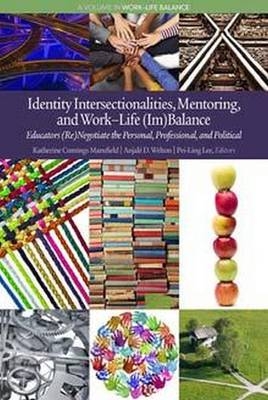
In an effort to build on the first book in the series, that focused on professors in educational leadership preparation programs, the authors here represent educators across the P?20 pipeline (primary and secondary schools in addition to higher education). This book is also unique in that it includes the voices of practitioners, students, and academics from a variety of related disciplines within the education profession, enabling the editors to include a diverse group of educators whose many voices speak to work?life balance in unique and very personal ways.
Contributing authors challenge whether the concept of work?life balance might be conceived as a privileged –and even an impractical?endeavor. Yet, the bottom line is, conceptions of work?life balance are exceptionally complex and vary widely depending on one’s many roles and intersecting identities. Moreover, this book considers how mentoring is important to negotiating the politics that come with balancing work and life; especially, if those intersecting identities are frequently associated with unsolicited stereotypes that impede upon one’s academic, professional and personal pursuits in life.
Finally, the editors argue that the power to authentically “be ourselves” is not only important to individual success, but also beneficial to fostering an institutional culture and climate that is truly supportive of and responsive to diversity, equity, and justice. Taken together, the voices in this book are a clarion call for P?12 and higher education professionals and organizations to envision how identity intersectionalities might become an every?day understanding, a normalized appreciation, and a customary commitment that translates into policy and practice.
Identity matters. Who we are in terms of our intersecting identities such as gender, race, social class, (dis)ability, geography, and religion are integral to who we are and how we navigate work and life. Unfortunately, many people have yet to grasp this understanding and, as a result, so many of our work spaces lack appropriate responses to what this means. Therefore, Identity Intersectionalities, Mentoring, and Worklife (Im)balance: Educators (Re)negotiate the Personal, Professional, and Political, the most recent installment of the worklife balance series, uses an intersectional perspective to critically examine the concept of worklife balance.In an effort to build on the first book in the series, that focused on professors in educational leadership preparation programs, the authors here represent educators across the P20 pipeline (primary and secondary schools in addition to higher education). This book is also unique in that it includes the voices of practitioners, students, and academics from a variety of related disciplines within the education profession, enabling the editors to include a diverse group of educators whose many voices speak to worklife balance in unique and very personal ways.Contributing authors challenge whether the concept of worklife balance might be conceived as a privileged -and even an impracticalendeavor. Yet, the bottom line is, conceptions of worklife balance are exceptionally complex and vary widely depending on one's many roles and intersecting identities. Moreover, this book considers how mentoring is important to negotiating the politics that come with balancing work and life; especially, if those intersecting identities are frequently associated with unsolicited stereotypes that impede upon one's academic, professional and personal pursuits in life.Finally, the editors argue that the power to authentically "e;be ourselves"e; is not only important to individual success, but also beneficial to fostering an institutional culture and climate that is truly supportive of and responsive to diversity, equity, and justice. Taken together, the voices in this book are a clarion call for P12 and higher education professionals and organizations to envision how identity intersectionalities might become an everyday understanding, a normalized appreciation, and a customary commitment that translates into policy and practice.
Cover 1
Series page 2
Identity Intersectionalities, Mentoring, and Work–Life (Im)Balance 4
Library of Congress Cataloging-in-Publication Data 5
Contents 6
Foreword 10
Introduction 14
CHAPTER 1: Transgressing Boundaries or Remapping Terrain? 24
CHAPTER 2: A Tale of Two Professors 36
CHAPTER 3: Conflicting Identities, Work–Life Challenges, and Stereotype Threat Among Divorced Catholic Feminist Mothers 46
CHAPTER 4: Work–Life Balance From an African-Centered Perspective 60
CHAPTER 5: The Cool Kids 74
CHAPTER 6: “If Not at University, Then Where?” 86
CHAPTER 7: Living on the Hyphen 100
CHAPTER 8: Disability and the Privileges of the Professorship 120
CHAPTER 9: Glass Ceilings in a House of Cards 130
CHAPTER 10: Keeping on the Academic Tracks 142
CHAPTER 11: “Why Do I Need to Learn to ‘Cope?’” 154
CHAPTER 12: Highlighting the Bright Side 172
CHAPTER 13: An Autoethnographic Exploration of an African American Male Professor Who Stutters 186
CHAPTER 14: “Should I Stay of Should I Go?” 200
CHAPTER 15: Asian Foreign-Born Women Scholars Experience a Triple Threat to Work–Life Balance 212
CHAPTER 16: “Check All That Apply” 228
CHAPTER 17: Interrogating Work–Life Balance Discourses 238
CHAPTER 18: Towards a More Sustainable Approach to Social Justice Education 252
CHAPTER 19: A Model for Mentoring New Faculty Members 260
CHAPTER 20: Women Senior Student Affairs Officers at Four-Year Public Institutions 274
CHAPTER 21: Priming the Pipeline 286
CHAPTER 22: Intersectionalities of Advisors and Advisees 298
CHAPTER 23: Conclusion 316
About the Editors 322
About the Contributors 324
| Erscheint lt. Verlag | 1.8.2016 |
|---|---|
| Sprache | englisch |
| Themenwelt | Schulbuch / Wörterbuch ► Lexikon / Chroniken |
| Geisteswissenschaften | |
| Sozialwissenschaften ► Pädagogik | |
| Sozialwissenschaften ► Politik / Verwaltung | |
| Sozialwissenschaften ► Soziologie ► Mikrosoziologie | |
| Technik | |
| Wirtschaft ► Betriebswirtschaft / Management | |
| ISBN-10 | 1-68123-557-9 / 1681235579 |
| ISBN-13 | 978-1-68123-557-8 / 9781681235578 |
| Informationen gemäß Produktsicherheitsverordnung (GPSR) | |
| Haben Sie eine Frage zum Produkt? |
 PDF (Adobe DRM)
Größe: 3,9 MB
Kopierschutz: Adobe-DRM
Adobe-DRM ist ein Kopierschutz, der das eBook vor Mißbrauch schützen soll. Dabei wird das eBook bereits beim Download auf Ihre persönliche Adobe-ID autorisiert. Lesen können Sie das eBook dann nur auf den Geräten, welche ebenfalls auf Ihre Adobe-ID registriert sind.
Details zum Adobe-DRM
Dateiformat: PDF (Portable Document Format)
Mit einem festen Seitenlayout eignet sich die PDF besonders für Fachbücher mit Spalten, Tabellen und Abbildungen. Eine PDF kann auf fast allen Geräten angezeigt werden, ist aber für kleine Displays (Smartphone, eReader) nur eingeschränkt geeignet.
Systemvoraussetzungen:
PC/Mac: Mit einem PC oder Mac können Sie dieses eBook lesen. Sie benötigen eine
eReader: Dieses eBook kann mit (fast) allen eBook-Readern gelesen werden. Mit dem amazon-Kindle ist es aber nicht kompatibel.
Smartphone/Tablet: Egal ob Apple oder Android, dieses eBook können Sie lesen. Sie benötigen eine
Geräteliste und zusätzliche Hinweise
Zusätzliches Feature: Online Lesen
Dieses eBook können Sie zusätzlich zum Download auch online im Webbrowser lesen.
Buying eBooks from abroad
For tax law reasons we can sell eBooks just within Germany and Switzerland. Regrettably we cannot fulfill eBook-orders from other countries.
 EPUB (Adobe DRM)
Kopierschutz: Adobe-DRM
Adobe-DRM ist ein Kopierschutz, der das eBook vor Mißbrauch schützen soll. Dabei wird das eBook bereits beim Download auf Ihre persönliche Adobe-ID autorisiert. Lesen können Sie das eBook dann nur auf den Geräten, welche ebenfalls auf Ihre Adobe-ID registriert sind.
Details zum Adobe-DRM
Dateiformat: EPUB (Electronic Publication)
EPUB ist ein offener Standard für eBooks und eignet sich besonders zur Darstellung von Belletristik und Sachbüchern. Der Fließtext wird dynamisch an die Display- und Schriftgröße angepasst. Auch für mobile Lesegeräte ist EPUB daher gut geeignet.
Systemvoraussetzungen:
PC/Mac: Mit einem PC oder Mac können Sie dieses eBook lesen. Sie benötigen eine
eReader: Dieses eBook kann mit (fast) allen eBook-Readern gelesen werden. Mit dem amazon-Kindle ist es aber nicht kompatibel.
Smartphone/Tablet: Egal ob Apple oder Android, dieses eBook können Sie lesen. Sie benötigen eine
Geräteliste und zusätzliche Hinweise
Buying eBooks from abroad
For tax law reasons we can sell eBooks just within Germany and Switzerland. Regrettably we cannot fulfill eBook-orders from other countries.
aus dem Bereich