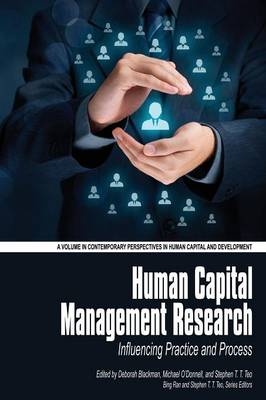
Covering a range of topics which affect the way that human capital is attracted, developed, managed and supported, this book presents recent research which can be applied to the real world. Written by practitioners with academics, each chapter provides an overview of the research, as well as the links to current human capital management practices and identifying potential implications for future implementation. The book is designed to be of interest to academic researchers, university professors and graduate students, and to management scientists, industry economists, government officials, public policy developers and analysts, research and laboratory managers, marketing, human resources and operations managers, in fact anyone who is interested at understanding the current progress of human resources management and human capital development.
When reading current human capital management or human resources management textbooks, it is clear that many do not reflect current research. Even new Strategic HRM books are only recently reporting research that has been widely discussed in academic journals over the last 10 years. Discussion with those who span the academic/practice worlds shows that they have regularly been struck by the dissonance between the journals and the texts. They agree that there should be more commonality but suggest that, although some of the HRM journal articles may carry some implications for practice, many do not. They are often vague as to the real potential value of the research and only outline potential interventions in a very rudimentary way.Covering a range of topics which affect the way that human capital is attracted, developed, managed and supported, this book presents recent research which can be applied to the real world. Written by practitioners with academics, each chapter provides an overview of the research, as well as the links to current human capital management practices and identifying potential implications for future implementation. The book is designed to be of interest to academic researchers, university professors and graduate students, and to management scientists, industry economists, government officials, public policy developers and analysts, research and laboratory managers, marketing, human resources and operations managers, in fact anyone who is interested at understanding the current progress of human resources management and human capital development.
Front Cover
1
Human Capital Management Research 2
Influencing Practice and Process 2
A Volume in Contemporary Perspectives in Human Capital and Development 2
Series Editors: 2
Bing Ran, Penn State Harrisburg Stephen T. T. Teo, RMIT University, Australia 2
CONTENTS 6
1. Is There a New Path to Advancing the Art and Science of Management? 6
2. Not so “Secondary” Data—The Use of Staff Surveys in Human Capital Management Research 6
3. Employee Engagement in the Public Sector: What Needs to Change 6
4. Employee Commitment to the Supervisor: The Role of Side Bets 6
5. A Three-Stage Approach for the Diagnosis and Reduction of Employee Turnover 6
6. Recruiting for Commitment and Performance 6
7. Technology-Based Training: Connecting HR Research With HR Practice 6
8. Current Themes in Behavioral Business Ethics: Implications for Human Resources Training and Development 7
9. Performance Management: Common Practice, Unique Practice, and Effective Practice 7
10. Performance Management as a Strategic Tool for Change 7
11. Conclusion: Where to From Here? 7
Contemporary Perspectives in Human Capital and Development 3
Human Capital Management Research 4
Influencing Practice and Process 4
Edited by 4
Deborah Blackman University of New South Wales 4
Michael O’Donnell University of New South Wales 4
and 4
Stephen T. T. Teo RMIT University, Australia 4
Information Age Publishing, Inc. 4
Charlotte, North Carolina • www.infoagepub.com 4
Preface to the Series 8
Bing Ran and Stephen T. T. Teo 8
Introduction 10
Deborah Blackman, Michael O’Donnell, and Stephen T. T. Teo 10
NOTE 16
References 16
CHAPTER 1 18
Is There a New Path to Advancing the Art and Science of Management? 18
David Schmidtchen 18
WHAT MIGHT WE DO TOGETHER TO IMPROVE THE SITUATION? 26
References 28
CHAPTER 2 30
Not so “Secondary” Data 30
Tony Cotton, Alastair Warren, and Deborah Blackman 30
Surveys of staff 31
STAFF SURVEYS 34
PRIMARY OR SECONDARY DATA— OR SOMETHING ALTOGETHER DIFFERENT? 37
THE AUSTRALIAN PUBLIC SERVICE CENSUS 38
CASE STUDY—THE DEVELOPMENT OF THE APS EMPLOYEE ENGAGEMENT MODEL 39
CASE STUDY: MEASURING APS CULTURE 41
Conclusion 43
NOTE 44
REFERENCES 44
CHAPTER 3 48
Employee Engagement in the Public Sector 48
Natalie Jones and Sally Sambrook 48
THE PUBLIC SECTOR 49
ACADEMIC RESEARCH ON EMPLOYEE ENGAGEMENT 49
Definitions 50
How We Know About Employee Engagement 51
What Do We Know About Employment Engagement in the Public Sector? 51
Our Research on the Practice of Employee Engagement in the Public Sector 52
Figure 3. 1. EE practices in the public sector: Observed and reported, 2010-2011 53
What needs to change about employee engagement in practice? 55
Conclusion 59
NOTE 60
References 60
Table 3.1. Autoethnography-Inspired Employee Engagement in the Public Sector 58
Figure 4. 1. Two step side-bet process impacting employee-commitment. 71
CHAPTER 4 64
Employee Commitment to the Supervisor 64
Damian West 64
WHAT IS KNOWN? 65
Location of the Research 66
HOW IS EMPLOYEE COMMITMENT DEVELOPED? 67
EMPLOYEES INVEST THEIR TIME TO BUILD A RELATIONSHIP 69
THE IMPACT OF FRACTURING THE EMPLOYEE-SUPERVISOR RELATIONSHIP 72
SIDE BET REEMERGE IF THE EMPLOYEE RELINKS 74
INVESTING IN THE FUTURE 74
CONCLUSION 76
References 77
Table 5.1. Prototypes Associated With the Unfolding Model’s Pathways 82
CHAPTER 5 80
A Three-Stage Approach for the Diagnosis and Reduction of Employee Turnover 80
Gerrit J. M. Treuren and Julie Goods 80
Introduction 80
Why Do people Leave? The Unfolding Theory of Turnover 81
Shocks, Plans, and Image Violation 81
Separation Paths 83
Why do People Stay? Job Embeddedness Theory 85
Ready to Leave or Wanting to Stay? Employee Proximal Withdrawal States 87
Integrating UFT, JET and Proximal Withdrawal State Into a Retention Strategy 90
Stage 1: Diagnosing an Organization’s Turnover 91
Stage 2: Surveying for Employee Embeddedness 93
Stage 3: The “Staying Interview” 94
The Three Stages Together or Separately 95
References 95
Table 5.2. Length of Service and Time Taken to Decide to Leave, in Months and Pathway 84
Figure 5. 1. Employee embeddedness as a buffer to shock, dissatisfaction, and plan. 86
Figure 5. 2. Employee organizational embeddedness (OE) as a buffer to the negative effect of psychological contract breach (PCB) on leaving intention. 86
Table 5.3. Management Activities Aimed at Increasing Embeddedness 88
Table 5.4. Employee Embeddedness Scores 88
Table 5.5. Employee Withdrawal States 89
Table 5.6. Employee Withdrawal States in Five Organizations (%) 89
Table 5.7. Employer Risk and Management Response 90
Table 5.8. Percentage of Proximal Withdrawal State Cohort in 2011 and 2012 who had Left by 2014 and Selected Attitudinal Scores 91
Figure 5. 3. Three stages of diagnosis and reduction of turnover. 91
CHAPTER 6 98
Recruiting for Commitment and Performance 98
Samantha Johnson 98
THE STATE OF ORGANIZATIONAL COMMITMENT: A DEFINITION 99
Commitment Profiles 100
THE LINK BETWEEN COMMITMENT AND PERFORMANCE 101
COMMITMENT, PERFORMANCE AND HRM PRACTICES 101
Methodology 102
1. What levels of continuance commitment are experienced by a group of Australian federal public servants? 103
2. In what way, if any, does continuance commitment differ for this group of public service employees? 103
3. What implications are evident for HRM practices in the Australian public sector context? 103
WHAT COMMITMENT LOOKED LIKE IN THIS SETTING 104
IDENTIFICATION OF A UNIQUE COMMITMENT PROFILE 105
Organizational commitment and performance— linked to large-scale recruitment 106
RECRUITMENT AS AN INFLUENCE ON COMMITMENT 107
Conclusion 110
References 111
Table 7.1. Learning Objectives 125
Table 7.1. (Continued) 126
CHAPTER 7 116
Technology-Based Training 116
Adam M. Kanar, Matisha Montgomery, Rebecca L. Fraser, and Tara S. Behrend 116
TBT DESIGN: THEORY VERSUS PRACTICE 118
Theory-based instructional design process 120
CASE STUDY 123
NEEDS ASSESSMENT 123
COURSE DESIGN AND DEVELOPMENT PROCESS 126
LEVERAGING TECHNOLOGY TO ACHIEVE LEARNING GOALS 127
EFFECTIVENESS OF THE TBT PROGRAM 131
Lessons learned and recommendations for the future 132
References 133
Table 7.2. Course Design Elements 128
Table 7.3. Course Structure 129
CHAPTER 8 134
Current Themes in Behavioral Business Ethics 134
Sheldene Simola 134
WHY BEHAVIORAL BUSINESS ETHICS? 135
RESEARCH IN BEHAVIORAL ETHICS: SOME KEY FINDINGS 136
CONTEXTUAL GUIDELINES FOR HUMAN RESOURCES TRAINING AND DEVELOPMENT 141
Contextual Guidelines 141
1. In order for the positive effects of ethics-related training and development to be fully realized, the organization itself must be committed to an ethical culture. If ethics are peripheral rather than central to organizational strategy, then ethic... 141
2. In terms of actual implementation of ethics-related training and development, it should be noted that one size does not fit all (Garavan & McGuire, 2010). Rather, different HR roles and approaches might emerge through consideration of a range of v...
3. A needs assessment is often a useful starting point. Although research within behavioral ethics suggests various areas on which training and development initiatives might fruitfully focus, it is also important to understand the unique concerns and... 142
4. Include information not only on compliance to legal requirements, but also on the use of values in ethical decision making and action. Research on the relationship between employee perceptions of training program orientations and employee attitude... 142
5. Use training and development techniques that are likely to be effective. Although ethics-related training often occurs as part of orientation for new employees (Sekerka, 2009), it has been noted that development of ethics-related skills is often a... 143
6. It is also important to use training that promotes subsequent transfer of newly acquired skills into the actual work of participants. Transfer of training can be facilitated in various ways, including through the use of meta-cognitive strategies i... 143
7. In order to have a strategic impact, outcomes should be assessed (Sloan & Gavin, 2010). However, assessment of outcomes, such as trainee satisfaction, knowledge or skill acquisition, are likely to be insufficient. Rather, assessing the extent to w...
Summary 144
References 144
Table 9.1. Performance Management Practices, Assumptions, and Theories 151
CHAPTER 9 148
Performance Management 148
Alan Colquitt 148
Introduction 148
Research Support—Theories and Assumptions Underlying Performance Management Practices 150
Summary of Research Support 155
Next-Generation Performance Management 156
NGPM Practices 157
CONCLUSION 160
References 160
Table 9.2. The Path to Next Generation Performance Management 157
Table 9.3. Next Generation Performance Management Practices 158
Table 9.3. (Continued) 159
Table 10.1. Case Studies Used in This Study 168
CHAPTER 10 166
Performance Management as a Strategic Tool for Change 166
Deborah Blackman, Fiona Buick, Michael O’Donnell, Janine O’Flynn, and Damian West 166
PERFORMANCE MANAGEMENT AS A HIGH PERFORMANCE WORK CHARACTERISTIC 167
METHODOLOGY 167
DEVELOPING A NEW PERFORMANCE MANAGEMENT FRAMEWORK 169
USING THE PERFORMANCE MANAGEMENT FRAMEWORK 172
Conclusion 177
References 178
Table 10.2. Overall Participant Sample 169
Table 10.3. Illustrative Quotes Developing the Themes 170
2. Lack of clarity regarding what high performance affects change outcomes as: “Change doesn’t seem to be managed that well in terms of people communicating what the objectives are and having that filtered down to staff so that they know what’s... 170
2. “In 20 years, every performance management issue I’ve dealt with, with the exclusion of one or two … have been about complete lack of clarity of what they were supposed to be doing” (Senior manager, F). 170
2. “I’ve had the benefit of working for a really strong [senior executive service] hierarchy, so in developing [performance agreements] we’ve always got the departmental plan and synthesized that down into a cluster plan, synthesized that down ... 170
2. “[I’ve] just been doing that this morning banging my head, just going ‘we can’t just recruit people.’ First of all we’ve got to work out … are they the right people working … but then, having brought them in … we’d just need t...
2. Mutuality enables employees to adapt to change through maintaining awareness of changing priorities: ‘the hypothesis [that] “OK 1 July 2012, 20% cut in resources’ … ‘What are we going to stop doing? What are we going to do differently?... 170
Table 10.3. (Continued) 171
2. Lack of consultation often meant that many employees felt unprepared for the change and as though it was thrust upon them: “What I believe we don’t tend to do is communicate what we know to be indicators of change until the change is almost in... 171
2. “We have to have staff who are agile, who are flexible, who can respond to changed circumstances, particularly novel changed circumstances, in a way that … enables us … to meet the needs of the minister and to meet the needs of the departmen... 171
2. “So, I think we identify the … resting points along the way … you know when you’re hiking up a mountain or something, you stop at a couple of different places and look back to where you’ve come from and you look forward to where you go. ... 171
2. “We sometimes here fall into the trap of too much process to measure what you’re doing, and lose sight of the outcome. So personally I think our current business plan process has set up all these activity plans, and everyone’s got to do a mo... 171
Table 10.3. (Continued) 172
2. “I’ve had several supervisors who are in their 30s maybe, and they just have no … managerial experience. It’s just so obvious to me what they’re lacking. There’s not a system in place to make sure that if someone is in charge of someon... 172
2. “Accepting that that’s the fact that we can’t do all of those things to the extent that we would like … acknowledge the constraints in which we work, and that if we are to be high performing that we are going to need to reprioritize our fo... 172
Figure 10. 1. A framework for performance management. 173
Table 10.4. Explanation of the Principles and Foundations 174
Table 10.4. Explanation of the Principles and Foundations 175
Figure 10. 2. Using the performance management framework as a strategic tool for change. 176
CHAPTER 11 180
Conclusion 180
Deborah Blackman, Michael O’Donnell, and Stephen Teo 180
TYPES OF DATA USED 181
HOW THE RESEARCH IS PRESENTED 181
LEVEL OF COMPLEXITY PRESENTED AROUND A TOPIC 182
THE CONTEXTUAL/PREDICTION DIVIDE 183
WHO ARE THE RESEARCHERS 184
WHERE NEXT? 185
NOTE 185
References 185
About the Contributors 188
Editors 188
CONTRIBUTORS 189
Back Cover
198
| Erscheint lt. Verlag | 1.6.2016 |
|---|---|
| Sprache | englisch |
| Themenwelt | Schulbuch / Wörterbuch ► Lexikon / Chroniken |
| Wirtschaft ► Betriebswirtschaft / Management ► Personalwesen | |
| Wirtschaft ► Betriebswirtschaft / Management ► Unternehmensführung / Management | |
| ISBN-13 | 9781681234663 / 9781681234663 |
| Informationen gemäß Produktsicherheitsverordnung (GPSR) | |
| Haben Sie eine Frage zum Produkt? |
 PDF (Adobe DRM)
Größe: 85,0 MB
Kopierschutz: Adobe-DRM
Adobe-DRM ist ein Kopierschutz, der das eBook vor Mißbrauch schützen soll. Dabei wird das eBook bereits beim Download auf Ihre persönliche Adobe-ID autorisiert. Lesen können Sie das eBook dann nur auf den Geräten, welche ebenfalls auf Ihre Adobe-ID registriert sind.
Details zum Adobe-DRM
Dateiformat: PDF (Portable Document Format)
Mit einem festen Seitenlayout eignet sich die PDF besonders für Fachbücher mit Spalten, Tabellen und Abbildungen. Eine PDF kann auf fast allen Geräten angezeigt werden, ist aber für kleine Displays (Smartphone, eReader) nur eingeschränkt geeignet.
Systemvoraussetzungen:
PC/Mac: Mit einem PC oder Mac können Sie dieses eBook lesen. Sie benötigen eine
eReader: Dieses eBook kann mit (fast) allen eBook-Readern gelesen werden. Mit dem amazon-Kindle ist es aber nicht kompatibel.
Smartphone/Tablet: Egal ob Apple oder Android, dieses eBook können Sie lesen. Sie benötigen eine
Geräteliste und zusätzliche Hinweise
Zusätzliches Feature: Online Lesen
Dieses eBook können Sie zusätzlich zum Download auch online im Webbrowser lesen.
Buying eBooks from abroad
For tax law reasons we can sell eBooks just within Germany and Switzerland. Regrettably we cannot fulfill eBook-orders from other countries.
 EPUB (Adobe DRM)
Kopierschutz: Adobe-DRM
Adobe-DRM ist ein Kopierschutz, der das eBook vor Mißbrauch schützen soll. Dabei wird das eBook bereits beim Download auf Ihre persönliche Adobe-ID autorisiert. Lesen können Sie das eBook dann nur auf den Geräten, welche ebenfalls auf Ihre Adobe-ID registriert sind.
Details zum Adobe-DRM
Dateiformat: EPUB (Electronic Publication)
EPUB ist ein offener Standard für eBooks und eignet sich besonders zur Darstellung von Belletristik und Sachbüchern. Der Fließtext wird dynamisch an die Display- und Schriftgröße angepasst. Auch für mobile Lesegeräte ist EPUB daher gut geeignet.
Systemvoraussetzungen:
PC/Mac: Mit einem PC oder Mac können Sie dieses eBook lesen. Sie benötigen eine
eReader: Dieses eBook kann mit (fast) allen eBook-Readern gelesen werden. Mit dem amazon-Kindle ist es aber nicht kompatibel.
Smartphone/Tablet: Egal ob Apple oder Android, dieses eBook können Sie lesen. Sie benötigen eine
Geräteliste und zusätzliche Hinweise
Buying eBooks from abroad
For tax law reasons we can sell eBooks just within Germany and Switzerland. Regrettably we cannot fulfill eBook-orders from other countries.
aus dem Bereich