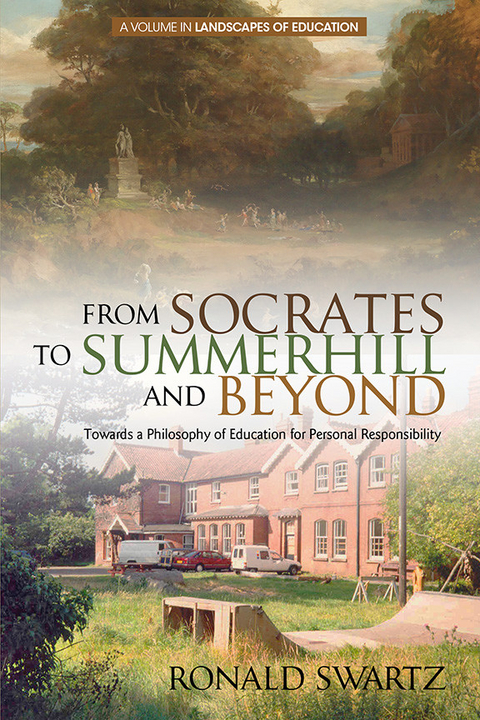
In providing an historical and philosophical understanding of Summerhill style schools, Swartz suggests that these educational alternatives have intellectual roots in the ideas associated with Socrates as portrayed in Plato’s Apology. Specifically, in personal responsibility schools teachers are not viewed as authorities who attempt to transmit wisdom to their students. Rather, self?governing schools follow the Socratic tradition which claims that teachers can be viewed as fallible authorities who attempt to engage students in dialogues about questions of interest to students. The interpretation of Plato’s works used by Swartz can be found in Karl Popper’s The Open Society and Its Enemies. Swartz has also been significantly influenced by the educational writings of Bertrand Russell and Paul Goodman. Goodman’s Compulsory Miseducation makes it clear that schools which follow in the tradition of Summerhill compete with the educational programs that are an outgrowth of John Dewey’s writings.
In summary, Swartz’s book aims to engage educators in dialogues that will lead to improved educational theories and practices.
In From Socrates to Summerhill and Beyond: Towards a Philosophy of Education for Personal Responsibility, Ronald Swartz offers an evolving development of fallible, liberal democratic, selfgoverning educational philosophies. He suggests that educators can benefit from having dialogues about questions such as these: 1). Are there some authorities that can be consistently relied upon to tell school members what they should do and learn while they are in school? 2.) How should the imagination of social theorists be both used and checked in the development and implementation of innovative educational reforms? 3.) How can teachers in personal responsibility schools help their students learn? These questions are representative of problems that Swartz raises in his book.Swartz identifies four educational programs as personal responsibility schools. These are Little Commonwealth (Homer Lane); Summerhill (A.S.Neill); Orphans Home (Janusz Korczak) and Sudbury Valley School (Daniel Greenberg). Swartz then suggests that these learning environments create social institutions that are liberal, democratic, and selfgoverning and therefore endorse the policy of personal responsibility. This policy states: All school members, students included, are fallible authorities who should be personally responsible for determining their own school activities and many policies that govern a school. Schools which incorporate this policy can interchangeably be referred to as personal responsibility, selfgoverning, or Summerhill style schools.In providing an historical and philosophical understanding of Summerhill style schools, Swartz suggests that these educational alternatives have intellectual roots in the ideas associated with Socrates as portrayed in Plato's Apology. Specifically, in personal responsibility schools teachers are not viewed as authorities who attempt to transmit wisdom to their students. Rather, selfgoverning schools follow the Socratic tradition which claims that teachers can be viewed as fallible authorities who attempt to engage students in dialogues about questions of interest to students. The interpretation of Plato's works used by Swartz can be found in Karl Popper's The Open Society and Its Enemies. Swartz has also been significantly influenced by the educational writings of Bertrand Russell and Paul Goodman. Goodman's Compulsory Miseducation makes it clear that schools which follow in the tradition of Summerhill compete with the educational programs that are an outgrowth of John Dewey's writings.In summary, Swartz's book aims to engage educators in dialogues that will lead to improved educational theories and practices.
Cover 1
Series page 2
From Socrates to Summerhill and Beyond 4
Library of Congress Cataloging-in-Publication Data 5
Dedication 6
Contents 8
Series Foreword 12
Acknowledgment 18
PART I: Introduction 20
Chapter 1: Towards an Educational Philosophy of Personal Responsibility 22
PART II: Dewey Studies 28
Chapter 2: John Dewey and Homer Lane 30
Chapter 3: Dewey and Popper on Learning from Induction 44
Chapter 4: Some Possible Educational Implications From the Dewey, Russell, and Popper Dialogue on Learning from Induction 70
Chapter 5: Doing Dewey Again and Again 74
PART III: Socratic Studies 90
Chapter 6: Education for Freedom from Socrates to Einstein and Beyond 92
Chapter 7: Paul Goodman as a Twentieth Century Advocate of a Socratic Educational Philosophy 110
Chapter 8: Homer Lane as a Socratic Education Reformer 124
Chapter 9: Homer Lane and Paul Goodman 128
PART IV: Curriculum Studies 142
Chapter 10: Student Choices and a Standardized Curriculum Reconsidered 144
Chapter 11: On Granting Academic Freedom 154
Chapter 12: Responsibility, Reading, and Schooling 174
Chapter 13: Learning About AIDS 182
Chapter 14: Reconsidering the Prescribed Curriculum 188
PART V: Model Programs 198
Chapter 15: Education as Entertainment and Irresponsibility in the Classroom 200
Chapter 16: Schooling and Responsibility 208
Chapter 17: Summerhill Revisited 214
Chapter 18: A. S. Neill’s Quest for Autonomy 230
Chapter 19: Homer Lane’s Lost Influence on Western Thought 234
Chapter 20: Janusz Korczak and Self-Governing Schools in the Twentieth Century 244
Chapter 21: On Why Self-Government Failed at Bronson Alcott’s Temple School 260
PART VI: Learning Strategies 272
Chapter 22: Alternative Learning Strategies as Part of the Educational Process 274
Chapter 23: Mistakes as an Important Part of the Learning Process 288
Chapter 24: Problems and Their Possible Uses in Educational Programs 298
Chapter 25: Induction as an Obstacle for the Improvement of Human Knowledge 310
PART VII: Liberalism in Education 320
Chapter 26: Toward a Liberal View of Educational Authorities 322
Chapter 27: Liberalism, Radicalism and Self-Governing Schools 348
Chapter 28: Liberalism and Imaginative Education Reforms 362
PART VIII: Afterthoughts 374
Chapter 29: Three Women from Guizhou 376
Chapter 30: A Caveman’s Nightmare 378
Chapter 31: The Practitioner’s Dilemma—Bridging the Gap Between Theory and Practice 382
Chapter 32: Johnny Doody Rides Again 386
Chapter 33: Berkeley, Kent State, and Paul Goodman in Retrospect 388
Chapter 34: Educating Elites in Democratic Society 392
Chapter 35: A Dialogue on Education for Autonomy—An Interview 402
Chapter 36: A Postscript to Education for Autonomy 422
Chapter 37: Educating Teachers in Democratic Societies 428
Chapter 38: More on the Schools We Deserve 438
APPENDIX: Bibliography of Swartz’s Publications Included in This Book 452
References 456
| Erscheint lt. Verlag | 1.6.2016 |
|---|---|
| Sprache | englisch |
| Themenwelt | Schulbuch / Wörterbuch ► Lexikon / Chroniken |
| Geisteswissenschaften | |
| Sozialwissenschaften ► Pädagogik ► Allgemeines / Lexika | |
| Sozialwissenschaften ► Pädagogik ► Bildungstheorie | |
| ISBN-10 | 1-68123-554-4 / 1681235544 |
| ISBN-13 | 978-1-68123-554-7 / 9781681235547 |
| Informationen gemäß Produktsicherheitsverordnung (GPSR) | |
| Haben Sie eine Frage zum Produkt? |
 PDF (Adobe DRM)
Größe: 4,1 MB
Kopierschutz: Adobe-DRM
Adobe-DRM ist ein Kopierschutz, der das eBook vor Mißbrauch schützen soll. Dabei wird das eBook bereits beim Download auf Ihre persönliche Adobe-ID autorisiert. Lesen können Sie das eBook dann nur auf den Geräten, welche ebenfalls auf Ihre Adobe-ID registriert sind.
Details zum Adobe-DRM
Dateiformat: PDF (Portable Document Format)
Mit einem festen Seitenlayout eignet sich die PDF besonders für Fachbücher mit Spalten, Tabellen und Abbildungen. Eine PDF kann auf fast allen Geräten angezeigt werden, ist aber für kleine Displays (Smartphone, eReader) nur eingeschränkt geeignet.
Systemvoraussetzungen:
PC/Mac: Mit einem PC oder Mac können Sie dieses eBook lesen. Sie benötigen eine
eReader: Dieses eBook kann mit (fast) allen eBook-Readern gelesen werden. Mit dem amazon-Kindle ist es aber nicht kompatibel.
Smartphone/Tablet: Egal ob Apple oder Android, dieses eBook können Sie lesen. Sie benötigen eine
Geräteliste und zusätzliche Hinweise
Zusätzliches Feature: Online Lesen
Dieses eBook können Sie zusätzlich zum Download auch online im Webbrowser lesen.
Buying eBooks from abroad
For tax law reasons we can sell eBooks just within Germany and Switzerland. Regrettably we cannot fulfill eBook-orders from other countries.
 EPUB (Adobe DRM)
Kopierschutz: Adobe-DRM
Adobe-DRM ist ein Kopierschutz, der das eBook vor Mißbrauch schützen soll. Dabei wird das eBook bereits beim Download auf Ihre persönliche Adobe-ID autorisiert. Lesen können Sie das eBook dann nur auf den Geräten, welche ebenfalls auf Ihre Adobe-ID registriert sind.
Details zum Adobe-DRM
Dateiformat: EPUB (Electronic Publication)
EPUB ist ein offener Standard für eBooks und eignet sich besonders zur Darstellung von Belletristik und Sachbüchern. Der Fließtext wird dynamisch an die Display- und Schriftgröße angepasst. Auch für mobile Lesegeräte ist EPUB daher gut geeignet.
Systemvoraussetzungen:
PC/Mac: Mit einem PC oder Mac können Sie dieses eBook lesen. Sie benötigen eine
eReader: Dieses eBook kann mit (fast) allen eBook-Readern gelesen werden. Mit dem amazon-Kindle ist es aber nicht kompatibel.
Smartphone/Tablet: Egal ob Apple oder Android, dieses eBook können Sie lesen. Sie benötigen eine
Geräteliste und zusätzliche Hinweise
Buying eBooks from abroad
For tax law reasons we can sell eBooks just within Germany and Switzerland. Regrettably we cannot fulfill eBook-orders from other countries.
aus dem Bereich