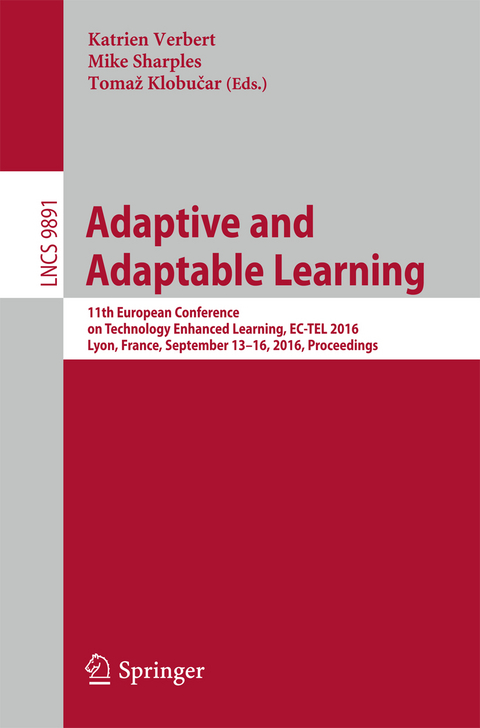
Adaptive and Adaptable Learning
Springer International Publishing (Verlag)
978-3-319-45152-7 (ISBN)
The 26 full papers, 23 short papers, 8 demo papers, and 33 poster papers presented in this volume were carefully reviewed and selected from 148 submissions.
Full Papers.- A semantic-driven model for ranking digital learning objects based on diversity in the user comments.- Social Facilitation due to online inter-classrooms Tournaments.- How to Attract Students' Visual Attention.- Creating Effective Learning Analytics Dashboards: Lessons Learnt.- Retrieval Practice and Study Planning in MOOCs: Exploring Classroom-Based Self-Regulated Learning Strategies at Scale.- "Keep your eyes on 'em all!": A mobile eye-tracking analysis of teachers' sensitivity to students.- Flipped Classroom Model: Effects on Performance, Attitudes and Perceptions in High School Algebra.- Argumentation Identification for Academic Support in Undergraduate Writings.- Mobile Grading Paper-based Programming Exams: Automatic Semantic Partial Credit Assignment Approach.- Which Algorithms Suit Which Learning Environments? A Comparative Study of Recommender Systems in TEL.- Discouraging Gaming the System through Interventions of an Animated Pedagogical Agent.- Multi-Device Territoriality to Support Collaborative Activities -Implementation and Findings from the e-learning Domain.- Refinement of a Q-matrix with an ensemble technique based on multi-label classification algorithms.- When teaching practices meet tablets' affordances. Insights on the materiality of learning.- A Peer Evaluation tool of Learning Designs.- Learning in the context of ManuSkills: Attracting Youth to Manufacturing through TEL.- Does taking a MOOC as a complement for remedial courses have an effect on my learning outcomes? A pilot study on calculus.- Are you ready to collaborate? An adaptive measurement of students arguing skills before expecting them to learn together.- Examining the effects of social media in co-located classrooms: A case study based on SpeakUp.- Enhancing public speaking skills- an evaluation of the Presentation Trainer in the wild.- How to quantify student's regularity? Nurturing communities of inquiry: A formative study of the DojoIBL platform.- Inferring student attention with ASQ.- Chronicle of a scenario graph: from expected to observed learning path.- Adaptive Testing using a General Diagnostic Model.- How Teachers Use Data to Help Students Learn: Contextual Inquiry for the Design Of a Dashboard.- Short Papers.- Assessing learner-constructed conceptual models and simulations of dynamic systems.- Learning Analytics pilot with COACH2 - Searching for effective mirroring.- Predicting Academic Performance Based on Students' Blog and Microblog Posts.- Take up my Tags: Exploring Benefits of Meaning Making in a Collaborative Learning Task at the Workplace.- Consistency verification of learner profiles in adaptive serious games.- MoodlePeers: Factors relevant in learning group formation for improved learning outcomes, satisfaction and commitment in E-learning scenarios using GroupAL.- Towards a capitalization of processes analyzing interaction traces.- Improving usage of learning designs by teachers: a set of concepts for well-defined problems resolution.- Immersion and Persistence: Improving Learners' Engagement in Authentic Learning Situations.- STI-DICO: a Web-Based ITS for Fostering Dictionary Skills and Knowledge.- PyramidApp: Scalable Method Enabling Collaboration in the Classroom.- From Idea to Reality: Extensive and Executable Modeling Language for Mobile Learning Games.- Combining adaptive learning with learning analytics: precedents and directions.- An Adaptive E-learning Strategy to Overcome the Inherent Difficulties of the Learning Content.- Evaluating the effectiveness of an affective tutoring agent in specialized education.- MOOC design workshop: educational innovation with empathy and intent.- OERauthors: Requirements for collaborative OER authoring tools in global settings.- Virtual Reality for Training Doctors to Break Bad News.- User Motivation & Technology Acceptance in Online Learning Environments.- Reflective learning at the workplace - The MIRROR design toolbox.- Toward a Play Management System for Pla
| Erscheinungsdatum | 11.10.2016 |
|---|---|
| Reihe/Serie | Information Systems and Applications, incl. Internet/Web, and HCI | Lecture Notes in Computer Science |
| Zusatzinfo | XX, 686 p. 177 illus. |
| Verlagsort | Cham |
| Sprache | englisch |
| Maße | 155 x 235 mm |
| Themenwelt | Schulbuch / Wörterbuch ► Unterrichtsvorbereitung ► Unterrichts-Handreichungen |
| Mathematik / Informatik ► Informatik | |
| Schlagworte | Applications • Artificial Intelligence • Collaborative Learning • Computer aided instruction • Computers and education • Computer Science • conference proceedings • Education • Educational equipment and technology, computer-aid • E-Learning • Human-Computer Interaction (HCI) • Informatics • Information Retrieval • intelligent tutoring system • Learning Analytics • Learning Design • learning experience • machine learning • Massive Open Online Course (MOOC) • Mobile Devices • Mobile Learning • Recommender Systems • Research • Semantics • Serious Games • Social Media • web applications |
| ISBN-10 | 3-319-45152-9 / 3319451529 |
| ISBN-13 | 978-3-319-45152-7 / 9783319451527 |
| Zustand | Neuware |
| Informationen gemäß Produktsicherheitsverordnung (GPSR) | |
| Haben Sie eine Frage zum Produkt? |
aus dem Bereich