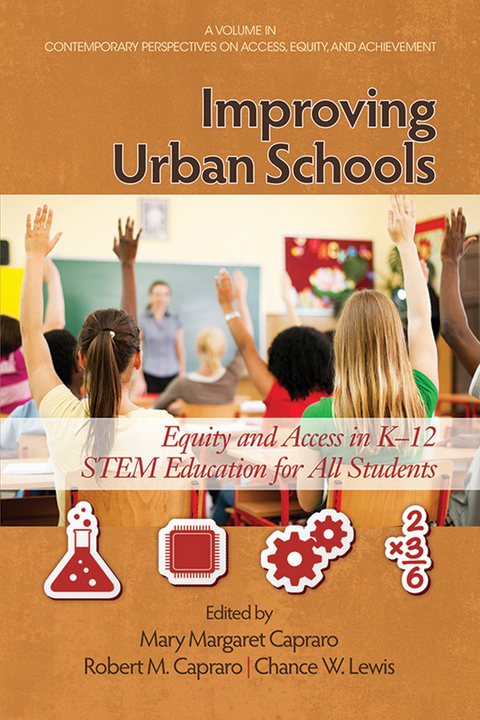
Although STEM (Science, Technology, Engineering, and Mathematics) has been diversely defined by various researchers (e.g. Buck Institute, 2003; Capraro & Slough, 2009; Scott, 2009; Wolf, 2008), during the last decade, STEM education has gained an increasing presence on the national agenda through initiatives from the National Science Foundation (NSF) and the Institute for Educational Sciences (IES). The rate of technological innovation and change has been tremendous over the past ten years, and this rapid increase will only continue. STEM literacy is the power to 'identify, apply, and integrate concepts from science, technology, engineering, and mathematics to understand complex problems and to innovate to solve them' (Washington State STEM, 2011, Internet). In order for U.S. students to be on the forefront of this revolution, ALL of our schools need to be part of the STEM vision and guide students in acquiring STEM literacy. Understanding and addressing the challenge of achieving STEM literacy for ALL students begins with an understanding of its element and the connections between them. In order to remain competitive, the Committee on Prospering in the Global Economy has recommended that the US optimize 'its knowledge-based resources, particularly in science and technology' (National Academies, 2007, p. 4). Optimizing knowledge-based resources needs to be the goal but is also a challenge for ALL educators (Scheurich & Huggins, 2009). Regardless, there is little disagreement that contemporary society is increasingly dependent on science, technology, engineering, and mathematics and thus comprehensive understandings are essential for those pursuing STEM careers. It is also generally agreed that PK-12 students do not do well in STEM areas, both in terms of national standards and in terms of international comparisons (Kuenzi, Matthews, & Mangan, 2006; Capraro, Capraro, Yetkiner, Corlu, Ozel, Ye, & Kim, 2011). The question then becomes what might PK-12 schools do to improve teachers' and students' STEM knowledge and skills? This book will look at equity and access issues in STEM education from PK-12, university, and administrative and policy lenses.
| Erscheint lt. Verlag | 24.6.2013 |
|---|---|
| Sprache | englisch |
| Themenwelt | Schulbuch / Wörterbuch ► Lexikon / Chroniken |
| Geisteswissenschaften | |
| Sozialwissenschaften ► Pädagogik ► Erwachsenenbildung | |
| Sozialwissenschaften ► Pädagogik ► Schulpädagogik / Sekundarstufe I+II | |
| Sozialwissenschaften ► Soziologie ► Empirische Sozialforschung | |
| ISBN-10 | 1-62396-232-3 / 1623962323 |
| ISBN-13 | 978-1-62396-232-6 / 9781623962326 |
| Informationen gemäß Produktsicherheitsverordnung (GPSR) | |
| Haben Sie eine Frage zum Produkt? |
 PDF (Adobe DRM)
Größe: 4,9 MB
Kopierschutz: Adobe-DRM
Adobe-DRM ist ein Kopierschutz, der das eBook vor Mißbrauch schützen soll. Dabei wird das eBook bereits beim Download auf Ihre persönliche Adobe-ID autorisiert. Lesen können Sie das eBook dann nur auf den Geräten, welche ebenfalls auf Ihre Adobe-ID registriert sind.
Details zum Adobe-DRM
Dateiformat: PDF (Portable Document Format)
Mit einem festen Seitenlayout eignet sich die PDF besonders für Fachbücher mit Spalten, Tabellen und Abbildungen. Eine PDF kann auf fast allen Geräten angezeigt werden, ist aber für kleine Displays (Smartphone, eReader) nur eingeschränkt geeignet.
Systemvoraussetzungen:
PC/Mac: Mit einem PC oder Mac können Sie dieses eBook lesen. Sie benötigen eine
eReader: Dieses eBook kann mit (fast) allen eBook-Readern gelesen werden. Mit dem amazon-Kindle ist es aber nicht kompatibel.
Smartphone/Tablet: Egal ob Apple oder Android, dieses eBook können Sie lesen. Sie benötigen eine
Geräteliste und zusätzliche Hinweise
Buying eBooks from abroad
For tax law reasons we can sell eBooks just within Germany and Switzerland. Regrettably we cannot fulfill eBook-orders from other countries.
 EPUB (Adobe DRM)
Kopierschutz: Adobe-DRM
Adobe-DRM ist ein Kopierschutz, der das eBook vor Mißbrauch schützen soll. Dabei wird das eBook bereits beim Download auf Ihre persönliche Adobe-ID autorisiert. Lesen können Sie das eBook dann nur auf den Geräten, welche ebenfalls auf Ihre Adobe-ID registriert sind.
Details zum Adobe-DRM
Dateiformat: EPUB (Electronic Publication)
EPUB ist ein offener Standard für eBooks und eignet sich besonders zur Darstellung von Belletristik und Sachbüchern. Der Fließtext wird dynamisch an die Display- und Schriftgröße angepasst. Auch für mobile Lesegeräte ist EPUB daher gut geeignet.
Systemvoraussetzungen:
PC/Mac: Mit einem PC oder Mac können Sie dieses eBook lesen. Sie benötigen eine
eReader: Dieses eBook kann mit (fast) allen eBook-Readern gelesen werden. Mit dem amazon-Kindle ist es aber nicht kompatibel.
Smartphone/Tablet: Egal ob Apple oder Android, dieses eBook können Sie lesen. Sie benötigen eine
Geräteliste und zusätzliche Hinweise
Buying eBooks from abroad
For tax law reasons we can sell eBooks just within Germany and Switzerland. Regrettably we cannot fulfill eBook-orders from other countries.
aus dem Bereich