


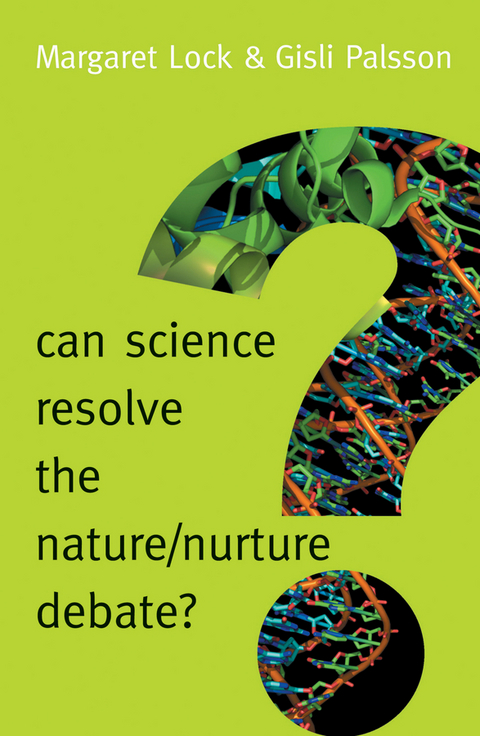
Can Science Resolve the Nature / Nurture Debate? (eBook)
John Wiley & Sons (Verlag)
978-0-7456-9000-1 (ISBN)
Since the 1950s, the new science of epigenetics has demonstrated how cellular environments and certain experiences and behaviors influence gene expression at the molecular level, with significant implications for health and wellbeing. To the amazement of scientists, mapping the human genome indirectly supported these insights. Anthropologists Margaret Lock and Gisli Palsson outline vituperative arguments from Classical times about the relationship between nature and nurture, furthered today by epigenetic findings and the demonstration of a 'reactive genome.' The nature/nurture debate, they show, can never be put to rest, because these concepts are in constant flux in response to the new insights science continually offers.
Margaret Lock is Marjorie Bronfman Professor Emerita in Social Studies of Medicine at McGill University
Gisli Palsson is Professor of Anthropology at the University of Iceland
Following centuries of debate about "e;nature and nurture"e; the discovery of DNA established the idea that nature (genes) determines who we are, relegating nurture (environment) to icing on the cake. Since the 1950s, the new science of epigenetics has demonstrated how cellular environments and certain experiences and behaviors influence gene expression at the molecular level, with significant implications for health and wellbeing. To the amazement of scientists, mapping the human genome indirectly supported these insights. Anthropologists Margaret Lock and Gisli Palsson outline vituperative arguments from Classical times about the relationship between nature and nurture, furthered today by epigenetic findings and the demonstration of a "e;reactive genome."e; The nature/nurture debate, they show, can never be put to rest, because these concepts are in constant flux in response to the new insights science continually offers.
Margaret Lock is Marjorie Bronfman Professor Emerita in Social Studies of Medicine at McGill University Gisli Palsson is Professor of Anthropology at the University of Iceland
Preamble: Beyond the Molecular Vision of Life
1. Moveable Concepts: Nature and Nurture
2. Promotion and Demotion of the Gene
3. Reinstating Nurture: From Opposition to Commingling
4. Accruing Biosocial Momentum
5. Biopolitics for the Future
"We know that nature and nurture are entwined, but we often overlook the fact that neither science nor the humanities alone can resolve the nature/nurture debate. This accessible and clever book introduces the reader to recent discoveries in epigenetics and shows how the new horizons and hopes opened up by this field entail new responsibilities and new types of vigilance."
Eva Jablonka, Tel Aviv University
"A cool appraisal of a turbulent field, this fine book exposes an unfolding saga of interdisciplinary dimensions. A radical shift is emerging in the conceptualization of the human body and its environment: the authors' state-of-the-art climax is a message for everyone."
Marilyn Strathern, Girton College, Cambridge
"Lock and Palsson reaffirm their critique of the dualistic thinking that has prevailed in the past two hundred years. The reader is left with the firm understanding that the biochemical promise of gene therapy is empty if it is not undertaken in tandem with measures to improve the nurturing role of the social and physical environment. [...] It offers an all too brief but wonderful historical and contemporary overview of the nature/nurture debate from both perspectives and touches on some other interesting topics in the history of science."
Anthropological Forum
"Beautifully written and elegantly argued, Margaret Lock and Gísli Pálsson's reconstruction of the nature/nurture debate is a bright, very accessible introduction to a much-discussed topic."
Journal of the Royal Anthropological Institute
preamble
Beyond the Molecular Vision of Life
Numerous people take it for granted today that genes cause certain kinds of developmental problems and diseases. Down syndrome comes to mind, as do images of Stephen Hawking wheelchair-bound with motor neuron disease. But these same people assume that, in addition to genes, lifestyle and environment are implicated to varying degrees in conditions such as heart and lung diseases, asthma, obesity, and diabetes. In other words, poor habits and toxic environments somehow interact with genes, with negative consequences. Researchers are likely to express this situation in terms of the percentage input from genes and environment respectively involved in any given condition. Conversely, “healthy” lifestyles and environments can be protective.
The burgeoning field of epigenetics challenges received wisdom about the relationship – and relative importance – of genes and environment, nature and nurture. From the early twentieth century, following recognition of the significance of Gregor Mendel's work on pea plants, an assumption gradually took hold among numerous geneticists that genes fully account for human biology and behavior. This position was consistently countered for the next few decades by researchers who argued that human behavioral traits develop almost exclusively from environmental influences, following John Locke's late seventeenth-century idea of a tabula rasa. However, the demonstration of the existence of DNA and its helical structure in the 1950s ensured that genetic determinism under the designation of “The New Synthesis” was rapidly consolidated as the dominant approach to understanding life itself.
Massive infusions of money were put into research in genetics, and critics of gene-centrism, biologists and social scientists alike, of whom there were a good number, were largely ignored. Now epigeneticists have added a strong voice to this critique, one grounded in molecular biology, and the century-long assumption, held by numerous scientists, that genes are the controlling force of life has been badly shaken by these claims to the contrary.
Epigenetics literally means “over or above genetics,” but its concise meaning changes and becomes further elaborated as new discoveries come to light. A few years ago, scientists in the expanding subfield of behavioral epigenetics claimed that they had uncovered molecular links between nature and nurture, that is, evidence that nature/nurture is not divisible. This assertion was based on research demonstrating how environmental stimuli and stressors originating externally and internally to the body initiate trains of molecular activity that modifies how DNA functions during individual development, at times with life-long effects on human behavior and wellbeing. The epigenetic mechanism best researched to date is methylation, a process initiated by enzymes in which DNA sequences are not changed, but one nucleotide, cytosine, is converted to 5-methylcytocine, resulting in changes to the shape or character of the nucleotide base, thus rendering a portion of DNA inactive. Protein methylation also takes place. Animal research has shown that methylation modifications can even be transmitted intergenerationally.
Debates about the locus of responsibility for malaise and disease, policy making relating to human wellbeing, and discussion about social justice in connection with healthcare are increasingly taking epigenetic findings into consideration, a move that will have wide-ranging social and political consequences.
The ubiquity of hype
In the first years of the twenty-first century, when mapping the human genome was close to completion, many experts and members of the public alike thought that with the “blueprint of life” in our hands, substantial improvements in health, illness, and wellbeing would soon follow. The hyperbole before and during the tedious process of mapping the genome was extraordinary. As early as 1988, the United States Office of Technology Assessment claimed that emerging genetic information would bring about a “eugenics of normalcy,” ensuring that “each individual has at least a modicum of normal genes.” It was claimed that eugenic practices carried out since the early part of the twentieth century would from now on be achieved through “technological” as opposed to “social controls,” thus achieving “a paramount right to be born with a normal, adequate, hereditary endowment” (United States Office of Technology Assessment 1988: 86).
A second report, Predictive Medicine, published in 1988 by the European Commission, claimed that individuals would be protected from the kinds of illnesses to which they are most vulnerable, and transmission of genetic susceptibilities to the next generation would be prevented. This “neo-eugenics,” as it was termed, designed to detect and abort “unsuitable” fetuses through the implementation of genetic screening programs, was fostered in the 1980s and early 1990s with the blessing of Margaret Thatcher and like-minded European politicians, specifically in order to reduce future healthcare expenditure. Extensive critical commentary by German Greens, activist Catholics, and certain conservative politicians, however, ensured that “predictive medicine” was never funded.
Following completion of the Human Genome Project, another round of promises were made, among them the development of personalized drugs, and the prevention of common diseases through the detection and modification of genes. These endeavours have had limited success, although significant advances in genotyping cancer tumors have improved treatment outcomes and a powerful new technology that enables editing of specific genes has enormous potential.
Epigenetic findings have raised the stakes enormously – some claim that a paradigm shift is taking place, and a new round of hype has appeared. On the cover of its issue for January 6, 2010, Time magazine displayed the unzipping of the DNA double helix under the title “Why your DNA isn't your destiny: The new science of epigenetics reveals how the choices you make can change your genes – and those of your kids.” The related article by John Cloud suggests that a single winter of overeating as a youngster can initiate a biological chain of events eventually contributing to the death of one's grandchildren.
The number of publications carrying “epigenetics” in their titles in 2010 amounted to a stunning 20,000. Since then, success stories have rapidly escalated. The annual number of papers with either “epigenetics” or “epigenetic” in their titles indexed by WorldCat from 2011 to 2015 is 25,208 (books, theses, journal articles, and book chapters). In comparison, annual figures prior to 1995 were in two digits or less. Googling the word “epigenetics” in late 2015 yielded 3.5 million hits, and a molecular biologist claims that this new discipline is “revolutionising biology” (Carey 2012: 6). Research is underway to develop pharmaceutical interventions to reverse epigenetic changes, although this is virtually confined thus far to the management of cancer. A significant transformation is apparently brewing in the world of molecular biology, and while some dismiss this as a transient bubble, they are doing so with less and less conviction as time passes.
Bridging two cultures
In 1959, the chemist and novelist C.P. Snow published the now classic book Two Cultures, in which he lamented that intellectual life in “western society” was divided between the sciences and the humanities – a split, he argued, that hindered efforts to solve the world's problems. Such a division is strikingly evident today within the academic field of anthropology (our own speciality): research into human “nature” – biological evolution and variation – has been divorced from research into “nurture” – the social, economic, political, and cultural contexts in which people live.
A 2012 editorial in Nature (490, 11) suggests that, in light of recent developments in epigenetics and related fields, the time is overdue for social scientists and biologists “to bury the hatchet” and abandon the long-standing “fortresses” of nature and nurture. But it is one thing to transcend the hostile intellectual domains of previous generations, and quite another to form a united effort to address the growing recognition among many researchers in the biological and social sciences respectively of the entanglement of biology in environmental, social, and political relations. To date, there are few signs of a fundamental change in orientation. On the contrary, it is evident that the molecular endpoints of epigenetic activity detected inside the body are capturing most attention in both the research world and the media, thus setting to one side the numerous factors external to the body that contribute to distress and disease throughout life.
Epigeneticists often “miniaturize” nurture in order to standardize their research practices. For example, it has been shown that exposure of a fetus in utero to maternal stress and anxiety can have post-natal effects that may last for years, possibly a lifetime. Researchers attribute this to “epigenetic dysregulation” that occurred during pregnancy. The reality of the...
| Erscheint lt. Verlag | 20.6.2016 |
|---|---|
| Reihe/Serie | New Human Frontiers |
| New Human Frontiers - Polity | New Human Frontiers - Polity |
| Sprache | englisch |
| Themenwelt | Schulbuch / Wörterbuch |
| Geisteswissenschaften ► Psychologie ► Entwicklungspsychologie | |
| Naturwissenschaften ► Biologie ► Evolution | |
| Sozialwissenschaften ► Pädagogik ► Bildungstheorie | |
| Schlagworte | Bildungswesen • Biowissenschaften • DNA • Education • Environment • epigenetics • Epigenetik • genes • gene science • Genetics • Genetik • Genome • Lehrpläne / Naturwissenschaften • Lehrpläne / Naturwissenschaften • Life Sciences • medical genetics • Medizinische Genetik • methylation • Nucleosome • Science • Sociology • Sociology of Science & Technology • Soziologie • Soziologie d. Naturwissenschaft u. Technik |
| ISBN-10 | 0-7456-9000-9 / 0745690009 |
| ISBN-13 | 978-0-7456-9000-1 / 9780745690001 |
| Informationen gemäß Produktsicherheitsverordnung (GPSR) | |
| Haben Sie eine Frage zum Produkt? |
 EPUB (Adobe DRM)
Kopierschutz: Adobe-DRM
Adobe-DRM ist ein Kopierschutz, der das eBook vor Mißbrauch schützen soll. Dabei wird das eBook bereits beim Download auf Ihre persönliche Adobe-ID autorisiert. Lesen können Sie das eBook dann nur auf den Geräten, welche ebenfalls auf Ihre Adobe-ID registriert sind.
Details zum Adobe-DRM
Dateiformat: EPUB (Electronic Publication)
EPUB ist ein offener Standard für eBooks und eignet sich besonders zur Darstellung von Belletristik und Sachbüchern. Der Fließtext wird dynamisch an die Display- und Schriftgröße angepasst. Auch für mobile Lesegeräte ist EPUB daher gut geeignet.
Systemvoraussetzungen:
PC/Mac: Mit einem PC oder Mac können Sie dieses eBook lesen. Sie benötigen eine
eReader: Dieses eBook kann mit (fast) allen eBook-Readern gelesen werden. Mit dem amazon-Kindle ist es aber nicht kompatibel.
Smartphone/Tablet: Egal ob Apple oder Android, dieses eBook können Sie lesen. Sie benötigen eine
Geräteliste und zusätzliche Hinweise
Buying eBooks from abroad
For tax law reasons we can sell eBooks just within Germany and Switzerland. Regrettably we cannot fulfill eBook-orders from other countries.
aus dem Bereich


