


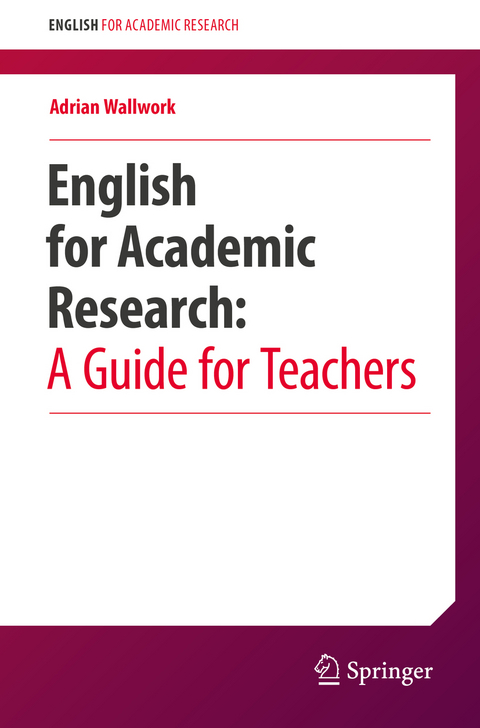
English for Academic Research: A Guide for Teachers (eBook)
XX, 234 Seiten
Springer-Verlag
978-3-319-32687-0 (ISBN)
Adrian Wallwork has written over 30 books covering General English (Cambridge University Press, Scholastic), Business English (Oxford University Press), and Scientific English (Springer). He has trained several thousand PhD students from all over the world to write and present their research. Adrian also runs a scientific editing service: English for Academics (E4AC).
English for Academic Research: A Guide for Teachers 4
Copyright 5
Introduction 6
Who is this book for? 6
What kind of teacher's book is this? Is it a step-by-step guide to using all the books in the series? 6
What is English for Academic Research? Is it the same as English for Academic Purposes (EAP)? Who is the target audience? 7
What are the components of the English for Academic Research series? 8
What key differences are there between this book and other guides to teaching academic English? 9
What is the main focus of this book? Which skills are covered the most? 9
How is this book organized? 10
Does the series cover both science and humanities students? 11
Why should I want to teach EAP / scientific English? 11
I am a regular EFL teacher. Will I be able to use English for Academic Research series? 12
What are the possible pitfalls to this book? 13
The author 13
Contents 14
Part I: Academic Written English: What It Is and How to Teach It 22
Chapter 1: What Is EAP / Scientific English? What Do I Need to Do to Prepare Myself to Teach Scientific English? 23
1.1 In this book, how are the terms Academic English and Scientific English used? 23
1.2 What is Academic English? 23
1.3 Are the rules of Academic English the same for all disciplines? 24
1.4 Is the grammar of Academic English different from that of General English? 26
1.5 Does Academic / Scientific English share any similarities with Business English? 28
1.6 So can I really teach'scientific' English when I don't have a scientific background? 29
1.7 What kind of background reading will help me to understand science and how it is written up? 30
1.8 How can papers and presentations written by scientists possibly be easier to correct / edit than those written by humanists? 31
1.9 What do students typically think that their'English problems' are? 32
Chapter 2: The Research and Publication Process: Why Papers Get Rejected 34
2.1 What are the aims of PhD students and researchers? 34
2.2 How important is it for my students to write good papers? 35
2.3 What are the main steps in getting research published? 35
2.4 What about conferences - how do they affect the publication process? 36
2.5 What steps do the students themselves follow when writing their manuscript? 37
2.6 What do my students need to know about referees? 38
2.7 How do referees do their job? Do native speakers always get their papers accepted? 39
2.8 How do I know what to focus on when teaching students how to write up their research for publication? What criteria do referees follow when reviewing a manuscript or abstract? 39
2.9 How can I help my students write better English? When manuscripts are rejected for 'poor English' what exactly does'poor' mean? 41
2.10 Are there differences in the comments made by native and non-native reviewers? What do I need to tell my students in this regard? 42
2.11 So what do referees say when commenting about the English? 44
2.12 So do I really need to know what editors and reviewers expect from a paper? 45
Chapter 3: Readability 47
3.1 How are papers read? 47
3.2 How does the reader's and writer's role vary between Anglo countries and non-Anglo countries? 48
3.3 What do non-native speakers think about English in comparison with their own language? Are they right? 49
3.4 How does the English of today compare to the English of past centuries? 49
3.5 So how and why has the English language evolved? 51
3.6 What about native English researchers? Do they always write clearly? 52
3.7 Why do academics write and speak in such an abstract way? 53
3.8 Would some students have difficulty in writing papers even in their own language? 54
3.9 Is there a connection between a student's mother tongue and how likely they are to be published? 54
3.10 So is it really important to write (and speak) clearly? How can I convince my students? 56
3.11 Not many of my students will be aiming to publish in Nature. Will my students really be able to see the benefits of communicating in a simple way? Aren't I likely to encounter a lot of resistance? 58
3.12 Do students judge their writing in English in the same way as they would judge it if they had written the paper in their native language? 58
Chapter 4: Difficult Grammatical Structures and Other Aspects that Are Typical of Academic English that May Be Best Left Well Alone 60
4.1 How can I decide what grammar (not) to cover? 60
4.2 Nominalization 61
4.3 Inversion of subject and verb 63
4.4 Complex conjunctions (although vs notwithstanding) 64
4.5 Avoidance of repetition 65
4.6 Is it worth teaching my students how to use references? 66
4.7 What kind of style should my students avoid? 67
4.8 How likely are students to be unaware that they have used informal language in a research paper? Should I teach them a more formal style? If so, how? 67
4.9 Insistence on the passive voice (but the passive is useful in many circumstances) 69
4.10 A few more myths about academic writing and presenting 70
4.11 Moral of the story of this chapter 71
Chapter 5: Using Google Translate and Analysing Student- and GT-Generated Mistakes 72
5.1 Should I encourage students to use Google Translate? 72
5.2 How good is Google Translate? 73
5.3 How well does GT compare with a typical student's translation? 76
5.4 What kind of grammar and vocabulary mistakes do students make? 77
5.5 What kinds of mistakes does GT make? 79
5.6 So how should I use Google Translate in lessons? 80
5.7 How can Google Scholar help students to correct their English? 84
5.8 So what is the moral of the story regarding whether teachers should encourage students to use Google Translate? 85
Chapter 6: Teaching Students to Recognize the Pros and Cons of Short and Long Sentences 86
6.1 Do native speakers write in long sentences? 86
6.2 But doesn't academic English have a style of its own? Aren't the French, Spanish and Italians right: surely short sentences are inappropriate in a paper? 87
6.3 But are short sentences always a good idea? 88
6.4 Do people write in short sentences in other languages? 91
6.5 Is English word order logical? 92
6.6 What about paragraphs? Are they structured in the same way from language to language? 93
Chapter 7: Using Students' Own Materials 95
7.1 Why use students' own materials? 95
7.2 Removing redundancy from an Abstract 95
7.3 Making a humanist text more cohesive and interesting 98
7.4 Highlighting ambiguity 99
7.5 Emails 100
7.6 CVs 100
7.7 Adding a cross-cultural element 102
Chapter 8: Showing How Skills Taught in Your Writing Course Are Also Applicable in Other Areas of Communication 103
8.1 Encourage students to transfer their skills from one area of communication to another 103
8.2 Ambiguity 104
8.3 Attention gaining, highlighting, paragraphing 105
8.4 Conclusions 105
8.5 Criticizing 106
8.6 Hedging 107
8.7 Paragraphing 108
8.8 Readability and empathy 109
8.9 Redundancy 111
Part II: Academic Presentations: What They Are and How to Teach Them 112
Chapter 9: Teacher's Preparation 113
9.1 How important are presentation skills for my students? 113
9.2 How can I help someone with their presentation when I have zero understanding of their topic? 114
9.3 What can I do to find out about presentations? 115
9.4 What questions do I need to think about before starting to teach my students how to do presentations? 116
9.5 How much theory should I give my students? 117
9.6 What objections am I likely to encounter in terms of the approach presented in English for Presentations at International Conferences? 117
Chapter 10: Getting Students to Think About Presentations 119
10.1 What common misconceptions do students have about presentations? 119
10.2 What's a fun way to get students thinking about the typical bad things that presenters do? 121
10.3 How can I get the students to think about the structure of their presentation? 121
10.4 How can I help students who are reluctant to give a presentation? 123
10.5 How can students practise presentations without standing up in front of the whole class? 124
10.6 How important is their body language? 124
10.7 Is it better to set a limit on time or a limit on the number of slides? 125
10.8 How can I teach the useful phrases given in Chapter 20 of the Presentations book? 125
Chapter 11: Using TED 126
11.1 What is TED? 126
11.2 What are some good and bad presentations that are worth showing students? 126
11.3 How can I use the 'comments' feature? 127
11.4 Is it worth using the 'rate this talk' feature? 127
11.5 How should I use the subtitles and the interactive transcript? 128
11.6 Can students really be expected to imitate all these great TED presenters? Aren't they likely to be demotivated? 128
11.7 Can students use TED presentations as a model? 129
11.8 Use TED to encourage your students to be more curious about the world 131
Chapter 12: Giving Feedback and Teaching Self Evaluation 132
12.1 The importance of giving positive feedback 132
12.2 Teach students how to give feedback on each other 133
12.3 How can I teach my students to self-evaluate their own slides and those of their colleagues? 133
12.4 What's a good way to highlight the importance of putting statistics, facts, graphs etc. into context? 135
Chapter 13: Working on Students' Pronunciation 138
13.1 Why do some nationalities speak better English than others? 138
13.2 Why do students mispronounce English words? 139
13.3 Is there a standard English pronunciation that I should teach my students? 140
13.4 How can I help my students discover what words they mispronounce so badly that the audience may not understand them? 141
13.5 Are there others ways of teaching students to improve their pronunciation? 142
13.6 How can I teach sentence stress? 143
Chapter 14: Students’ Progress 145
14.1 How should the quality of a student’s slides improve over the course? 145
14.2 What can I do to get students to hone their speeches? 152
Part III: Strategies for Teaching Writing and Presenting 154
Chapter 15: How to Inject Some Fun into Your Lessons / Making Comparisons with Other Areas Outside Academia 155
15.1 What is the point of this chapter? 155
15.2 Abstracts: Following a clear structure 156
15.3 Introduction: Paraphrasing and plagiarism 156
15.4 Materials and Methods: Explaining a process or strategy 158
15.5 Results: Statistics for use in presentations 159
15.6 Results: using sports as an example 160
15.7 Discussion: Interpreting findings 161
15.8 Discussion: Hedging 162
15.9 Discussion: Getting students to think about the importance of their research 163
15.10 Discussion: Highlighting the author's unique contribution 163
15.11 Conclusions: Discussing limitations and future research 164
15.12 Conclusions: Avoiding a cut and paste from the Abstract 165
15.13 Final check: papers and presentations 166
Chapter 16: Giving Students Advice, Dealing with Their Resistance, Handling Different Nationalities 167
16.1 Pepper your lessons with useful advice. Don't be afraid of repeating the same advice 167
16.2 Be aware that students tend to take any advice, guidelines or rules that you give them very literally 168
16.3 Dealing with resistance: give students external evidence of what you are telling them 169
16.4 Use advice and examples from ex-students 170
16.5 Reassure students about their English with evidence from your own life 171
16.6 Remember that teaching EAP / scientific English is very different from preparing students for a Cambridge English exam 172
16.7 Academic writing and academic life in general differ from country to country 173
16.8 Learning styles and cultural issues in multicultural / multinational classes 174
Part IV: Syllabus and Lesson Plans 178
Chapter 17: Creating a Syllabus 179
17.1 What do I need to think about when deciding on a syllabus? 179
17.2 What sections of the core books were specifically designed for in-class use? 180
17.3 Why are there only syllabuses for the Writing and Presentations courses in this book? Why not for the Correspondence and Campus books? 181
17.4 Given the choice, should I opt to do the Writing and Presentations courses separately, or integrate them into one course? 182
17.5 Are there any PPTs or PDFs of some teacher's slides for writing courses and presentations courses? 182
17.6 What do I need to know about my students before the start of the course? 183
17.7 What explanations do I need to give in my first lesson? 184
17.8 What can I do as a warm-up activity in my first lesson? 185
17.9 Why doesn't the syllabus outlined in Chapters 19 and 20 follow the same order as the chapters in the Writing and Presentations books? 186
17.10 How can I ensure that I don't go into lecturing mode? 186
17.11 How long are the courses and individual lessons designed to last? 187
17.12 Given that I cannot be sure in advance how long my courses are going to last, how can I plan in advance which lessons I could cut? 187
17.13 Do I need to ensure that students do all the exercises recommended in the syllabuses? 187
17.14 How much homework, if any, should I give my students? 188
17.15 In the Writing course, is it a good idea to choose a paper and use this as a basis for all the lessons? 188
17.16 In the Writing course, is the aim for students to begin writing a paper in Lesson 1 and have it finished by the end of the course? 189
17.17 How much exposure to doing presentations will my students already have had? 189
Chapter 18: What's the Buzz Sections 190
18.1 English for Writing Research Papers 190
18.2 English for Presentations at International Conferences 193
18.3 English for Academic Correspondence 193
18.4 English for Interacting on Campus 195
Chapter 19: Writing Course: Lesson Plans 197
19.1 Lesson 1 Preparation Readability &
19.2 Lesson 2 More on short sentences, Word Order 199
19.3 Lesson 3 Abstracts 200
19.4 Lesson 4 More on Abstracts, Redundancy / Conciseness 201
19.5 Lesson 5 Titles 202
19.6 Lesson 6: Introductions, Review of the Literature, Paraphrasing and Plagiarism 203
19.7 Lesson 7 Methods and Results 204
19.8 Lesson 8 Ambiguity 205
19.9 Lesson 9 Discussion - part 1 206
19.10 Lesson 10 Discussion - part 2, Conclusions 207
Chapter 20: Presentations Course: Lesson Plans 208
20.1 Lesson 1 Good vs bad presentations, the importance of presentations 209
20.2 Lesson 2 TED 210
20.3 Lesson 3 Writing a script 211
20.4 Lesson 4 Pronunciation 212
20.5 Lesson 5 Slides 213
20.6 Lesson 6 Beginnings 214
20.7 Lesson 7 Conclusions and Q& A
20.8 Lesson 8 Methodology, Results and Discussion Socializing at a conference
20.9 Lesson 9 Attracting and maintaining audience attention 218
20.10 Lesson 10A Posters 219
20.11 Lesson 10B Final lesson 220
Appendix: Table of course components 221
Acknowledgements 228
Sources 229
Index 234
| Erscheint lt. Verlag | 19.5.2016 |
|---|---|
| Reihe/Serie | English for Academic Research | English for Academic Research |
| Zusatzinfo | XX, 234 p. 11 illus. in color. |
| Verlagsort | Cham |
| Sprache | englisch |
| Themenwelt | Schulbuch / Wörterbuch ► Wörterbuch / Fremdsprachen |
| Geisteswissenschaften ► Sprach- / Literaturwissenschaft ► Anglistik / Amerikanistik | |
| Geisteswissenschaften ► Sprach- / Literaturwissenschaft ► Germanistik | |
| Sozialwissenschaften ► Pädagogik | |
| Technik | |
| Schlagworte | EAP (English for Academic Purposes) • EFL (English as a Foreign Language) • English • ESP (English for Special Purposes) • non-native English-speaking academics • non-native speakers • Scientific English • Trainer's/Teacher's guide |
| ISBN-10 | 3-319-32687-2 / 3319326872 |
| ISBN-13 | 978-3-319-32687-0 / 9783319326870 |
| Informationen gemäß Produktsicherheitsverordnung (GPSR) | |
| Haben Sie eine Frage zum Produkt? |
 PDF (Wasserzeichen)
DRM: Digitales Wasserzeichen
Dieses eBook enthält ein digitales Wasserzeichen und ist damit für Sie personalisiert. Bei einer missbräuchlichen Weitergabe des eBooks an Dritte ist eine Rückverfolgung an die Quelle möglich.
Dateiformat: PDF (Portable Document Format)
Mit einem festen Seitenlayout eignet sich die PDF besonders für Fachbücher mit Spalten, Tabellen und Abbildungen. Eine PDF kann auf fast allen Geräten angezeigt werden, ist aber für kleine Displays (Smartphone, eReader) nur eingeschränkt geeignet.
Systemvoraussetzungen:
PC/Mac: Mit einem PC oder Mac können Sie dieses eBook lesen. Sie benötigen dafür einen PDF-Viewer - z.B. den Adobe Reader oder Adobe Digital Editions.
eReader: Dieses eBook kann mit (fast) allen eBook-Readern gelesen werden. Mit dem amazon-Kindle ist es aber nicht kompatibel.
Smartphone/Tablet: Egal ob Apple oder Android, dieses eBook können Sie lesen. Sie benötigen dafür einen PDF-Viewer - z.B. die kostenlose Adobe Digital Editions-App.
Buying eBooks from abroad
For tax law reasons we can sell eBooks just within Germany and Switzerland. Regrettably we cannot fulfill eBook-orders from other countries.
aus dem Bereich


