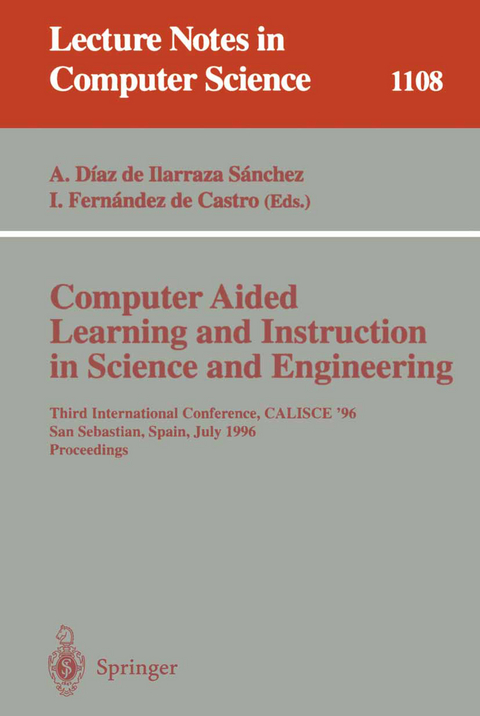
Computer Aided Learning and Instruction in Science and Engineering
Springer Berlin (Verlag)
978-3-540-61491-3 (ISBN)
The 42 revised full papers presented in the book were selected from a total of 134 submissions; also included are the abstracts of full papers of four invited talks and 17 poster presentations. The papers are organized in topical sections on learning environments: modelling and design, authoring and development tools and techniques, CAL in distance learning, multimedia and hypermedia in CAL, and applications in science and engineering.
Some characteristics of instructional design for industrial training.- Support for simulation-based learning: The effect of assignments in learning about transmission lines.- Deconstructionist student models in the computer-based learning of science.- Evaluating educational technologies: Evaluation of teaching material versus evaluation of learning?.- Panel discussion: The use of internet in education.- Epiphyte advisor systems for collaborative learning.- Expertext approach and learning environments.- On content-balanced adaptive testing.- An object-oriented shell for intelligent tutoring lessons.- WORDMATH: A computer-based environment for learning word problem solving.- Towards pedagogically sound learning environments: The specification process.- A multi-agent architecture for an ITS with multiple strategies.- Decentralized computer learning systems based on autonomous agent approach.- Foundations on an adaptative tutoring system based on systemic networks.- The intelligent discussion supporting system under the distributed environment.- Applied artificial intelligence for teaching numeric topics in engineering disciplines.- Motivating the design of a computer assisted environment for writers in a second language.- An experimental environment for the production of pedagogical simulations.- A component-based interactive practice environment.- Representations of instructional purpose in courseware requirements engineering.- The formula: A relation? Yes, but a concept too!.- CREAM-Tools: An authoring environment for curriculum and course building in an intelligent tutoring system.- Authoring System for Reinforcement and Evaluation (SARE).- Preliminary student evaluation of a CBL course on Digital Systems Electronics.- Cooperative and distance learning in electronics using internet.- Cooperative Distance Learning with an integrated system for computer assisted laboratory work.- Implementation and evaluation of a WWW multiple choice question server.- Teaching Informatics with ARIANE: An experimental Internet-based Pedagogical Environment.- Multimedia training and remote operating laboratory: Innovative solutions for instrumentation and electronic measurements courses.- Hypermedia exercises prototyping and modelising.- Testbed for measuring multimedia presentation quality disorders in courseware.- Hypertexts as educational systems: Pedagogical issues in teaching and learning mathematical problem solving.- Structured hypermedia authoring: A simple tool for the design and implementation of structured hypermedia databases.- Designing educational multimedia.- Design of a windows software for elastic field simulation: Application to visualization and animation of a rectangular piece in a projection with a load on the end.- A Hypermedia Intelligent Tutor for mathematical modelling teaching.- Design of software for the simulated and tutorized study of atomic models through the use of hypertext.- TEA: An Agrarian Economy instructor system.- The AnalogicalModel-based Physics System: A workbench to investigate issues in how to support learning by analogy in physics.- Seeing is believing.- FLIP - Flexible learning in physics and mechanics.- 3D-Schema: An intuitive model for analog circuits instruction.- Computer aided learning in microelectronics technology in Slovakia (State of the art).- to thermodynamics based on simulations and hypertext.- A computer-supported course in mechanics.- The informed professor: Clinical instruction of breast disease diagnosis and management.- Computer modelling and simulation of the high frequency disturbing processes for low voltage consumers applied in power system training and education.- Interactive practical teaching of digital circuits design by means of Field Programmable Gate Arrays.- Interactive learning environment in mechanics.- Flexible intelligent environment for tutoring and assessing learners.- DLW - A learning environment for lake water diagnosis.- XMOISE: A logical spreadsheet to elicit dida
| Erscheint lt. Verlag | 1.7.1996 |
|---|---|
| Reihe/Serie | Lecture Notes in Computer Science |
| Zusatzinfo | XIV, 485 p. |
| Verlagsort | Berlin |
| Sprache | englisch |
| Maße | 155 x 235 mm |
| Gewicht | 739 g |
| Themenwelt | Schulbuch / Wörterbuch ► Unterrichtsvorbereitung ► Unterrichts-Handreichungen |
| Mathematik / Informatik ► Informatik ► Web / Internet | |
| Sozialwissenschaften ► Pädagogik ► Schulpädagogik / Grundschule | |
| Schlagworte | Computer • Computer Aided Learning (CAL) • Computergestütztes Leren • Computergestütztes Lernen • Computerunterstütztes Lernen • Development • Distance Learning • Environment • Fernstudium • Fernunterricht • Hardcover, Softcover / Informatik, EDV/Internet • HC/Informatik, EDV/Internet • Human Computer Interaction (HCI) • Intelligente Tutoren Systeme • Intelligent Tutoring Systems • learning • Mensch-Computer Interaktion • Mensch-Maschine-System • Modeling • Multimedia • Science • Tools |
| ISBN-10 | 3-540-61491-5 / 3540614915 |
| ISBN-13 | 978-3-540-61491-3 / 9783540614913 |
| Zustand | Neuware |
| Informationen gemäß Produktsicherheitsverordnung (GPSR) | |
| Haben Sie eine Frage zum Produkt? |
aus dem Bereich