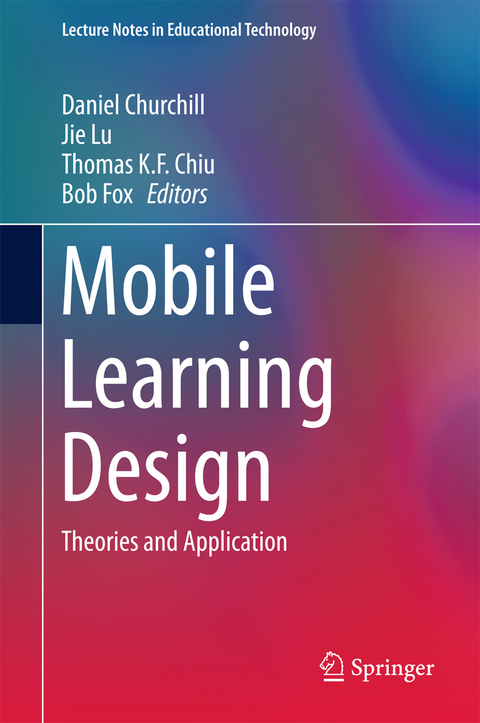
Mobile Learning Design (eBook)
XVIII, 431 Seiten
Springer Singapore (Verlag)
978-981-10-0027-0 (ISBN)
This book focuses on mobile learning design from both theoretical and practical perspectives. It introduces and discusses how mobile learning can be effectively integrated into curricula, highlighting the design of four key components of learning-centric pedagogy: Resource, Activity, Support and Evaluation in the context of mobile learning. It also investigates the learning theories underpinning mobile learning design, and includes case studies in different contexts. It provides practical insights that allow teachers to change and transform teaching practices using mobile technology. Anyone involved in mobile-technology enhanced learning and teaching will find this book both informative and useful.
Foreword 6
What Will They Think of Next? 6
Preface 8
Contents 14
About the Editors 17
Part IMobile Learning Design 19
1 Framework for Designing Mobile Learning Environments 20
Abstract 20
1.1 Introduction 20
1.2 RASE Learning Design 21
1.2.1 Resources 24
1.2.2 Activity 25
1.2.3 Evaluation 26
1.2.4 Support 26
1.3 Affordances of Mobile Learning Technologies and the RASE Learning Design 27
1.4 A Case for an App that Integrates Multiple Affordances of Mobile Technology and Supports the RASE Learning Design 32
1.5 Conclusion 38
References 39
2 Conceptualising Authentic Mobile Learning 43
Abstract 43
2.1 Introduction 43
2.2 Why Is Authentic Learning Important? 45
2.3 Defining Authenticity 46
2.4 Authentic Learning and Mobile Technologies 46
2.5 Unpacking Authentic Learning 47
2.5.1 Participatory Contexts 47
2.5.2 Simulated Contexts 48
2.5.3 Hybrid Contexts 49
2.6 Is Authentic Mobile Learning Predefined or Emergent? 49
2.6.1 Personal Commitment of Learners 51
2.7 Discussion and Implications 52
2.7.1 How Does the Model Work? 53
2.7.2 Returning to Research Questions 54
2.8 Conclusion 55
References 56
3 Mobile Social Media: Redefining Professional Development and Collaborative Scholarship 59
Abstract 59
3.1 Introduction 59
3.1.1 Why Mobile Social Media? 60
3.1.2 Communities of Practice and Social Scholarship 61
3.1.3 An MSM Framework for New Pedagogies 62
3.2 Methodology 64
3.2.1 Method 64
3.2.2 Establishing the COPs 66
3.2.3 MSM Tools 66
3.2.4 Social Scholarship 68
3.2.5 Scholarship of Design 68
3.2.6 Scholarship of Integration 69
3.2.7 Scholarship of Teaching and Learning 69
3.2.8 Scholarship of Application 69
3.2.9 Establishing a Technology Infrastructure 69
3.3 Discussion 70
3.3.1 Journalism and Law 71
3.3.2 Communication Studies 72
3.3.3 Designing an Appropriate Technology Support Infrastructure 73
3.3.4 Future Research 74
3.4 Conclusions 74
References 75
4 Interactivity and Mobile Technologies: An Activity Theory Perspective 78
Abstract 78
4.1 Background 78
4.2 Theoretical Framework 79
4.3 Review of Literature 81
4.3.1 Pedagogy 81
4.3.2 Professional Learning 82
4.3.3 Digital Resources 83
4.4 Methods 84
4.5 Findings/Discussion 85
4.5.1 Teacher-Centred Interactivity 87
4.5.2 Learner-Centred Interactivity 88
4.5.3 Blended Interactivity 88
4.5.4 Juxtaposition of Teacher- and Learner-Centred Interactivity 89
4.6 Conclusion 91
References 93
5 Educational Apps Ontology 98
Abstract 98
5.1 Introduction 98
5.2 What Is an App/What Is an Educational App? 99
5.3 Educational App Typologies 100
5.4 Educational Apps from Different Perspectives 102
5.4.1 The Learner's View 103
5.4.2 The Teacher's View 104
5.4.3 The Developer's View 105
5.4.4 The Distributor's View 106
5.5 Why so Many Educational Apps Are Games? 107
5.6 Conclusion 108
References 109
6 Augmented Learning with Augmented Reality 112
Abstract 112
6.1 Introduction 112
6.2 Defining Augmented Reality 113
6.3 Evolution of Educational Augmented Realty 113
6.4 Augmented Reality in Education 114
6.4.1 Educational Affordances 115
6.4.2 Learning with Others 116
6.4.3 Tangible Interface Metaphor 116
6.4.4 Transition 116
6.5 Augmented Reality Programs for Education 117
6.5.1 AR Educational Gaming 117
6.5.2 Augmented Realty Books 117
6.5.3 Book Applications 118
6.6 Teaching with Augmented Reality 119
6.6.1 Student-Centered Learning 119
6.6.2 Designing for Learning 120
6.7 The Future of Augmented Reality in Education 120
6.8 Recommendations 121
6.9 Conclusion 121
References 122
Part IIMobile Learning Adoption and StudentPerception 124
7 Mobile Technology and Interactive Lectures: The Key Adoption Factors 125
Abstract 125
7.1 Introduction 125
7.2 Background Study and Hypotheses Development 127
7.2.1 Technology Acceptance Model (TAM, TAM2, TAM3) 127
7.2.2 Intrinsic Motivator Theory 128
7.2.3 Delone and McLean Information System Success Model 129
7.2.4 Uncertainty Avoidance 130
7.3 Research Methods 130
7.4 Results 131
7.4.1 Principal Component Analysis 131
7.4.2 Pearson Product-Moment Correlation 132
7.4.3 Standard Multiple Regression 134
7.5 Discussions 135
7.6 Conclusion and Future Works 136
Acknowledgments 137
References 137
8 University Student Conceptions of M-learning in Bangladesh 141
Abstract 141
8.1 Introduction 141
8.2 M-Learning and Related Literature to the Research Problem 142
8.3 Methodology 144
8.3.1 Sample 144
8.3.2 Data Collection 145
8.3.3 Data Analysis 145
8.4 Results 145
8.4.1 Categories of Description 146
8.4.1.1 Category A: Storing Learning Materials 146
8.4.1.2 Category B: Accessing Information and Knowledge 146
8.4.1.3 Category C: Effective Learning Tool 147
8.4.1.4 Category D: Effective Tool for Collaboration 148
8.5 Discussion and Conclusions 148
Acknowledgments 150
References 150
9 Mobile Learning, Student Concerns and Attitudes 153
Abstract 153
9.1 Introduction 153
9.2 State of the Art 154
9.3 The Present Study 158
9.3.1 Current Situation in Serbia in General 158
9.3.2 Specific Situation at the Department of Mathematics and Informatics, Novi Sad, Serbia 159
9.4 Methodology 159
9.4.1 Instrument 159
9.5 Conclusion 164
References 166
10 Access Moodle Using Mobile Phones: Student Usage and Perceptions 168
Abstract 168
10.1 Introduction 169
10.2 Related Work 169
10.2.1 Use of LMS 169
10.2.2 Mobile Learning 170
10.3 Methodology 171
10.3.1 The LMS and the Courses 171
10.3.2 Participants and Procedure 172
10.3.2.1 The Survey 172
10.3.2.2 The Interview 172
10.3.3 Instruments 174
10.4 Results 175
10.4.1 Questionnaire Responses 175
10.4.2 Themes from Interviews 178
10.5 Discussion 179
10.6 Conclusion and Future Work 181
Acknowledgments 182
Appendix 1: Questionnaire 182
References 182
Part IIIMobile Learning Analytics 185
11 An Effective Cloud-Based Simulator Facilitating Learning Analytics on Mobile Devices 186
Abstract 186
11.1 Introduction 187
11.2 Previous Work 188
11.3 System Design of Our Cloud-Based COMPAD+ Simulator 189
11.3.1 The Adaptive User Interface of the COMPAD+ Simulator 191
11.3.2 The Improved Learning Path Optimization Algorithm for Learning Analytics 192
11.4 Our Empirical Evaluation 193
11.4.1 The Adaptive User Interface of the COMPAD+ Simulator 194
11.4.2 The Improved Learning Path Optimization Algorithm for Learning Analytics 196
11.5 Concluding Remarks 198
Acknowledgments 198
References 198
12 A New Wave of Innovation Using Mobile Learning Analytics for Flipped Classroom 200
Abstract 200
12.1 Introduction 200
12.2 Conceptual Framework 201
12.2.1 Formative Assessment and Feedback 202
12.2.2 Mobile Learning Analytics 203
12.2.3 Flipped Learning Approach 205
12.2.4 Unified Conceptual Model for Active Learning 206
12.3 Research Design and Methodology 207
12.3.1 Research Objectives 207
12.3.2 Context of Study 209
12.3.3 Learning Management System 209
12.3.4 Participants 210
12.3.5 Instruments and Procedure 210
12.3.6 Data Analysis 211
12.4 Results and Analysis 212
12.4.1 Access to Course Notes and Learning Activities 212
12.4.2 Access to Video Lectures 214
12.4.3 Access Through Mobile Platforms 215
12.4.4 Students' Perceptions on Mobile Learning Analytics 216
12.4.5 Discussions and Implications 221
12.5 Conclusions and Limitations 223
Acknowledgments 224
References 224
Part IVMobile Learning Across Curriculum 230
13 Mobile Learning in K-12 Education: Personal Meets Systemic 231
Abstract 231
13.1 Introduction 231
13.2 Defining Mobile Learning 232
13.2.1 Mobile Learning in Schools 233
13.2.2 The Role of the Teacher 234
13.3 A Short History of Mobile Learning in a School 235
13.4 Evaluating Mobile Learning 237
13.5 School Case Reviews 238
13.5.1 Study One: Grade 11 Parent Conferencing 238
13.5.2 Study Two: Grade 8 EBook and Process Journal 240
13.5.3 Study Three: Grade 6 Digital Literacy 241
13.5.4 Study Four: Grade 1 iPad as iFolio 243
13.6 Discussion 244
13.7 Conclusion 245
References 246
14 Overcoming Teachers' Concerns---Where Are We in the Harnessing of Mobile Technology in K-12 Classrooms in Hong Kong? 249
Abstract 249
14.1 Introduction 249
14.2 Stages of Concern (SoC) 250
14.3 Research Question 251
14.4 Participants 252
14.5 Research Design 252
14.6 Results and Data Analysis 254
14.7 Preliminary Discussions and Implications for Practice 255
14.8 Conclusions 257
References 257
15 Exploring the Suitability of the Book Creator for iPad App for Early Childhood Education 259
Abstract 259
15.1 Introduction 259
15.2 Literature Review 260
15.3 Creating to Learn 261
15.4 Methods 261
15.4.1 Early Childhood Setting 262
15.4.2 Ethical Considerations 262
15.4.3 Selection and Evaluation of App 263
15.4.4 Procedure 263
15.4.5 Data Collection Procedure and Analysis 264
15.5 Findings and Discussion 266
15.5.1 Post-study Evaluation of the Book Creator for ECE 267
15.5.2 Suitability of the Book Creator for ECE 267
15.5.3 Children's Artefacts 274
15.6 Conclusion 278
References 279
16 Text Messaging for Out-of-Class Communication: Impact on Immediacy and Affective Learning 281
Abstract 281
16.1 Introduction 281
16.2 Instructor Immediacy 282
16.3 Text Messaging in Education 283
16.4 Methodology 284
16.4.1 Text Messaging Service 284
16.4.2 Categories of Text Messages 285
16.5 Data Collection 286
16.6 Results and Discussion 286
16.6.1 Levels of Participation 287
16.6.2 Quantitative Results 287
16.7 Qualitative Results 288
16.8 Reflections and Conclusions 289
16.8.1 Concerns with Instructor-Student Text Messaging 289
16.8.2 Guidelines for Instructor-Student Text Messaging 291
16.8.3 Conclusion 291
References 292
17 Implementing a Mobile App as a Personal Learning Environment for Workplace Learners 295
Abstract 295
17.1 Introduction 295
17.2 Theoretical Framework 296
17.2.1 Personal Learning Environments (PLE) 297
17.2.2 A Personal Informal Learning Framework in the Context of Mobile Web 2.0 297
17.3 Design and Development of MobLearn@Work 299
17.3.1 An Agile Design Approach 300
17.3.2 Functions of MobLearn@Work 301
17.3.3 UI Improvements of MobLearn@Work 303
17.4 A Novel Method for Quantifying the Data 305
17.4.1 The Log System 305
17.4.2 Measure of Actual Learning Time via MobLearn@Work 307
17.5 Recommendations for Future Study 308
17.6 Conclusion 309
References 309
Part VMobile Learning in Subject Domains 311
18 The Theory of Context-Aware Ubiquitous Learning and the Affordances of This Approach for Geometry Learners 312
Abstract 312
18.1 Introduction 312
18.2 Mobile Learning 313
18.3 Context-Aware Ubiquitous Learning 315
18.3.1 Sensory 318
18.3.2 Ambient 319
18.4 Geometry: Measure of the Earth 320
18.5 The Future 320
18.6 Conclusion 321
19 Three Phases of Mobile Learning State of the Art and Case of Mobile Help Seeking Tool for the Health Care Sector 324
Abstract 324
19.1 Introduction 324
19.2 Three Phases of Mobile Learning State of the Art 325
19.3 Design Research in the Learning Layers Project 329
19.3.1 Design Research 329
19.3.2 Vygotsky 329
19.3.3 Learning Layers 330
19.4 Help Seeking Tool 331
19.4.1 Overview of WP2 `Networked Scaffolding---Interacting with People' 331
19.4.2 Early Co-design of the Help Seeking Tool 333
19.4.3 Help Seeking: Follow-up Empirical Co-design Study 334
19.5 Innovation in Context: Help Seeking Using the Social Semantic Server 336
19.5.1 Social Semantic Server 337
19.5.2 Layers Social Semantic Server and Help Seeking Tool in Healthcare Sector 337
19.6 Conclusions 340
Acknowledgments 340
References 341
20 Mobile-Assisted Language Learning in China's College English Education: The Reality and Research 343
Abstract 343
20.1 Introduction 343
20.2 Definitions of Key Terms 345
20.3 College English Education in China 346
20.3.1 Historical Context 346
20.3.2 Problems 347
20.4 Mobile Technologies 349
20.5 MALL Research in China's Higher Education 350
20.6 Recommendation 353
20.7 Conclusion 354
Acknowledgments 355
References 355
21 Enacting App-Based Learning Activities with Viewing and Representing Skills in Preschool Mathematics Lessons 358
Abstract 358
21.1 Introduction 358
21.2 Literature Review 361
21.2.1 Designing a Creative Reasoning and Collaborative Learning Environment 361
21.2.2 Viewing and Representing Skills with Digital Texts 361
21.3 Research Design 363
21.4 Observation of Participants' Enacting the App with Viewing and Representing Skills 367
21.4.1 Participant One: Peter 367
21.4.2 Participant Two: Mary 369
21.4.3 Participant Three: Ben 370
21.4.4 Participant Four: Nicole 371
21.5 Discussions 371
21.6 Conclusions 376
References 376
22 Effects of Prior Knowledge on Mathematics Different Order Thinking Skills in Mobile Multimedia Environments 380
Abstract 380
22.1 Introduction 380
22.2 Literature Review 381
22.2.1 Multimedia Learning and Prior Knowledge 381
22.2.2 Instructional Design in Mathematics 382
22.2.3 The Present Study 383
22.3 Method 384
22.3.1 Participants 384
22.3.2 Design 384
22.3.3 Materials 385
22.3.4 Procedure 385
22.4 Result 386
22.4.1 Graphical Property and Concept Association 386
22.4.2 Evaluation of Solution and Written Explanation 387
22.4.3 Procedural Knowledge 388
22.5 Discussions 388
22.5.1 Prior Knowledge and Low Order Thinking Skill in Conceptual Knowledge 388
22.5.2 Design Approach and High Order Thinking Skill in Conceptual Knowledge 389
22.5.3 Design Approach and Procedural Skill 389
22.6 Conclusions 390
References 390
23 An Investigation of the Effects of Individual Differences on Mobile-Based Augmented Reality English Vocabulary Learning 394
Abstract 394
23.1 Introduction 395
23.2 Literature Review 396
23.2.1 English Vocabulary Learning 396
23.2.2 Situated Learning 398
23.2.3 The Present Study 400
23.3 Methods 400
23.3.1 Participants 401
23.3.2 Mobile-Based AR Simulations Learning System Overview 401
23.3.3 Procedure 402
23.3.4 Variables and Instruments 404
23.3.5 Data Analysis 406
23.4 Results 406
23.4.1 Research Question 1 406
23.4.2 Research Question 2 407
23.4.3 Research Question 3 408
23.4.4 Research Question 4 408
23.4.5 Findings from the Interviews 409
23.4.5.1 Fun 409
23.4.5.2 Effectiveness 409
23.4.5.3 Satisfaction 410
23.4.5.4 Confidence 410
23.5 Conclusion 410
23.5.1 Summary and Discussion of Major Findings 410
23.5.2 Pedagogical Implications 412
23.5.3 Limitations of the Study and Suggestions for Future Research 413
Acknowledgments 413
Appendix A: Motivation Questionnaire 414
References 415
Part VIFuture Developments 418
24 Future Directions in Mobile Learning 419
Abstract 419
24.1 Introduction 419
24.2 Present and Future Mobile Learning 420
24.3 The Technological Context 421
24.4 The Educational Context 425
24.4.1 Contextualisation of Learning (E.G., Through Augmented Reality) 426
24.4.2 Personalisation of Learning (E.G., Through Big Data and Learning Analytics) 427
24.4.3 Diversification of Learning (E.G., Through MOOCs) 428
24.4.4 Student Support (E.G., Through Virtual Assistants) 429
24.4.5 Student Engagement (E.G., Through Gaming and Gamification) 430
24.4.6 Student Creativity (E.G., Through Makerspaces) 430
24.4.7 Wider Collaboration (E.G., Through Digital Networking) 431
24.5 Conclusion 432
Acknowledgments 432
References 433
| Erscheint lt. Verlag | 21.12.2015 |
|---|---|
| Reihe/Serie | Lecture Notes in Educational Technology | Lecture Notes in Educational Technology |
| Zusatzinfo | XVIII, 431 p. 67 illus., 28 illus. in color. |
| Verlagsort | Singapore |
| Sprache | englisch |
| Themenwelt | Schulbuch / Wörterbuch ► Unterrichtsvorbereitung ► Unterrichts-Handreichungen |
| Geisteswissenschaften | |
| Sozialwissenschaften ► Pädagogik ► Allgemeines / Lexika | |
| Sozialwissenschaften ► Pädagogik ► Schulpädagogik / Grundschule | |
| Schlagworte | Educational Application • Educational technology • Instructional Design • Learning and Instruction • Learning-centered Pedagogy • Learning Design • Mobile Learning • mobile technology |
| ISBN-10 | 981-10-0027-1 / 9811000271 |
| ISBN-13 | 978-981-10-0027-0 / 9789811000270 |
| Informationen gemäß Produktsicherheitsverordnung (GPSR) | |
| Haben Sie eine Frage zum Produkt? |
 PDF (Wasserzeichen)
DRM: Digitales Wasserzeichen
Dieses eBook enthält ein digitales Wasserzeichen und ist damit für Sie personalisiert. Bei einer missbräuchlichen Weitergabe des eBooks an Dritte ist eine Rückverfolgung an die Quelle möglich.
Dateiformat: PDF (Portable Document Format)
Mit einem festen Seitenlayout eignet sich die PDF besonders für Fachbücher mit Spalten, Tabellen und Abbildungen. Eine PDF kann auf fast allen Geräten angezeigt werden, ist aber für kleine Displays (Smartphone, eReader) nur eingeschränkt geeignet.
Systemvoraussetzungen:
PC/Mac: Mit einem PC oder Mac können Sie dieses eBook lesen. Sie benötigen dafür einen PDF-Viewer - z.B. den Adobe Reader oder Adobe Digital Editions.
eReader: Dieses eBook kann mit (fast) allen eBook-Readern gelesen werden. Mit dem amazon-Kindle ist es aber nicht kompatibel.
Smartphone/Tablet: Egal ob Apple oder Android, dieses eBook können Sie lesen. Sie benötigen dafür einen PDF-Viewer - z.B. die kostenlose Adobe Digital Editions-App.
Buying eBooks from abroad
For tax law reasons we can sell eBooks just within Germany and Switzerland. Regrettably we cannot fulfill eBook-orders from other countries.
aus dem Bereich