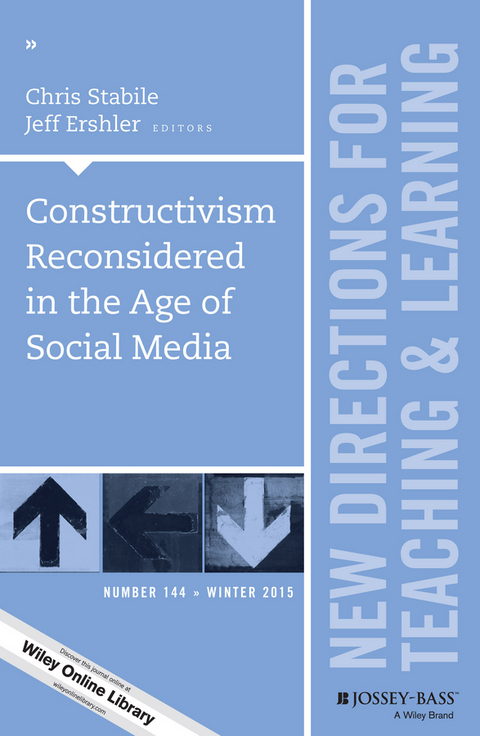
Constructivism Reconsidered in the Age of Social Media (eBook)
136 Seiten
Wiley (Verlag)
978-1-119-21623-0 (ISBN)
Chris Stabile, EdD, is the associate vice chancellor of teaching and learning at Keiser University. Jeff Ershler, JD, is a graduate of the University of the Pacific, McGeorge School of Law and has completed an educational leadership graduate program from Barry University.
EDITORS' NOTES 1
Chris Stabile, Jeff Ershler
1. The Learning Virus: An Affective, Constructivist Movement Shaped by Ultrasociality in the Age of Social Media 5
Jeff Ershler, Chris Stabile
Redefining the discourse toward a "better fit" cultural framework of beliefs, thought, language, and action through ultrasociality, a constructivist meme can help nurture an epistemological break (or rupture) from the traditional objectivist paradigm in education.
2. Constructivism and Learning in the Age of Social Media: Changing Minds and Learning Communities 23
Dawn E. Schrader
Social media provide new means and opportunities for learning that are consistent with major tenets of both social and cognitive constructivism, and extend the process of learning and meaning construction to more diverse communities and universally accessible shared activities that are jointly and concurrently engaged in by both peers and experts.
3. Leveraging Social Media for Instructional Goals: Status, Possibilities, and Concerns 37
Mark Taylor
This chapter addresses issues faculty should consider when exploring the possible use of social media in instruction with today's learners.
4. Teaching Students to Think Critically About Social Media 47
Stephen D. Brookfield
Instructors can incorporate social media and the immediacy and accessibility to information these offer in ways that support student learning, while simultaneously encouraging students to be critical of these same media systems and platforms.
5. Learner-Centered Online Instruction 57
Barbara McCombs
This chapter offers a theoretical rationale and an explanation of evidence for using research-validated, learner-centered principles and practices in online course development, highlighting the evidence based practices that have been used successfully to develop online courses that engage and retain students.
6. Implications of Graphic Organizers in an Age of Social Media 73
Michael Record
This chapter deconstructs the definition of graphic organizer, reimagining it for a social media age, leading to a more mindful use of the concept as an entire approach to teaching and learning rather than one specific set of tools.
7. How Critical Reflection Benefits Faculty as They Implement Learner-Centered Teaching 87
Phyllis Blumberg
Critical reflection assists faculty as they transition to using learner centered approaches. When this reflection occurs within the context of social media, they can obtain reinforcing feedback and support.
8. Learner-Centered Faculty Development 99
Kevin Yee
To maximize their effectiveness, faculty developers should not merely advocate for an active learning approach but also enact it in their own workshops and service-oriented interactions with faculty, even extending to their use of outreach and social media.
9. Toward Education 3.0: Pedagogical Affordances and Implications of Social Software and the Semantic Web 109
Mark Allison, Lynn Marie Kendrick
This chapter explores the implications of this new educational paradigm from a technical standpoint and proposes a constructivist aware approach to best leverage its significance.
INDEX 121
| Erscheint lt. Verlag | 16.12.2015 |
|---|---|
| Reihe/Serie | J-B TL Single Issue Teaching and Learning |
| Sprache | englisch |
| Themenwelt | Schulbuch / Wörterbuch ► Unterrichtsvorbereitung ► Unterrichts-Handreichungen |
| Geisteswissenschaften | |
| Mathematik / Informatik ► Informatik ► Web / Internet | |
| Sozialwissenschaften ► Pädagogik ► Bildungstheorie | |
| Schlagworte | Adult & Continuing Education • Bildungswesen • Education • Education Special Topics • Erwachsenenbildung, Weiterbildung • Hochschulen / Lehren u. Lernen • Spezialthemen Bildungswesen • Teaching & Learning (Higher Education) |
| ISBN-10 | 1-119-21623-0 / 1119216230 |
| ISBN-13 | 978-1-119-21623-0 / 9781119216230 |
| Informationen gemäß Produktsicherheitsverordnung (GPSR) | |
| Haben Sie eine Frage zum Produkt? |
 PDF (Adobe DRM)
Kopierschutz: Adobe-DRM
Adobe-DRM ist ein Kopierschutz, der das eBook vor Mißbrauch schützen soll. Dabei wird das eBook bereits beim Download auf Ihre persönliche Adobe-ID autorisiert. Lesen können Sie das eBook dann nur auf den Geräten, welche ebenfalls auf Ihre Adobe-ID registriert sind.
Details zum Adobe-DRM
Dateiformat: PDF (Portable Document Format)
Mit einem festen Seitenlayout eignet sich die PDF besonders für Fachbücher mit Spalten, Tabellen und Abbildungen. Eine PDF kann auf fast allen Geräten angezeigt werden, ist aber für kleine Displays (Smartphone, eReader) nur eingeschränkt geeignet.
Systemvoraussetzungen:
PC/Mac: Mit einem PC oder Mac können Sie dieses eBook lesen. Sie benötigen eine
eReader: Dieses eBook kann mit (fast) allen eBook-Readern gelesen werden. Mit dem amazon-Kindle ist es aber nicht kompatibel.
Smartphone/Tablet: Egal ob Apple oder Android, dieses eBook können Sie lesen. Sie benötigen eine
Geräteliste und zusätzliche Hinweise
Buying eBooks from abroad
For tax law reasons we can sell eBooks just within Germany and Switzerland. Regrettably we cannot fulfill eBook-orders from other countries.
aus dem Bereich