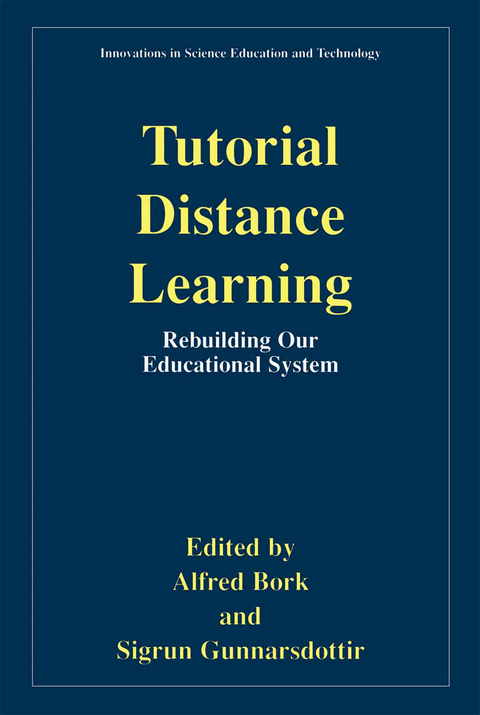
Tutorial Distance Learning
Plenum Publishing Co.,N.Y. (Verlag)
978-0-306-46644-1 (ISBN)
Learning is a critical worldwide problem for humans, essential to create a peaceful and happy world. We have serious problems in learning in both wealthy and poor areas. New approaches to learning are needed, as the current system may not rise to the new challenges.
This book proposes a new strategy for learning, worldwide and for all ages of students. Computer-based distance learning would be the major delivery mechanism, with very large numbers of students. The very frequent interactions between the student and the computer would be like that with a skilled human teacher. These interactions would take place in the student's native language, in both directions. A typical interaction would be a question to a student, and a free-form student response. Both voice and keyboard student input would be possible. The learning programs would work with each student until mastery is achieved, adapting to the needs of each. Students would be active learners.
The book begins with the problems and goals of learning. It considers possible forms of distance learning, looking at the variables involved, current examples of distance learning, and possible future forms including examples from science fiction. It then investigates student interactions, considering both frequency of interactions and the quality of each interaction. Programs developed in the Educational Technology Center at the University of California, Irvine, illustrate the critical idea of tutorial learning with computers. Production of tutorial learning material and costs for a student hour of learning is discussed. The book ends with suggestions for future progress.
Current hardware and software is fully adequate for the tasks described. Development of all required learning units is a major activity. After this development, both better quality of learning and lower costs are very likely. Further experimental work is essential to understand the possibilities.
1. Introduction.- 1.1 Summary of Each Chapter.- 2. Problems And Visions Of Learning.- 2.1 The Problems of Education Today.- 2.2 The Visions.- 2.3 Need for a New Approach to Learning.- 3. Factors Of Distance Learning.- 3.1 Learning Paradigm.- 3.2 Level of Interaction.- 3.3 Student Locations.- 3.4 Time Constraints.- 3.5 Size of Learning Segments.- 3.6 Student Control of Content.- 3.7 Years of Learning.- 3.8 Student Support.- 3.9 Teachers or No Teachers.- 3.10 Number of Students.- 3.11 Grading or Mastery.- 3.12 Cost Factors.- 3.13 Evaluation.- 3.14 Delivery Method.- 3.15 Learning Subjects.- 3.16 Credit or NonCredit.- 3.17 Profit or NonProfit.- 4. Distance Learning—Present And Future.- 4.1 Correspondence Learning.- 4.2 Remote Sound and Video.- 4.3 Remote Versions of Standard Courses.- 4.4 The United Kingdom Open University.- 4.5 The Mega-universities.- 4.6 Distance Learning in Fiction.- 4.7 Aspects of These Fictional Views of Learning.- 5. Individualization And Interaction.- 5.1 Individualization.- 5.2 Interaction.- 5.3 Cooperative Learning Groups.- 5.4 Storing Student Information.- 5.5 What Material Is Presented Next.- 5.6 Mastery Learning.- 5.7 Motivating Learners.- 6. Multimedia In Learning.- 6.1 Types of Multimedia.- 6.2 Why Media Improve Learning.- 7. Tutorial Learning.- 7.1 Tutors.- 7.2 Computer-Based Tutors.- 7.3 Is Computer-Based Tutorial Learning Possible?.- 7.4 Summary of Computer-Based Tutorial Learning.- 8. Delivery Of Learning.- 8.1 Older Delivery Methods.- 8.2 CD-ROM and DVD-ROM.- 8.3 The World Wide Web.- 8.4 Communication.- 8.5 Communication Media.- 9. Learning And Assessment.- 9.1 Why Do We Assess?.- 9.2 Types of Assessment.- 9.3 Combining Learning and Assessment.- 10. Structures For Technology Based Learning.- 10.1 Traditional Courses.- 10.2 Non-linearLearning.- 10.3 Mastery Organization.- 10.4 The Learning Cycle.- 10.5 Complete Mastery Learning Cycle.- 11. Developing Tutorial Learning Units.- 11.1 History of the Irvine-Geneva System.- 11.2 Management.- 11.3 Design.- 11.4 Implementation.- 11.5 Formative Evaluation and Improvement.- 11.6 Summative Evaluation.- 11.7 Improving the Irvine-Geneva System.- 12. Costs Of Highly Interactive Learning.- 12.1 The Economics of Learning.- 12.2 Developmental Costs.- 12.3 Marketing Costs.- 12.4 Administrative Costs.- 12.5 Delivery Costs.- 12.6 Profit.- 12.7 Costs for Usage by Poor Students.- 12.8 Funds for Additional Development and Distribution.- 12.9 Complete Costs for a Student Hour.- 12.10 Other Forms of Learning.- 12.11 Up Front Costs and Continuing Costs.- 13. Initial Tutorial Learning Units.- 13.1 Pre-school and Early Learning.- 13.2 Home Learning.- 13.3 Training.- 13.4 Adult Education.- 13.5 Schools.- 13.6 Literacy.- 13.7 Informal Learning Environments.- 13.8 Apprentice Learning.- 13.9 University Education.- 14. Starting New Distance Learning Institutions.- 14.1 The Experiment.- 14.2 Full Development.- 14.3 Marketing of Tutorial Units.- 14.4 Funding.- 14.5 Conclusions.
| Reihe/Serie | Innovations in Science Education and Technology ; 12 |
|---|---|
| Zusatzinfo | 4 Illustrations, black and white |
| Verlagsort | Dordrecht |
| Sprache | englisch |
| Maße | 155 x 235 mm |
| Themenwelt | Schulbuch / Wörterbuch ► Unterrichtsvorbereitung ► Unterrichts-Handreichungen |
| Naturwissenschaften | |
| Sozialwissenschaften ► Pädagogik ► Erwachsenenbildung | |
| Technik | |
| ISBN-10 | 0-306-46644-9 / 0306466449 |
| ISBN-13 | 978-0-306-46644-1 / 9780306466441 |
| Zustand | Neuware |
| Informationen gemäß Produktsicherheitsverordnung (GPSR) | |
| Haben Sie eine Frage zum Produkt? |
aus dem Bereich