


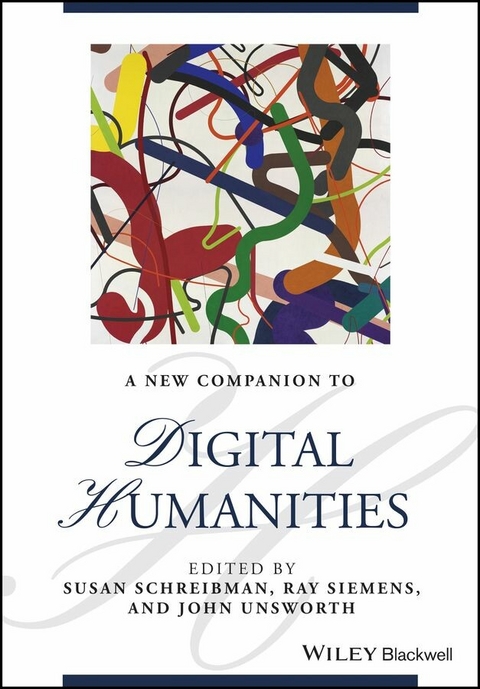
A New Companion to Digital Humanities (eBook)
John Wiley & Sons (Verlag)
978-1-118-68063-6 (ISBN)
This highly-anticipated volume has been extensively revised to reflect changes in technology, digital humanities methods and practices, and institutional culture surrounding the valuation and publication of digital scholarship.
- A fully revised edition of a celebrated reference work, offering the most comprehensive and up-to-date collection of research currently available in this rapidly evolving discipline
- Includes new articles addressing topical and provocative issues and ideas such as retro computing, desktop fabrication, gender dynamics, and globalization
- Brings together a global team of authors who are pioneers of innovative research in the digital humanities
- Accessibly structured into five sections exploring infrastructures, creation, analysis, dissemination, and the future of digital humanities
- Surveys the past, present, and future of the field, offering essential research for anyone interested in better understanding the theory, methods, and application of the digital humanities
Susan Schreibman is Professor of Digital Humanities and Director of An Foras Feasa, the Institute for Research in Irish Historical & Cultural Traditions at NUI Maynooth. Her research in the digital humanities ranges from text encoding and the creation of digital scholarly editions, to more recent interests in virtual worlds and data mining. She is the co-editor of A Companion to Digital Literary Studies (with Ray Siemens, Wiley Blackwell, 2007), and the founding editor of several web-based projects, including Letters of 1916 (hhtp://letters1916.ie), The Thomas MacGreevy Archive (http://macgreevy.org), Irish Resources in the Humanities (hhtp://irith.org), and The Versioning Machine (http://v-machine.org), a tool to edit and visualize multiple versions of deeply-encoded text.
Ray Siemens is Canada Research Chair in Humanities Computing and Distinguished Professor in the Faculty of Humanities at the University of Victoria. In 2014 he received the Alliance of Digital Humanities Organizations' Antonio Zampolli Prize for outstanding scholarly achievement in humanities computing. Dr. Siemens has published numerous articles on the intersection of literary studies and computational methods and is the co-editor of A Companion to Digital Literary Studies (with Susan Schreibman, Wiley Blackwell, 2007) and Literary Studies in the Digital Age: An Evolving Anthology (with Kenneth M. Price, 2013), the MLA's first born digital open access anthology. http://web.uvic.ca/-siemens/.
John Unsworth is Professor of English, Vice Provost for Library and Technology Services, Chief Information Office, and University Librarian at Brandeis University. In August of 2013, he was appointed by President Obama to serve on the National Humanities Council. A co-founder of Postmodern Culture, the first peer-reviewed electronic journal in the humanities, he organized, incorporated, and chaired the Text Encoding Initiative Consortium; co-chaired the Modern Language Association's Committee on Scholarly Editions; served as President of the Association for Computers and the Humanities and later as chair of the steering committee for the Alliance of Digital Humanities Organizations; as well as serving on many other editorial and advisory boards.
This highly-anticipated volume has been extensively revised to reflect changes in technology, digital humanities methods and practices, and institutional culture surrounding the valuation and publication of digital scholarship. A fully revised edition of a celebrated reference work, offering the most comprehensive and up-to-date collection of research currently available in this rapidly evolving discipline Includes new articles addressing topical and provocative issues and ideas such as retro computing, desktop fabrication, gender dynamics, and globalization Brings together a global team of authors who are pioneers of innovative research in the digital humanities Accessibly structured into five sections exploring infrastructures, creation, analysis, dissemination, and the future of digital humanities Surveys the past, present, and future of the field, offering essential research for anyone interested in better understanding the theory, methods, and application of the digital humanities
Susan Schreibman is Professor of Digital Humanities and Director of An Foras Feasa, the Institute for Research in Irish Historical & Cultural Traditions at NUI Maynooth. Her research in the digital humanities ranges from text encoding and the creation of digital scholarly editions, to more recent interests in virtual worlds and data mining. She is the co-editor of A Companion to Digital Literary Studies (with Ray Siemens, Wiley Blackwell, 2007), and the founding editor of several web-based projects, including Letters of 1916 (hhtp://letters1916.ie), The Thomas MacGreevy Archive (http://macgreevy.org), Irish Resources in the Humanities (hhtp://irith.org), and The Versioning Machine (http://v-machine.org), a tool to edit and visualize multiple versions of deeply-encoded text. Ray Siemens is Canada Research Chair in Humanities Computing and Distinguished Professor in the Faculty of Humanities at the University of Victoria. In 2014 he received the Alliance of Digital Humanities Organizations' Antonio Zampolli Prize for outstanding scholarly achievement in humanities computing. Dr. Siemens has published numerous articles on the intersection of literary studies and computational methods and is the co-editor of A Companion to Digital Literary Studies (with Susan Schreibman, Wiley Blackwell, 2007) and Literary Studies in the Digital Age: An Evolving Anthology (with Kenneth M. Price, 2013), the MLA's first born digital open access anthology. http://web.uvic.ca/~siemens/. John Unsworth is Professor of English, Vice Provost for Library and Technology Services, Chief Information Office, and University Librarian at Brandeis University. In August of 2013, he was appointed by President Obama to serve on the National Humanities Council. A co-founder of Postmodern Culture, the first peer-reviewed electronic journal in the humanities, he organized, incorporated, and chaired the Text Encoding Initiative Consortium; co-chaired the Modern Language Association's Committee on Scholarly Editions; served as President of the Association for Computers and the Humanities and later as chair of the steering committee for the Alliance of Digital Humanities Organizations; as well as serving on many other editorial and advisory boards.
Notes on Contributors
John Ashley Burgoyne is a lecturer in the Music Cognition Group at the University of Amsterdam and a guest researcher at the Netherlands Institute for Sound and Vision. Dr. Burgoyne led the compilation of the McGill Billboard transcriptions and the Hooked on Music project on long-term musical memorability.
Tanya E. Clement is an assistant professor in the School of Information at the University of Texas at Austin. Her primary area of research is scholarly information infrastructure. She has published widely on digital humanities and digital literacies as well as scholarly editing, modernist literature, and sound studies. Her current research projects include High Performance Sound Technologies for Access and Scholarship (HiPSTAS).
Owen Conlan is an assistant professor in the School of Computer Science and Statistics, Trinity College Dublin, with expertise in personalization and visualization. He has co-authored over 100 publications and has received several best-paper awards. Owen coordinated the European Commission-funded CULTURA project, and he is a passionate educator who teaches knowledge and data engineering.
Panos Constantopoulos is a professor in the Department of Informatics and Dean of the School of Information Sciences and Technology, Athens University of Economics and Business. He is also affiliated with the Athena Research Centre, where he heads the Digital Curation Unit. He was previously in the Department of Computer Science, University of Crete (1986–2003). From 1992 to 2003 he was head of the Information Systems Laboratory and the Centre for Cultural Informatics at the Institute of Computer Science, Foundation for Research and Technology – Hellas. His interests include digital curation and preservation, knowledge representation and conceptual modeling, ontology engineering, semantic information access, decision support and knowledge management systems, cultural informatics and digital libraries.
Costis Dallas is associate professor at the Faculty of Information, University of Toronto, where he served as Director of Museum Studies from 2012 to 2015, and assistant professor at the Department of Communication, Media and Culture, Panteion University. His current work as Research Fellow of the Digital Curation Unit, IMIS-Athena Research Centre, as chair of the DARIAH Digital Practices and Methods Observatory (DiMPO) working group, and as co-principal investigator in the CARARE, LoCloud, Europeana Cloud, and ARIADNE EU-funded projects, concerns developing a pragmatic theory of digital curation “in the wild”, knowledge practices and digital infrastructures for cultural heritage and humanities scholarship, and knowledge representation of material culture.
Martin Doerr is Research Director and head of the Centre for Cultural Informatics at FORTH-ICS in Crete. He has led and participated in projects for information systems in culture and e-science. He is chair of the working group of ICOM/CIDOC which developed ISO 21127:2006, and on the editorial boards of Applied Ontology and the ACM Journal on Computing and Cultural Heritage (JOCCH).
J. Stephen Downie is a professor and the Associate Dean for Research at the Graduate School of Library and Information Science, University of Illinois, where he conducts research in music information retrieval. He was instrumental in founding both the International Society for Music Information Retrieval and the Music Information Retrieval Evaluation eXchange.
Johanna Drucker is the Breslauer Professor in the Department of Information Studies at UCLA. She has published and lectured widely on topics related to digital humanities and aesthetics, book history and design futures, historiography of the alphabet, and contemporary art. Her most recent book is Graphesis: Visual Forms of Knowledge Production (Harvard University Press, 2014).
Jennifer Edmond is Director of Strategic Projects in the Faculty of Arts, Humanities and Social Sciences at Trinity College Dublin. Jennifer is Coordinator of the EU-funded infrastructure project CENDARI (Collaborative EuropeaN Digital/Archival Research Infrastructure) among others. She publishes primarily on topics related to infrastructure for humanities research, interdisciplinarity and the broader impact of the digital humanities on scholarly practice.
Devon Elliott is a PhD candidate in History at Western University. His dissertation examines the technological and cultural history of stage magic.
Kathleen Fitzpatrick is Director of Scholarly Communication of the Modern Language Association and author of Planned Obsolescence: Publishing, Technology, and the Future of the Academy (NYU Press, 2011). She co-founded the digital scholarly network MediaCommons, where she has led a number of experiments in open peer review and other innovations in scholarly publishing.
Julia Flanders directs the Digital Scholarship Group at Northeastern University, where she is a professor of practice in the department of English and a member of the NULab for Texts, Maps, and Networks. Her research focuses on text encoding, data modeling, and data curation in digital humanities.
Neil Fraistat is Professor of English and Director of the Maryland Institute for Technology in the Humanities (MITH) at the University of Maryland. A founder and co-chair of centerNet, his most recent books include Volume 3 of The Complete Poetry of Percy Bysshe Shelley (Johns Hopkins University Press, 2012) and The Cambridge Companion to Textual Scholarship (Cambridge University Press, 2013).
Ichiro Fujinaga is an associate professor in Music Technology Area at the Schulich School of Music at McGill University. In 2003–04, he was the acting director of the Center for Interdisciplinary Research in Music Media and Technology (CIRMMT) at McGill. In 2002–3, 2009–12, and 2014–5, he was the Chair of the Music Technology Area. Before that he was a faculty member of the Computer Music Department at the Peabody Conservatory of Music of the Johns Hopkins University. Research interests include optical music recognition, music theory, machine learning, music perception, digital signal processing, genetic algorithms, and music information acquisition, preservation, and retrieval.
Alex Gil is Digital Scholarship Coordinator for the Humanities and History at Columbia. He serves as a consultant to faculty, students, and the library on the impact of technology on humanities research, pedagogy, and scholarly communications. Current projects include an open repository of syllabi for curricular research, and an aggregator for digital humanities projects worldwide. He is currently acting chair of Global Outlook::Digital Humanities (GO::DH) and the organizer of the THATCamp Caribe series.
Stefan Gradmann is a professor in the Arts department of KU Leuven (Belgium) as well as director of the University Library. He was an international advisor for the ACLS Commission on Cyberinfrastructure for the Humanities and Social Sciences, and was heavily involved in building Europeana, the European Digital Library. His research interests include knowledge management, digital libraries and information architectures, document management, and document lifecycle management.
Cormac Hampson works at Boxever, a personalization-based startup in Dublin, Ireland. Prior to that, he was a postdoctoral researcher in the School of Computer Science and Statistics, Trinity College Dublin. His research areas include data exploration, personalization, and digital humanities.
Lorna Hughes is a professor of Digital Humanities at Glasglow University. Her research focuses on the use of digital content, and her publications include Digitizing Collections: Strategic Issues for the Information Manager (Facet, 2003), The Virtual Representation of the Past (Ashgate, 2008), and Evaluating and Measuring the Value, Use and Impact of Digital Collections (Facet, 2011). She chairs the ESF Network for Digital Methods in the Arts and Humanities (NeDiMAH), and was principal investigator on a JISC-funded mass digitization initiative, The Welsh Experience of the First World War.
Fotis Jannidis is a professor of German literature and literary computing at the University of Würzburg. His research interests include the quantitative study of literature, especially with larger text collections, and data modeling.
Matthew L. Jockers is the Susan J. Rosowski associate professor of English and director of the Literary Lab at the University of Nebraska. Jockers specializes in large-scale text mining. His books include Macroanalysis: Digital Methods and Literary History (UIUC Press, 2013) and Text Analysis with R for Students of Literature (Springer, 2014). Jockers blogs about his research at http://www.matthewjockers.net
Christopher Johanson is assistant professor in Classics and Digital Humanities at UCLA, co-director of the Experiential Technologies Center, chair of the Humanities Virtual World Consortium, and director of RomeLab, a multidisciplinary research group that studies the interrelationship between historical phenomena and their spatial contexts.
Steven E. Jones is professor of English and Director of the Center for Textual Studies and Digital Humanities at Loyola University, Chicago. He is the author of a number of books and articles on...
| Erscheint lt. Verlag | 12.11.2015 |
|---|---|
| Reihe/Serie | Blackwell Companions to Literature and Culture |
| Blackwell Companions to Literature and Culture | Blackwell Companions to Literature and Culture |
| Sprache | englisch |
| Themenwelt | Schulbuch / Wörterbuch ► Wörterbuch / Fremdsprachen |
| Geisteswissenschaften ► Sprach- / Literaturwissenschaft ► Anglistik / Amerikanistik | |
| Geisteswissenschaften ► Sprach- / Literaturwissenschaft ► Literaturwissenschaft | |
| Geisteswissenschaften ► Sprach- / Literaturwissenschaft ► Sprachwissenschaft | |
| Naturwissenschaften | |
| Sozialwissenschaften ► Kommunikation / Medien ► Medienwissenschaft | |
| Schlagworte | Alliance of Digital Humanities Organizations • Association for Computers and the Humanities • computational methods • Crowdsourcing • Data Mining • Data Modeling • Data Modelling • desktop fabrication • Digital Culture • digital humanities • digital literary studies • digital materiality • digital research methods • digital scholarship • Electronic Literature • Gaming • hermeneutics • Humanities • Humanities Computing • Information Technology • Library and Technology Services • Literatur • Literature • Literaturwissenschaft • National Humanities Council • New Media • Online publishing • open access • programming • retro computing • text analysis • text encoding |
| ISBN-10 | 1-118-68063-4 / 1118680634 |
| ISBN-13 | 978-1-118-68063-6 / 9781118680636 |
| Informationen gemäß Produktsicherheitsverordnung (GPSR) | |
| Haben Sie eine Frage zum Produkt? |
 EPUB (Adobe DRM)
Kopierschutz: Adobe-DRM
Adobe-DRM ist ein Kopierschutz, der das eBook vor Mißbrauch schützen soll. Dabei wird das eBook bereits beim Download auf Ihre persönliche Adobe-ID autorisiert. Lesen können Sie das eBook dann nur auf den Geräten, welche ebenfalls auf Ihre Adobe-ID registriert sind.
Details zum Adobe-DRM
Dateiformat: EPUB (Electronic Publication)
EPUB ist ein offener Standard für eBooks und eignet sich besonders zur Darstellung von Belletristik und Sachbüchern. Der Fließtext wird dynamisch an die Display- und Schriftgröße angepasst. Auch für mobile Lesegeräte ist EPUB daher gut geeignet.
Systemvoraussetzungen:
PC/Mac: Mit einem PC oder Mac können Sie dieses eBook lesen. Sie benötigen eine
eReader: Dieses eBook kann mit (fast) allen eBook-Readern gelesen werden. Mit dem amazon-Kindle ist es aber nicht kompatibel.
Smartphone/Tablet: Egal ob Apple oder Android, dieses eBook können Sie lesen. Sie benötigen eine
Geräteliste und zusätzliche Hinweise
Buying eBooks from abroad
For tax law reasons we can sell eBooks just within Germany and Switzerland. Regrettably we cannot fulfill eBook-orders from other countries.
aus dem Bereich


