


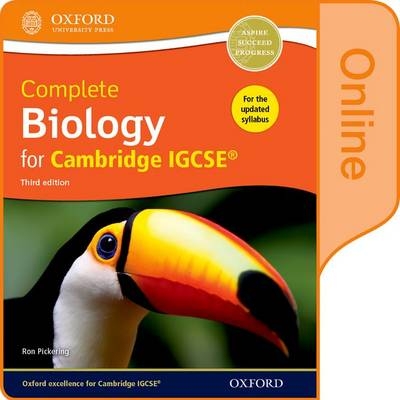
Complete Biology for Cambridge IGCSE® Online Student Book
Oxford University Press (Hersteller)
978-0-19-831033-4 (ISBN)
- Titel ist leider vergriffen;
keine Neuauflage - Artikel merken
Written by an experienced author, this online book is full of engaging content. Extension material stretches the highest ability students and prepares them to take the next step in their learning. Practice exam questions consolidate student understanding and prepare them for exam success.
The Online Book provides access to practice exam questions, revision checklists and advice on how to prepare for an examination.
1: Characteristics and classification of living organisms
1.1: Biology is the study of life and living organisms
1.2: The variety of life
1.3: Plants
1.4: Invertebrate animals
1.5: Vertebrate animals: five classes
Questions on characteristics and classification
1.6: Organisms are made up of cells
1.7: The organisation of living organisms
Questions on cells and organisation
2: Organisation and maintenance of organisms
2.1: Movement in and out of cells: diffusion
2.2: Movement in and out of cells: osmosis
Questions on diffusion and osmosis
2.3: All living things are made up of organic molecules
2.4: Testing for biochemicals
2.5: Enzymes control biochemical reactions in the living organisms
2.6: Enzyme experiments and the scientific method
Questions on enzymes and biological molecules
2.7: Photosynthesis and plant nutrition
2.8: The rate of photosynthesis
2.9: Leaf structure and photosynthesis
2.10: The control of photosynthesis
2.11: Photosynthesis and the environment
2.12: Plants and minerals
Questions on photosynthesis and plant nutrition
2.13: Food and the ideal diet: carbohydrates, lipids and proteins
2.14: Food and the ideal diet: vitamins, minerals, water and fibre
2.15: Food is the fuel that drives the processes of life
2.16: Balancing energy intake and energy demand: problems causing malnutrition
2.17: Animal nutrition converts food molecules to a usable form
2.18: Ingestion provides food for the gut to work on
2.19: Digestion prepares useful food molecules for absorption
2.20: Absorption and assimilation make food available
Questions on animal nutrition and health
2.21: Uptake of water and minerals by roots
2.22: Transport systems in plants
2.23: Transpiration: water movement through the plants
2.24: The leaf and water loss
2.25: Transport systems in animals use blood as the transport medium
2.26: The circulatory system
2.27: Capillaries: materials are exchanged between blood and tissues, and tissue is formed
2.28: The heart is the pump for the circulatory system
2.29: Coronary heart disease
Questions on circulation
2.30: Health and disease
2.31: Pathogens are organisms that cause disease
2.32: Preventing disease: safe food
2.33: Individuals and the community can fight disease together
2.34: Combating infection: blood and defence against disease
2.35: Antibodies and the immune response
2.36: Respiration provides the energy for life
2.37: Contraction of muscles requires energy supplied by respiration
2.38: The measurement of respiration
2.39: Gas exchange supplies oxygen for respiration
2.40: Breathing ventilates the lungs
Questions on gas exchange
2.41: Smoking and disease
2.42: How do we know that smoking causes disease?
2.43: Excretion: removal of the waste products of metabolism
2.44: Dialysis and the treatment of kidney failure
2.45: Homeostasis: maintaining a steady state
2.46: Control of body temperature
Questions on excretion and homeostasis
2.47: Coordination: the nervous system
2.48: Neurones can work together in reflex arcs
2.49: Integration by the central nervous system
2.50: Receptors and senses: the eye as a sense organ
Questions on receptors and senses
2.51: The endocrine system
Questions on hormones
2.52: Drugs and disorders of the nervous system
2.53: Sensitivity and movement in plants: tropisms
3: Development of organisms and the continuity of life
3.1: Reproduction is an important characteristic of living organisms
3.2: Reproduction in flowering plants: flowers
3.3: Pollination: the transfer of male sex cells to female flower parts
3.4: Fertilisation and the formation of seed and fruit
3.5: Germination of seeds
Questions on plant reproduction
3.6: Reproduction in humans
3.7: The menstrual cycle
3.8: Copulation and conception
3.9: Contraception
3.10: Pregnancy: the role of the placenta
3.11: Pregnancy: development and antenatal care
3.12: Birth and the newborn baby
3.13: Sexually transmitted infections
Questions on human reproduction
3.14: Variation and inheritance
3.15: DNA, proteins and the characteristics of organisms
3.16: How the code is carried
3.17: Cell division
3.18: Inheritance
3.19: Studying patterns of inheritance
3.20: Inherited medical conditions and codominance
3.21: Sex is determined by X and Y chromosomes
Questions on inheritance
3.22: Variation
3.23: Causes of variation
3.24: Variation and natural selection: the evolution of species
3.25: Natural selection
3.26: Artificial selection
Questions on variation
4: Organisms and their environment
4.1: Ecology and ecosystems
4.2: Flow of energy: food chains and food webs
4.3: Feeding relationships: pyramids of numbers, biomass and energy
4.4: Decay is a natural process
4.5: The carbon cycle
4.6: The nitrogen cycle
4.7: Water is recycled too!
Questions on ecosystems, decay and cycles
4.8: Factors affecting population size
4.9: Human population growth
4.10: Bacteria are useful in biotechnology and genetic engineering
4.11: Humans use enzymes from bacteria
4.12: Using fungi to produce antibiotics: drugs to control bacterial disease
4.13: Baking and brewing: the economic importance of yeast
Questions on bacteria
4.14: Genetic engineering
4.15: Food supply: humans and agriculture
4.16: Land use for agriculture
4.17: Damage to ecosystems: malnutrition and famine
4.18: Human impacts on the environment: pollution
4.19: Pollution of water: eutrophication
4.20: Humans may have a positive effect on the environment: conservation of species
4.21: Managing fish stocks: science and the fishing industry
4.22: Conservation efforts worldwide
4.23: Conservation of resources: recycling water by the treatment of sewage
4.24: Saving fossil fuels: fuel from fermentation
4.25: Recycling: management of solid waste
Questions on human impacts on ecosystems
5: Practical biology
5.1: Practical assessment
5.2: Laboratory equipment
Answers
Index
| Zusatzinfo | Colour |
|---|---|
| Verlagsort | Oxford |
| Sprache | englisch |
| Maße | 162 x 175 mm |
| Gewicht | 24 g |
| Themenwelt | Schulbuch / Wörterbuch |
| ISBN-10 | 0-19-831033-1 / 0198310331 |
| ISBN-13 | 978-0-19-831033-4 / 9780198310334 |
| Zustand | Neuware |
| Informationen gemäß Produktsicherheitsverordnung (GPSR) | |
| Haben Sie eine Frage zum Produkt? |


