


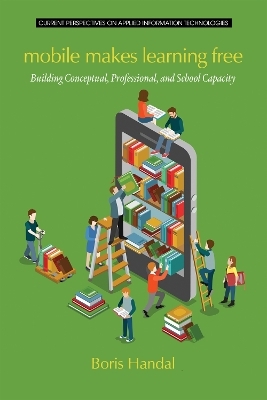
Mobile Makes Learning Free
Building Conceptual, Professional and School Capacity
Seiten
2015
Information Age Publishing (Verlag)
978-1-68123-283-6 (ISBN)
Information Age Publishing (Verlag)
978-1-68123-283-6 (ISBN)
This book explores best practices in mobile learning from schools in the US, Canada, and Australia. It includes case studies on modern pedagogies, digital citizenship, and professional development. The book offers strategies for principals and teachers to integrate mobile devices into teaching and learning.
The book provides new conceptual frameworks to understand good practice in the field of mobile learning. The book fills a gap in the current literature by drawing on examples of best practice from leading schools in the United States, Canada and Australia.
The author visited thirty educational sites and interviewed over 100 eminent teachers, principals, district superintendents and academics in the three aforementioned countries to study the implementation of mobile devices such as smartphones and tablets in teaching and learning.
During that period evidence and exemplars on issues that currently challenge educators worldwide such as modern pedagogies, digital citizenship, institutional change, equity and professional development were collected. The book presents a large number of case studies illustrating an effective integration of mobile learning and other technologies into the curriculum.
The contents include topics that are at the core of current attempts by educators to meet the demands of 21st century learning.
The book
- Addresses issues related to the delivery of mobile learning (e.g., smartphones, tablets)
- Presents real life scenarios from leading practitioners in the United States, Canada and Australia
- Introduces a four‐conversion model for whole‐school school transformation
- Provides principals with practical strategies to create effective communities of practice
- Provides teachers with best practice examples and recommendations for using mobile devices in teaching and learning
- Suggests practical activities and insights as to how to implement digital citizenship in schools
The book provides new conceptual frameworks to understand good practice in the field of mobile learning. The book fills a gap in the current literature by drawing on examples of best practice from leading schools in the United States, Canada and Australia.
The author visited thirty educational sites and interviewed over 100 eminent teachers, principals, district superintendents and academics in the three aforementioned countries to study the implementation of mobile devices such as smartphones and tablets in teaching and learning.
During that period evidence and exemplars on issues that currently challenge educators worldwide such as modern pedagogies, digital citizenship, institutional change, equity and professional development were collected. The book presents a large number of case studies illustrating an effective integration of mobile learning and other technologies into the curriculum.
The contents include topics that are at the core of current attempts by educators to meet the demands of 21st century learning.
The book
- Addresses issues related to the delivery of mobile learning (e.g., smartphones, tablets)
- Presents real life scenarios from leading practitioners in the United States, Canada and Australia
- Introduces a four‐conversion model for whole‐school school transformation
- Provides principals with practical strategies to create effective communities of practice
- Provides teachers with best practice examples and recommendations for using mobile devices in teaching and learning
- Suggests practical activities and insights as to how to implement digital citizenship in schools
Boris Handal, The University of Notre Dame, Australia.
Chapter 1. The Long Road to Mobile Learning.
Chapter 2. The Grasshopping Mind.
Chapter 3. The Ecology of Mobile Learning: What Are the Competing Agendas?
Chapter 4. The BYOD Game: How Much Freedom Should Students Have?
Chapter 5. Mobile Learning Strategies.
Chapter 6. Mobile Learning Wraps.
Chapter 7. Digital Citizenship: the New Citizenship.
Chapter 8. The Four School Conversions: the KITE Model.
Chapter 9. Kids as Players and Collaborators.
Chapter 10. Interest Groups as Community Mobilizers.
Chapter 11. Teachers as Learning Professionals.
Chapter 12. Executives as ChangeEnablers.
Chapter 13. Putting it All Together.
| Erscheinungsdatum | 25.09.2015 |
|---|---|
| Reihe/Serie | Current Perspectives on Applied Information Technologies |
| Sprache | englisch |
| Maße | 156 x 234 mm |
| Gewicht | 251 g |
| Themenwelt | Schulbuch / Wörterbuch ► Unterrichtsvorbereitung ► Unterrichts-Handreichungen |
| Sozialwissenschaften ► Pädagogik ► Allgemeines / Lexika | |
| ISBN-10 | 1-68123-283-9 / 1681232839 |
| ISBN-13 | 978-1-68123-283-6 / 9781681232836 |
| Zustand | Neuware |
| Informationen gemäß Produktsicherheitsverordnung (GPSR) | |
| Haben Sie eine Frage zum Produkt? |
Mehr entdecken
aus dem Bereich



aus dem Bereich
praxiserprobte Arbeitshilfen für Mentorinnen und Mentoren
Buch (2025)
Raabe (Verlag)
CHF 48,85
Flugsimulation mit Microsoft Flight Simulator, X-Plane, AeroflyFS und …
Buch | Softcover (2024)
Springer Fachmedien Wiesbaden (Verlag)
CHF 41,95


