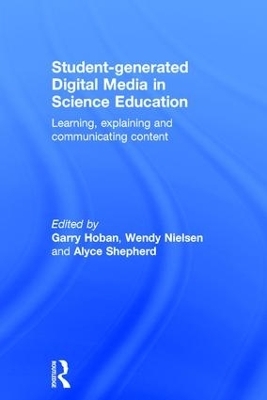
Student-generated Digital Media in Science Education
Routledge (Verlag)
978-1-138-83382-1 (ISBN)
Professors Susan Jones and Brian F. Yates, Australian Learning and Teaching Council Discipline Scholars for Science
"Represents a giant leap forward in our understanding of how digital media can enrich not only the learning of science but also the professional learning of science teachers."
Professor Tom Russell, Queen’s University, Ontario, Canada
"This excellent edited collection brings together authors at the forefront of promoting media creation in science by children and young people. New media of all kinds are the most culturally significant forms in the lives of learners and the work in this book shows how they can move between home and school and provide new contexts for learning as well as an understanding of key concepts."
Dr John Potter, London Knowledge Lab, Dept. of Culture, Communication and Media, University College London, UK
Student-generated Digital Media in Science Education supports secondary school teachers, lecturers in universities and teacher educators in improving engagement and understanding in science by helping students unleash their enthusiasm for creating media within the science classroom.
Written by pioneers who have been developing their ideas in students’ media making over the last 10 years, it provides a theoretical background, case studies, and a wide range of assignments and assessment tasks designed to address the vital issue of disengagement amongst science learners. It showcases opportunities for learners to use the tools that they already own to design, make and explain science content with five digital media forms that build upon each other— podcasts, digital stories, slowmation, video and blended media. Each chapter provides advice for implementation and evidence of engagement as learners use digital tools to learn science content, develop communication skills, and create science explanations. A student team’s music video animation of the Krebs cycle, a podcast on chemical reactions presented as commentary on a boxing match, a wiki page on an entry in the periodic table of elements, and an animation on vitamin D deficiency among hijab-wearing Muslim women are just some of the imaginative assignments demonstrated.
Student-generated Digital Media in Science Education illuminates innovative ways to engage science learners with science content using contemporary digital technologies. It is a must-read text for all educators keen to effectively convey the excitement and wonder of science in the 21st century.
Garry Hoban is Professor in the Faculty of Social Science at the University of Wollongong, Australia. Wendy Nielsen is Senior Lecturer in the Faculty of Social Science at the University of Wollongong, Australia. Alyce Shepherd is a PhD candidate in the Faculty of Social Science at the University of Wollongong, Australia.
Part 1. Twenty-first century science education 1. Promoting engagement in science education Wendy Nielsen 2. The case for student-generated digital media assignments in science courses Will Rifkin and Amelia Hine 3. Researching science learning through student-generated digital media Garry Hoban Part 2. Implementation in science discipline and science teacher education courses 4. Creative podcasting in chemistry: A case study Emma Bartle 5. Using digital stories to teach communication skills in the science curriculum Emily Purser 6. Stories and narratives: Using digital stories to learn science Pauline Ross 7. Video interviews in science and engineering for professional perspectives Julian Cox 8. Video blogs: A vehicle to support student-generated representations and explanations in chemistry Gwen Lawrie 9. Student-generated videos for inquiry-oriented projects in environmental science Gerry Rayner 10. Student-generated dynamic worked examples as videos to enhance learning in STEM Iouri Belski and Regina Belski 11. Students’ use of digital video in contemporary science teacher education Matthew Kearney, Kimberley Pressick-Kilborn and Peter Aubusson 12. Developing pedagogical knowledge of pre-service science teachers using slowmation as a shared experience Stephen Keast and Rebecca Cooper 13. Pre-service teachers’ use of slowmation: Developing transformative learning Gillian Kidman 14. Learner reflections on the use of slowmation as a tool for creating effective explanations in a science teacher education program Ruth Amos and Sandra Campbell 15. Using blended media as a pedagogical tool for science learning in the USA Dennis Jablonski 16. Multimedia production to promote an understanding of health literacy and communicate health messages Karma Pearce 17. Musical explanations: Using blended media for learning biochemistry Jessica Vanderlelie Part 3. Predictions for student-generated digital media 18. Future trends for student-generated digital media in science education Alyce Shepherd
| Erscheint lt. Verlag | 27.7.2015 |
|---|---|
| Zusatzinfo | 16 Tables, black and white; 6 Line drawings, black and white; 31 Halftones, black and white; 37 Illustrations, black and white |
| Verlagsort | London |
| Sprache | englisch |
| Maße | 156 x 234 mm |
| Gewicht | 612 g |
| Themenwelt | Schulbuch / Wörterbuch ► Unterrichtsvorbereitung ► Unterrichts-Handreichungen |
| Sozialwissenschaften ► Pädagogik ► Erwachsenenbildung | |
| Sozialwissenschaften ► Pädagogik ► Schulpädagogik / Sekundarstufe I+II | |
| ISBN-10 | 1-138-83382-7 / 1138833827 |
| ISBN-13 | 978-1-138-83382-1 / 9781138833821 |
| Zustand | Neuware |
| Informationen gemäß Produktsicherheitsverordnung (GPSR) | |
| Haben Sie eine Frage zum Produkt? |
aus dem Bereich