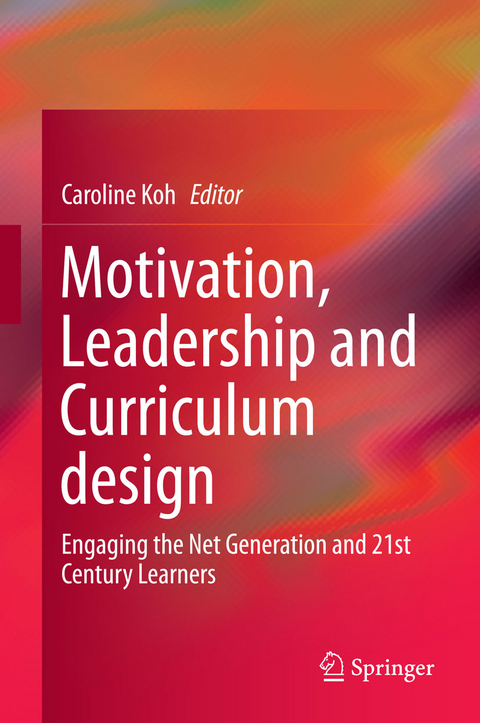
Motivation, Leadership and Curriculum Design (eBook)
VI, 256 Seiten
Springer Singapore (Verlag)
978-981-287-230-2 (ISBN)
Caroline Koh is Assistant Professor with the Psychological Studies Academic Group, National Institute of Education (NIE), Singapore. Prior to her current position at NIE, she taught at junior college level for a considerable number of years before a brief stint at the Ministry of Education Curriculum Planning and Development Division, Singapore. Her current teaching responsibilities include coordinating, developing curricula and conducting training for pre-service teachers, as well as professional development courses for experienced teachers. Her prime research focus is on Motivation and Learning, with a special interest in the use of the Self-determination theory in guiding research and classroom practice. In addition, she has conducted research on areas as diverse as group project work, moral development and reasoning, national education, the use of simulation-based learning, and most recently, the use of the e-portfolio as a pedagogical tool.
This book discusses the links between the basis of motivational, leadership and curricular constructs with regards to 21st century and net-generation learning. It brings together recent developments in motivation, educational leadership and curriculum design in order to offer a better understanding of what is already known and what is yet to be explored in these fields. It consists of a collection of findings on recent educational developments, including topics such as motivating the 21st century learner, leadership practices and influences, curriculum design and models, novel learning environments and 21st century learners and their needs.
Caroline Koh is Assistant Professor with the Psychological Studies Academic Group, National Institute of Education (NIE), Singapore. Prior to her current position at NIE, she taught at junior college level for a considerable number of years before a brief stint at the Ministry of Education Curriculum Planning and Development Division, Singapore. Her current teaching responsibilities include coordinating, developing curricula and conducting training for pre-service teachers, as well as professional development courses for experienced teachers. Her prime research focus is on Motivation and Learning, with a special interest in the use of the Self-determination theory in guiding research and classroom practice. In addition, she has conducted research on areas as diverse as group project work, moral development and reasoning, national education, the use of simulation-based learning, and most recently, the use of the e-portfolio as a pedagogical tool.
1. Understanding and facilitating learning for the Net Generation and 21st century learner through motivation, leadership and curriculum design.Caroline KohPART 1: MOTIVATING THE 21st CENTURY AND NET GEN LEARNERS 2. Identifying Factors Influencing Students’ Motivation and Engagement in Online CoursesDilani Gedera, John Williams and Noeline Wright3. Supporting the Needs of 21st century Learners: A Self-Determination Theory perspectiveW. L. Quint Oga-Baldwin4. Examining the Influence of the Big Five Personality Traits on the Relationship between Autonomy, Motivation and Academic Achievement in the 21st century LearnerKah Loong Chue5. Online Assessment and Learner Motivation in the 21st century Cathy Gunn6. Motivating Netizens to Develop Personal Knowledge management skillsAshwini Datt and Trudi Aspden7. The Promise of Well-Being for the Net GenerationCollie W. Conoley, Beatriz Bellow, Mercedes Oromendia and Jane Close ConoleyPART 2: LEADING 21st CENTURY LEARNING 8. A Closer Look at Developing Positive Learning Climate in the 21st century: The Role of Instructional Leadership PracticesIrene Ng 9. Leadership Influence on the 21st century Teacher’s Motivation for Professional DevelopmentMaria Sit10. Using Technology to Scaffold Problem-based Learning in Teacher Education: Its Tensions and Implications for Curriculum DesignersBee Leng Chua, Oon Seng Tan, Woon Chia Liu11. Motivating 21st century learners: The impact of an online reciprocal peer-tutoring initiative for foreign language learningConstanza Tolosa, Martin East and Helen Villers12. Leading Technology-Enhanced Learning: Upgrading the Digital Immigrants and Stretching the NativesCaroline Koh PART 3: CURRICULUM DESIGN AND PEDAGOGY FOR 21st CENTURY AND NET GEN LEARNERS 13. Designing Student Learning for a Networked WorldJudine Ladbrook and Judy Parr 14. Using Mobile Technologies to Provide Feedback on LearningAlan Ovens, Dawn Garbett and Rena Heap15. Maximizing the Benefit of Technology for Language LearningAlexander Yeung, Zhu Chen and Bingyi Li16. The Implementation of e-Networks to Support Inquiry Learning in ScienceJohn Williams17. The Use of Creative Problem Solving: Its Effect on Students’ Ability to Problem Find John Yeo18. The Playful Curriculum: Making Sense of Purposeful Play in the 21st century Pre-School ClassroomSusan SimEPILOGUE19. Linking Motivation, Leadership and Curriculum Design in 21st century Learning
| Erscheint lt. Verlag | 6.1.2015 |
|---|---|
| Zusatzinfo | VI, 256 p. 14 illus. |
| Verlagsort | Singapore |
| Sprache | englisch |
| Themenwelt | Schulbuch / Wörterbuch ► Unterrichtsvorbereitung ► Unterrichts-Handreichungen |
| Geisteswissenschaften | |
| Sozialwissenschaften ► Pädagogik ► Schulpädagogik / Grundschule | |
| Schlagworte | 21st Century learner • Curriculum Design • ICT in learning • Information Technology • Learning and leadership • Learning Design • Mobile techonlogies for learning • Motivational strategies • Motivation and learning • Net generation |
| ISBN-10 | 981-287-230-2 / 9812872302 |
| ISBN-13 | 978-981-287-230-2 / 9789812872302 |
| Informationen gemäß Produktsicherheitsverordnung (GPSR) | |
| Haben Sie eine Frage zum Produkt? |
 PDF (Wasserzeichen)
DRM: Digitales Wasserzeichen
Dieses eBook enthält ein digitales Wasserzeichen und ist damit für Sie personalisiert. Bei einer missbräuchlichen Weitergabe des eBooks an Dritte ist eine Rückverfolgung an die Quelle möglich.
Dateiformat: PDF (Portable Document Format)
Mit einem festen Seitenlayout eignet sich die PDF besonders für Fachbücher mit Spalten, Tabellen und Abbildungen. Eine PDF kann auf fast allen Geräten angezeigt werden, ist aber für kleine Displays (Smartphone, eReader) nur eingeschränkt geeignet.
Systemvoraussetzungen:
PC/Mac: Mit einem PC oder Mac können Sie dieses eBook lesen. Sie benötigen dafür einen PDF-Viewer - z.B. den Adobe Reader oder Adobe Digital Editions.
eReader: Dieses eBook kann mit (fast) allen eBook-Readern gelesen werden. Mit dem amazon-Kindle ist es aber nicht kompatibel.
Smartphone/Tablet: Egal ob Apple oder Android, dieses eBook können Sie lesen. Sie benötigen dafür einen PDF-Viewer - z.B. die kostenlose Adobe Digital Editions-App.
Buying eBooks from abroad
For tax law reasons we can sell eBooks just within Germany and Switzerland. Regrettably we cannot fulfill eBook-orders from other countries.
aus dem Bereich