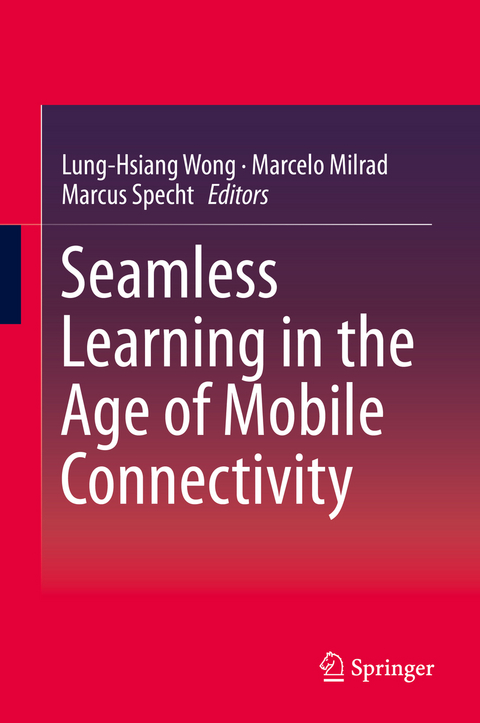
Seamless Learning in the Age of Mobile Connectivity (eBook)
500 Seiten
Springer Singapore (Verlag)
978-981-287-113-8 (ISBN)
The book departs from the approach of related titles by focusing on describing and reflecting upon the notion of seamless learning with regard to salient characteristics of learner mobility and bridging of learning experiences across learning spaces. It is the first such work that is solely dedicated to research on and the practice of seamless learning, uniquely combining interpretations, visions, and past research on and practices in seamless learning from diversified perspectives. The book also strikes a good balance between theoretical and practical perspectivess, going beyond a collection of reports on specific research projects. Instead of thick descriptions of research processes and findings, readers will find significant insights and food for thought intended to inspire further advances in the research on and practice of seamless learning.
Dr. Lung-Hsiang Wong is a Senior Research Scientist of the Learning Sciences Lab., National institute of Education, Nanyang Technological University, Singapore. His work involves the theorization of and pedagogical design for seamless learning, mobile learning, Computer-Assisted Language Learning, Computer-Supported Collaborative Learning, and teachers' professional development. He has published more than 150 peer-reviewed papers or chapters in journals, conferences and scholarly books and is known for developing the characterization model '10 Dimensions of Mobile-Assisted Seamless Learning.' He has co-written a scholarly book in Chinese, 'Move, Language Learning - Exploring Seamless Language Learning', to be published by Nanjing University Press.
Prof. Marcelo Milrad is a Full Professor of Media Technology at Linnaeus University, Sweden, and the director of the Center for Learning and Knowledge Technologies (CeLeKT). His current research interests include the design of learning environments to support learning about complex domains, collaborative discovery learning, and the development of mobile and wireless applications to support collaborative learning. He was one of the seventeen scholars who co-authored the seminal paper on seamless learning, namely, Chan et al. (2006).
Prof. Dr. Marcus Specht is Professor for Advanced Learning Technologies at Welten Institute (Research Center for Learning, Teaching and Technology) at the Open University of the Netherlands and director oft the Learning Innovation Labs. He received his Diploma in Psychology in 1995 and a Dissertation from the University of Trier in 1998 on adaptive information technology. From 2001 he headed the department 'Mobile Knowledge' at the Fraunhofer Institute for Applied Information Technology (FIT). His research focus is on Mobile and Contextualized Learning Technologies and Social and Immersive Media for Learning. Prof. Specht is an Apple Distinguished Educator and since 2013 President of the International Association of Mobile Learning.
The book departs from the approach of related titles by focusing on describing and reflecting upon the notion of seamless learning with regard to salient characteristics of learner mobility and bridging of learning experiences across learning spaces. It is the first such work that is solely dedicated to research on and the practice of seamless learning, uniquely combining interpretations, visions, and past research on and practices in seamless learning from diversified perspectives. The book also strikes a good balance between theoretical and practical perspectivess, going beyond a collection of reports on specific research projects. Instead of thick descriptions of research processes and findings, readers will find significant insights and food for thought intended to inspire further advances in the research on and practice of seamless learning.
Dr. Lung-Hsiang Wong is a Senior Research Scientist of the Learning Sciences Lab., National institute of Education, Nanyang Technological University, Singapore. His work involves the theorization of and pedagogical design for seamless learning, mobile learning, Computer-Assisted Language Learning, Computer-Supported Collaborative Learning, and teachers’ professional development. He has published more than 150 peer-reviewed papers or chapters in journals, conferences and scholarly books and is known for developing the characterization model “10 Dimensions of Mobile-Assisted Seamless Learning.” He has co-written a scholarly book in Chinese, “Move, Language Learning – Exploring Seamless Language Learning”, to be published by Nanjing University Press. Prof. Marcelo Milrad is a Full Professor of Media Technology at Linnaeus University, Sweden, and the director of the Center for Learning and Knowledge Technologies (CeLeKT). His current research interests include the design of learning environments to support learning about complex domains, collaborative discovery learning, and the development of mobile and wireless applications to support collaborative learning. He was one of the seventeen scholars who co-authored the seminal paper on seamless learning, namely, Chan et al. (2006).Prof. Dr. Marcus Specht is Professor for Advanced Learning Technologies at Welten Institute (Research Center for Learning, Teaching and Technology) at the Open University of the Netherlands and director oft the Learning Innovation Labs. He received his Diploma in Psychology in 1995 and a Dissertation from the University of Trier in 1998 on adaptive information technology. From 2001 he headed the department "Mobile Knowledge" at the Fraunhofer Institute for Applied Information Technology (FIT). His research focus is on Mobile and Contextualized Learning Technologies and Social and Immersive Media for Learning. Prof. Specht is an Apple Distinguished Educator and since 2013 President of the International Association of Mobile Learning.
Foreword 6
How We Came Up with Seamless Learning 6
Two Seams 8
Removing Seams by Linking Up People 10
Removing Seams by Blurring 12
Summary 14
References 15
Preface 18
Contents 22
About the Editors and Authors 26
Chapter Reviewers 36
Part I: Modeling and Theorizing Seamless Learning 38
Chapter 1: A Brief History of Mobile Seamless Learning 39
The Two Lives of Seamless Learning 39
The First Life: Reforming the Higher Education 39
The Second Life: One-to-One Goes Seamless 41
Scoping and Re-scoping Seamless Learning 42
The Conceptual Groundings 46
The Theoretical Expositions, and the Characterization and Ecological Frameworks for MSL 50
Theoretical Expositions of MSL 50
The Characterization Frameworks 52
The Ecological Frameworks 55
The Cognitive Frameworks 56
The Design Frameworks for MSL 57
“Deconstruction and Reconstruction” of the Curriculum 57
The Generic Learning Process Design Frameworks 58
Knowledge Construction Through Seamless Learning 60
Designing “Seamless” Field Trips, Digital Storytelling, and Domain-Specific Learning Processes 62
The Methodological Frameworks for MSL Research 63
The Technological Frameworks for MSL Practices 65
Learning Hub 65
Frameworks to Support Development and Organization of Seamless Learning Resources 66
Technology as “Enabler” or “Enhancer?” “Adaptivity” or “Adaptability?” 68
Conclusion: Bridging the Past and the Future 69
References 70
Chapter 2: Seamless Learning Despite Context 77
Introduction 77
The Flow of Learning 78
Flow and Computer Games 80
Connected Learning 83
Orchestration of Learning 85
Conclusions 89
References 90
Chapter 3: Framing Ubiquitous Mobility Educationally: Mobile Devices and Context-Aware Learning 92
Mobile Devices as Representational Resources 93
Context-Aware and Situated Mobile Learning 96
Towards a Pedagogical Perspective on Mobile Learning: Some Examples 99
A Biology and Chemistry Workshop in the Botanical Garden 100
A Scenario for Learners in Media Design 102
The Results from a German Field Study Around Episodic Planning 105
Discussion and Conclusion 107
References 107
Chapter 4: Employing a Framework to Examine the “Niche” for Mobile-Assisted Seamless Learning from an Ecological Perspective 110
Introduction 110
Literature 111
Seamless Learning from an Ecological Perspective – Distributed Cognition 111
Affordances and Affordance Networks 112
Effectivities and Effectivity Sets 112
Niches 113
Framework of the “Niche” for Seamless Learning 113
Application of the Framework 114
Background of the Study 114
Pedagogical Design of This Study 114
Examining the “Niche” for Inquiry into the “Anatomy of Fish” in Seamless Learning Activities 116
Activity 1: Engage and Explore (Out of Class) 116
Activity 2 Observe and Explain (in School Lab) 117
Activity 3 Reflect and Share 118
Implications of the Framework 121
Conclusion 124
References 124
Chapter 5: Self-regulation: A Critical Learner Characteristic for Seamless Learning 126
Introduction 126
Existing Efforts to Characterize Mobile Seamless Learning 127
Self-regulation as Agency: An Intrinsic Demand for Mobile Seamless Learning 129
Self-Regulated Learning 130
Definitions and Main Components of Self-Regulated Learning 130
Motivation 131
Metacognition 132
SRL as a Framework for Technology-Enhanced Learning 133
Understanding Mobile Seamless Learning Under the Lens of Self-Regulated Learning 134
Understanding Mobile Seamless Learning from the Theoretical Perspective of SRL 134
Measuring Mobile Seamless Learning from the SRL Methodological Perspective 135
An Analytic SRL Model of Mobile Seamless Learning 137
References 139
Chapter 6: Reflections on Case Studies in Mobile Seamless Learning 143
Introduction 143
My Sports Pulse 144
Ride and Drive 146
Combat Medic 147
Virtual Family 149
Discussion 150
References 151
Part II: Technology Enhanced Seamless Learning 152
Chapter 7: Connecting Learning Contexts with Ambient Information Channels 153
Introduction 153
The AICHE Model for Ambient Learning Support 155
Contextual Metadata, Filters, Synchronisation and Framing 159
What Is Different with Contextualised Learning Support? 160
Implementing Sensors, Indicators and Control Structures in Contextual Learning 163
Sensor-Based Interaction for Learner Support 163
Mobile Games and Inquiry Support as Control Structures 165
Augmented Reality and Situated Displays as Indicators 167
Summary and Discussion 168
References 170
Chapter 8: A Resource Organization Model for Ubiquitous Learning in a Seamless Learning Space 173
Introduction 173
Learning Cell Framework 175
Concept 175
U-Learning Process Based on Learning Cell 176
Core Features of Learning Cell 177
Learning Cell Runtime Environment 181
Learning Cell System Development 183
Functional Framework of LCS 184
Features of LCS 186
Application Scenario Analysis 187
Conclusion 189
References 189
Chapter 9: Supporting Seamless Learning Using Ubiquitous Learning Log System 191
Introduction 191
Related Works 193
Life-Log 193
Seamless Learning 193
Seamless Rate 194
Linking Method 195
SCROLL 196
Design 196
Interface 197
Mobile Interface 197
Web Interface 198
Textbook Database 199
Linking In-Class Learning with Outside-Class Learning 200
Linking One Learning Log with Another 200
Link Rate 201
Empirical Study with SCROLL 202
Method 202
Results 203
Discussion 206
Conclusions and Future Works 209
References 210
Chapter 10: Situated Learning Theory and Geo-collaboration for Seamless Learning 212
Introduction 213
Situated and Seamless Learning Activities Supported by Geo-localization 214
Situated Learning and Geo-localization 214
Seamless Learning in Situated Learning 217
Geo-collaborative Application for Learning Wireless Signal Propagation 219
The Software and Hardware 222
Coverage Analysis Tool 223
The Collaboration Tool 224
Geo-collaborative Application for “Learning with Patterns” 225
Learning with Patterns 225
Application Description 225
Conclusions 228
References 230
Chapter 11: Requirements for a Seamless Collaborative and Cooperative MLearning System 232
Background 232
Justification for Seamless Learning 235
The MoLODUF 235
The Approach 239
The Field Survey 239
Interviews/Focus Group Discussions 240
Review of Literature 240
Towards Requirements for a Seamless Collaborative and Cooperative MLearning System 241
Requirements from the MLearning Costs Dimension 241
Requirements from the MLearning Policy and Context Dimensions 242
Requirements from the MLearning Resources Dimension 242
Requirements from the MLearning Ethics Dimension 243
Requirements from the Learning Processes Dimension 243
Requirements from the MLearning Connectivity Dimension 244
Requirements from the MLearning Devices Dimension 245
Requirements from the MLearning Interface Dimension 246
Requirements from the MLearning Object User Dimension 246
MLearning Objects Dimension 246
Requirements from the MLearning Evaluation Dimension 248
Summary of Requirements 248
Seamless Collaborative and Cooperative MLearning System Prototype 248
The Prototype Collaborative MLearning Component 249
The Prototype Cooperative MLearning Component 250
The Prototype MLearning Administrative Component 250
Summary and Conclusion 252
References 252
Chapter 12: Scripting and Orchestration of Learning Across Contexts: A Role for Intelligent Agents and Data Mining 254
Introduction: New Opportunities for Learning Across Contexts 254
Scripting and Orchestration 256
Intelligent Agents for Scripting and Orchestration 257
New Pedagogical Models for Collective Inquiry 258
New Technology Supports for Collective Inquiry 260
Methods 262
Physics Learning Across Contexts and Environments (PLACE) 262
S3 Supports for PLACE: Learning Across Contexts 264
PLACE.web 264
PLACE.neo: Leveraging Student-Contributed Materials and Tagging for New Learning Contexts 268
Technology Implementation of PLACE.neo 269
Enactment of the PLACE Script 274
Student-Contributed Content 274
Using Peers’ Contributions: The Challenge Problem Script 276
Culminating Activity: Scripting and Orchestration Across Contexts 276
Agent Orchestration of the At-Home Activity 276
Agent Orchestration of the In-Class Activity 276
Agent Orchestration of the Smart Classroom Activity 277
Solving the Hollywood Physics Problems 278
Evaluating the PLACE Enactment: Did We Support a Knowledge Community Across Contexts? 279
Evaluating the S3 Software Agents Within PLACE 281
Content Agents 281
Activity Sequencing Agents 282
Grouping Agents 283
Transitions Across Contexts: Factors and Design Principles 283
Visualizations of Community Knowledge 284
Data Structures and Semantic Metadata Supports 284
The Orchestrational Role of Intelligent Software Agents 285
Conclusions and Future Directions 286
References 286
Part III: Pedagogies and Application Domains of Seamless Learning 289
Chapter 13: Mobile Seamless Learning and Its Pedagogy 290
Introduction 290
Ubiquitous Resources 293
Ubiquitous Learning 294
Seamless Connections 296
Seamless Learning 296
Towards a Pedagogical Framing of Seamless Learning 300
Context 301
The Nature of Learning 302
Technological Constellation and Non-technological Resources 303
An Example of Seamless Learning 304
Conclusion 306
References 307
Chapter 14: Language as a Bridge Connecting Formal and Informal Language Learning Through Mobile Devices 310
Introduction 310
Purposes of Language Learning 312
Language as a Bridge 314
Emergent Forms of Language Learning 316
Informal Language Learning in the City: Crossing Boundaries 317
Conclusion 320
References 320
Chapter 15: What Seams Do We Remove in Learning a Language?–Towards a Seamless Language Learning Framework 324
Introduction 324
Literature Review 325
Limitations of Traditional/Current Language Learning Practices 325
From Second Language Acquisition (SLA) to Task-Based [Language] Learning (TBL) 326
Mobile Seamless Learning (MSL) 329
Towards a Seamless Language Learning (SLL) Framework 330
Prior Seamless Language Learning Research 333
MyCLOUD: Our Instantiation of the SLL Framework 339
Conclusion 343
References 343
Chapter 16: Experiences of Using a Blended Mobile Learning Approach to Connect Classroom and In-Field Learning Activities in a Local Culture Course 347
Background and Objectives 347
Blended Mobile Learning Model 350
Example of Developing a Seamless Learning Environment for a Local Culture Course 353
Practical Application and Findings 355
Discussion and Conclusions 357
Future Research Issues 358
References 359
Chapter 17: What Makes the Design of Mobile Learning Trails Effective: A Retrospective Analysis 362
Introduction 363
Context for the Current Study 364
Research Context 364
Overall Design Structure 365
Designing Two Mobile Learning Trails 365
What Makes the Design of Mobile Learning Trails Effective 369
Establishing an Optimal Level of Novelty Space 370
Designing Tasks for Control and Context 371
Socio-technical Configuration for the Establishment of Common Grounds 373
Discussion and Conclusion 375
References 377
Chapter 18: Tell Your Story About History: A Mobile Seamless Learning Approach to Support Mobile Digital Storytelling (mDS) 380
Introduction 380
Combining Digital Storytelling and Mobility 381
Theoretical Foundations and Related Work 383
Our Principal mDS Studies: Design, Outcomes, and Progression 385
First mDS Pilot Study: Conceptualizing at the Kronoberg Ruined Castle (2011) 387
Second mDS Pilot Study: Local History with the Bäckaslöv School (2012) 390
Third mDS Pilot Study: A Long-Term Experience at the Ulriksberg School (2012/2013) 393
Part I: The Teachers 394
Part II: The Pupils 395
Discussion, Outcomes, and Upcoming Efforts 397
Appendix 401
References 402
Chapter 19: Challenges and Approaches to Seamless Learning in Security and Defense 404
Introduction 404
Conditions of Professional Learning and Training in Security and Defense 407
Seamless Learning 412
Approaches and Solutions 415
Ubiquitous Knowledge Access and Interoperability with Existing Infrastructure 415
Bridging Between Formal Learning and Practice 416
Embedding Anywhere-Anytime Learning into Educational Practices 418
Orchestrating Social Learning for Bridging Between Theory and Application 419
Challenges for Future Research and Development 420
References 422
Chapter 20: Mindergie: A Pervasive Learning Game for Pro-environmental Behaviour at the Workplace 424
Introduction 424
Related Work 425
Method and Context 426
Technologies 427
Game Structure and Gameplay 430
Game Components 430
Game Design 433
Gameplay 435
Data Analysis and Results 438
Discussion and Conclusions 441
References 442
Chapter 21: Seamless Learning from Proof-of-Concept to Implementation and Scaling-Up: A Focus on Curriculum Design 445
Introduction 445
A Curricular Innovation Informed by the Seamless Learning Notion 446
Principles for Designing and Enacting a Seamless Learning Curricular Innovation 448
Curriculum Enabled by Smartphones 455
Progression of the Mobilized Curriculum 456
Seamless Learning Scaling-Up 457
Conclusion 460
References 461
Part IV: Seamless Learning in Social Contexts 462
Chapter 22: Fragmented yet Seamless: System Integration for Supporting Cross-Context CSCL Scripts 463
Introduction 463
General Requirements Towards Designing of a Complex Script 465
Learner-Generated Content, ELOs, and Their Reuse in the Different Phases 466
Sample Cases: Integrating Mobile Elements in CSCL Scripts 467
My Village 468
Usability in Campus 468
Negotiation Styles 471
Summary and Concluding Remarks 474
References 475
Chapter 23: Supporting Seamless Learning Across Individual, Collaborative, and Community-Based Learning in One-to-One Learning Age 477
Introduction 478
Diverse Learning Activities Supported by HLDs 479
Individual Learning with HLDs 481
Collaborative Learning with HLDs 481
Community-Based Learning with HLDs 482
Gaps in Individual, Reciprocal, and Community-Based Learning 483
Gaps Between Individual Learning and Collaborative Learning 484
Gaps Between Individual/Collaborative and Community-Based Learning 486
Examples of Seamless Learning Across Multiple Scenarios 486
Bridging the Gap Between Individual Learning and Collaborative Learning 487
Bridging the Gap Between Community-Based Learning and Collaborative Learning 489
Conclusions and Future Direction 489
Concluding Remarks 490
Future Works 491
References 492
Chapter 24: Integrated Use of Multiple Social Software Tools and Face-to-Face Activities to Support Self-Regulated Learning: A Case Study in a Higher Education Context 495
Introduction 495
Self-Regulated Learning as the Theoretical Framework for Pedagogical Design 496
Technological Artefacts as Cognitive Tools for Supporting Self-Regulated Learning 499
Adequate Scaffolds to Support Seamless Learning Activities 500
Designing Self-Regulated Learning Activities by Using Macro-scripted Approach 501
Case Study: Integrated Use of Multiple Social Software Tools and Face-to-Face Activities in a Higher Education Course 503
Conclusions 505
References 506
Afterword 509
Ben Bachmair and Norbert Pachler 509
Dan Kohen-Vacs and Miky Ronen 510
Agnes Kukulska-Hulme 510
Jari Laru and Sanna Järvelä 511
Susanna Nordmark and Marcelo Milrad 511
Hiroaki Ogata, Noriko Uosaki, Mengmeng Li, Bin Hou, and Kousuke Mouri 512
Li Sha 512
Mike Sharples 512
Hyo-Jeong So, Esther Tan, Yu Wei, and Xujuan Zhang 513
Yanjie Song and Siu Cheung Kong 513
Marcus Specht 514
Mike Tissenbaum and James D. Slotta 514
Lung-Hsiang Wong 515
Shenquan Yu and Xianmin Yang 515
Recommended Reading List 516
Key Publications 516
Additional Reading 517
Index 519
| Erscheint lt. Verlag | 2.11.2014 |
|---|---|
| Zusatzinfo | XXXVI, 500 p. 129 illus. |
| Verlagsort | Singapore |
| Sprache | englisch |
| Themenwelt | Schulbuch / Wörterbuch ► Unterrichtsvorbereitung ► Unterrichts-Handreichungen |
| Geisteswissenschaften ► Psychologie ► Pädagogische Psychologie | |
| Sozialwissenschaften ► Pädagogik ► Schulpädagogik / Grundschule | |
| Sozialwissenschaften ► Soziologie | |
| Schlagworte | formal and informal learning • Learning and Instruction • mCSCL measure • mobile computator-supported collaborative learning • Mobile Learning • Seamless Learning • Technology Enhanced Learning • ubiquitous learning |
| ISBN-10 | 981-287-113-6 / 9812871136 |
| ISBN-13 | 978-981-287-113-8 / 9789812871138 |
| Informationen gemäß Produktsicherheitsverordnung (GPSR) | |
| Haben Sie eine Frage zum Produkt? |
 PDF (Wasserzeichen)
DRM: Digitales Wasserzeichen
Dieses eBook enthält ein digitales Wasserzeichen und ist damit für Sie personalisiert. Bei einer missbräuchlichen Weitergabe des eBooks an Dritte ist eine Rückverfolgung an die Quelle möglich.
Dateiformat: PDF (Portable Document Format)
Mit einem festen Seitenlayout eignet sich die PDF besonders für Fachbücher mit Spalten, Tabellen und Abbildungen. Eine PDF kann auf fast allen Geräten angezeigt werden, ist aber für kleine Displays (Smartphone, eReader) nur eingeschränkt geeignet.
Systemvoraussetzungen:
PC/Mac: Mit einem PC oder Mac können Sie dieses eBook lesen. Sie benötigen dafür einen PDF-Viewer - z.B. den Adobe Reader oder Adobe Digital Editions.
eReader: Dieses eBook kann mit (fast) allen eBook-Readern gelesen werden. Mit dem amazon-Kindle ist es aber nicht kompatibel.
Smartphone/Tablet: Egal ob Apple oder Android, dieses eBook können Sie lesen. Sie benötigen dafür einen PDF-Viewer - z.B. die kostenlose Adobe Digital Editions-App.
Buying eBooks from abroad
For tax law reasons we can sell eBooks just within Germany and Switzerland. Regrettably we cannot fulfill eBook-orders from other countries.
aus dem Bereich