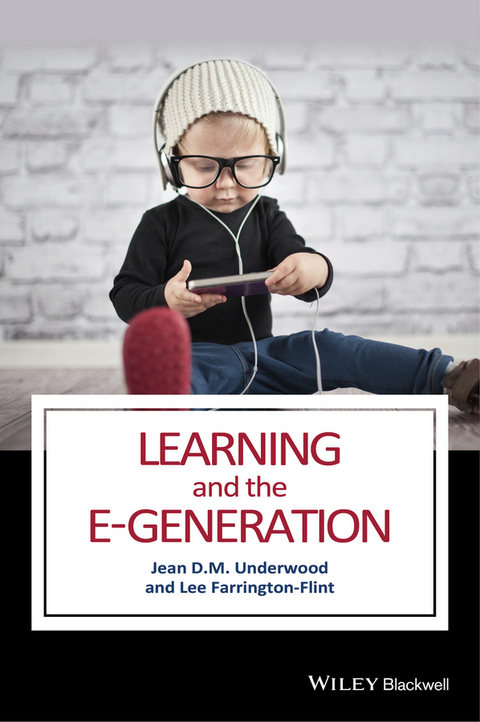
Learning and the E-Generation (eBook)
John Wiley & Sons (Verlag)
978-1-118-89756-0 (ISBN)
Learning and the E-Generation examines the impact of new and emerging digital technologies—from computers and tablets to social media and video games—on learners in formal and informal settings.
- Assesses the psychological factors at play, including social, cognitive, and behavioral characteristics that are influenced by exposure to technology
- Addresses the risks and benefits of 21st century digital technology on children and young adults
- Written by two experts in the field who draw on the latest research and practice from psychology, neuroscience, and education
- Discusses the potential of technology to make the learning process more authentic and engaging, as well as the obstacles which can prevent this from happening effectively
Jean D. M. Underwood is Professor Emeritus of Psychology at Nottingham Trent University, UK. She has published extensively on the effects of technology identifying the cognitive and social factors that facilitate and inhibit effective learning with and through digital technologies. She is the co-editor of several books, including Learning Through Digital Technologies (2007) and Integrated Learning Systems: Potential into Practice (1997).
Lee Farrington-Flint is Lecturer in Developmental Psychology at the Centre for Research in Education & Educational Technology at The Open University, UK. He has published on the topic of early language and literacy skills and early arithmetic development, and the role of digital technology on children’s communication and learning. His work has appeared in the Journal of Research in Reading, British Journal of Developmental Psychology, and Educational Psychology, among other top journals.
Jean D. M. Underwood is Professor Emeritus of Psychology at Nottingham Trent University, UK. She has published extensively on the effects of technology identifying the cognitive and social factors that facilitate and inhibit effective learning with and through digital technologies. She is the co-editor of several books, including Learning Through Digital Technologies (2007) and Integrated Learning Systems: Potential into Practice (1997). Lee Farrington-Flint is Lecturer in Developmental Psychology at the Centre for Research in Education & Educational Technology at The Open University, UK. He has published on the topic of early language and literacy skills and early arithmetic development, and the role of digital technology on children's communication and learning. His work has appeared in the Journal of Research in Reading, British Journal of Developmental Psychology, and Educational Psychology, among other top journals.
"Summing Up: Recommended. Upper-division undergraduates; faculty/researchers; professionals." (Choice, 1 December 2015)
Chapter One
Learning in a Digital World
Starting Points
It is two decades since Computers and learning: Helping children acquire thinking skills was published (Underwood & Underwood, 1990). This sequel text is entitled Learning and the e-generation as a recognition that the digital contexts in which individuals now learn has irrevocably changed. The new generation of students, for whom digital technologies are the norm, has grown up during the rise of the World Wide Web and uses technology at home and in school for learning and entertainment. Their use of digital media is expanding and their culture will have a major impact on the rest of society. They now use online resources as a preferred option and as a consequence headlines such as ‘Libraries dump 2m volumes’ (Atwood, 2007, p. 1) mark the move from paper to digital technology storage and the demand from students for more space for virtual-learning study areas. It is not that the students have abandoned libraries; they are simply reshaping their use. Video game playing, for example, has taught them to place less reliance on manuals or experts. Students use Google rather than use the library’s web pages: they are used to figuring things out for themselves and their reliance on the expert, in this case the librarian, is diminishing (Lippincott, 2005). Outside the classroom, everyday events such as paying the London congestion charge or finding the time of the next bus are facilitated by a savvy use of technology.
In 1990 we noted that classroom computers were now commonplace and we asked the question would any good come of it? We were cautiously confident of the value of educational computers. Has that state of restrained optimism changed and, 20 years on, is there reliable evidence of the impact of computer use on the cognitive, and indeed social and emotional development of the learner? There is compelling evidence that technology is changing the lives of many children and young adults in ways that we had not originally anticipated. With the rise in Web 2.0 technologies and new social media, learners have greater access to a range of digital tools for collaborating, communicating and exchanging ideas. Learners can share common interests, photos, music and videos and maintain active social relationships with friends, acquaintances and even strangers through a range of online communication tools. Facebook along with other social networking tools such as YouTube (video sharing), Flickr (photo sharing) and Blogger (interactive online diary) are incredibly popular among many learners and this popularity reflects a shift towards acquiring a range of new digital literacy skills beyond those of simply using a traditional computer. Technology is also being used in quite creative and innovative ways, invading every aspect of our lives, as Palmer acknowledges below:
It is only in the last couple of decades that electronic speed has overtaken real time, as technology has invaded every aspect of our life and work. PCs, the Internet, the web and mobile phones mean that the (Marshal McLuhan’s) electronic (global) village is around us 24/7, whether we like it or not.
(Palmer, 2006, p. 253)
It seems that we are now part of this extensive, global electronic village that shapes every aspect of our social lives. However, the rise in Web 2.0 technologies and the affordances of digital tools now challenges the relevance of our initial question. The digital world is here to stay and even if we decide not to fund resources into schools, as some are arguing should be the policy, the net generation will use the technology from home, in the streets and in every other aspect of the lives. The current generation of students is able to work with technologies in ways not thought of by even their elder siblings. The Test Bed project has shown children as young as 5 years of age happily working with digital cameras and editing photos to produce their own web pages, while in the secondary sector students are producing home movies and composing and recording music (Underwood, Dillon & Twining, 2007). Furthermore, communication has been transformed through the Internet. It is estimated that there are in excess of 27.2 million weblogs and the blogosphere continues to double about every 5.5 months. There are about 75,000 new weblogs created every day and 1.2 million posts per day on average (Sifry, 2006). These creative activities are not just for home or school consumption, the audience is now worldwide using YouTube or GoogleVideo for videos or Myspace, Facebook or Bebo to link to friends. As Green and Hannon (2007) point out these students are connecting, exchanging and creating in new ways, which appear quite unfamiliar to many parents and teachers (Banyard, Underwood, & Twiner, 2006).
So the question now is how do we make the best use of these digital technologies? There are many who would argue that the functions offered by Web 2.0 technologies have the potential to offer increased learning opportunities for students and young adults (see, for example, Bennett, Bishop, Dalgano, Waycott, & Kennedy, 2012; Contarello & Sarrica, 2007). Can we identify the ‘what’ and the ‘how’ of the impact that the major advances in and increased accesses to digital technologies are having on the development of the net generation? A second equally important question is can we identify and support those who have not yet joined the net generation? Throughout our own research (Underwood, Baguley, et al., 2007, 2009) there has been a persistent minority of some 10 per cent of students who have minimal access to computers and the Internet outside school, a finding confirmed by Madell and Muncer’s (2004) survey of 1,340 11-to-16 year olds in the north of England, which showed a large proportion of students simply did not have access to new digital technologies. These findings highlight the equity issues associated with the use of digital technologies for learning. Although cheap technologies such as the Raspberry Pi1 and the £30 UbiSlate 7Ci tablet2, which have recently entered the educational marketplace, is suspected to go some way to alleviating the issue of access, there are still a minority of individuals for whom this technology is unavailable.
There is little doubt that the prolific rise in our access to digital technologies is having a marked effect on how we learn and think. Johnson (2005) asserts that popular culture, to a large extent stimulated by rapid developments in digital technologies, has presented us with an increasingly complex, problem-orientated and intellectually challenging world. This is the antithesis of the ‘couch-potato’ perspective of the impact on the cultures evoked by digital technologies. Johnson’s book, Everything bad is good for you, has reinvigorated and redirected the debate on the impact of technology in a way reminiscent of Papert’s (1980) Mindstorms: Children, computers and powerful ideas. However, surprisingly three decades after the first computers were introduced into mainstream classrooms, the educational use of digital technologies still remains controversial. As with the introduction of earlier technologies, the spread of digital technologies, especially the Internet, arouses passionate debate about the consequences ensuing from technological change and innovation (Marvin, 1988; Southwell & Doyle, 2004). As Underwood (2006) points out the digital world is now an everyday reality but does this new reality bring benefits or costs to education? Is this too simplistic a dichotomy and, as Southwell and Doyle have argued, can both divergent positions be simultaneously correct? Here we investigate the challenge of digital technologies on learner behaviours across both formal and informal settings.
Hopes, Dreams and Nightmares
There are many who question the importance of digital technologies for education (see Selwyn, 2006; Underwood & Dillon, 2004, for a fuller debate) and vociferous arguments have been put forward to support the conclusion that, far from enhancing education, ICT is a drain on our educational system (see Cuban, 2001; Cuban, Kirkpatrick, & Peck, 2001; Oppenheimer, 2003). This perception clearly articulated in the title of Oppenheimer’s text, The flickering mind: The false promise of technology in the classroom and how learning can be saved. Notwithstanding this doom-laden title, Oppenheimer acknowledges, ‘Computers can, in select cases, be wonderfully useful to school’ (p. 411). For instance, the effectiveness of technology in supporting students with special educational needs is accepted by most. This is exemplified by work such as that of Standen and Brown (2005), which has shown the benefits of virtual reality as a tool to practise skills needed to function in society. These vulnerable students manipulated a virtual world safely, without being exposed to potentially humiliating or dangerous consequences, thus allowing them to develop skills such as grocery shopping, preparing food, orientation, road safety and manufacturing skills before facing a bewildering, and for some threatening, real world. The aim of this learning experience was to facilitate independence by transferring skills acquired virtually to the real world. Parsons and Mitchell (2002) have similar positive findings from virtual reality training of social skills with adults on the autism spectrum. The use of technology also allows those with special educational needs to demonstrate competencies thought to be beyond them....
| Erscheint lt. Verlag | 23.12.2014 |
|---|---|
| Sprache | englisch |
| Themenwelt | Schulbuch / Wörterbuch ► Unterrichtsvorbereitung ► Unterrichts-Handreichungen |
| Geisteswissenschaften ► Psychologie ► Allgemeine Psychologie | |
| Geisteswissenschaften ► Psychologie ► Entwicklungspsychologie | |
| Geisteswissenschaften ► Psychologie ► Pädagogische Psychologie | |
| Sozialwissenschaften ► Pädagogik | |
| Schlagworte | Bildungswesen • Education • Educational & School Psychology • Erziehungs- u. Schulpsychologie • Individual learning, developmental psychology, cognitive psychology, educational psychology, technology in the classroom, online, digital technology, e-learning, psychology, neuroscience, education, cognitive science, media studies, e-readers, social media, video games • Lernen • Pädagogik • Psychologie • Psychology • Schulpsychologie • Theorie der Pädagogik • Theory of Education |
| ISBN-10 | 1-118-89756-0 / 1118897560 |
| ISBN-13 | 978-1-118-89756-0 / 9781118897560 |
| Informationen gemäß Produktsicherheitsverordnung (GPSR) | |
| Haben Sie eine Frage zum Produkt? |
 EPUB (Adobe DRM)
Kopierschutz: Adobe-DRM
Adobe-DRM ist ein Kopierschutz, der das eBook vor Mißbrauch schützen soll. Dabei wird das eBook bereits beim Download auf Ihre persönliche Adobe-ID autorisiert. Lesen können Sie das eBook dann nur auf den Geräten, welche ebenfalls auf Ihre Adobe-ID registriert sind.
Details zum Adobe-DRM
Dateiformat: EPUB (Electronic Publication)
EPUB ist ein offener Standard für eBooks und eignet sich besonders zur Darstellung von Belletristik und Sachbüchern. Der Fließtext wird dynamisch an die Display- und Schriftgröße angepasst. Auch für mobile Lesegeräte ist EPUB daher gut geeignet.
Systemvoraussetzungen:
PC/Mac: Mit einem PC oder Mac können Sie dieses eBook lesen. Sie benötigen eine
eReader: Dieses eBook kann mit (fast) allen eBook-Readern gelesen werden. Mit dem amazon-Kindle ist es aber nicht kompatibel.
Smartphone/Tablet: Egal ob Apple oder Android, dieses eBook können Sie lesen. Sie benötigen eine
Geräteliste und zusätzliche Hinweise
Buying eBooks from abroad
For tax law reasons we can sell eBooks just within Germany and Switzerland. Regrettably we cannot fulfill eBook-orders from other countries.
aus dem Bereich