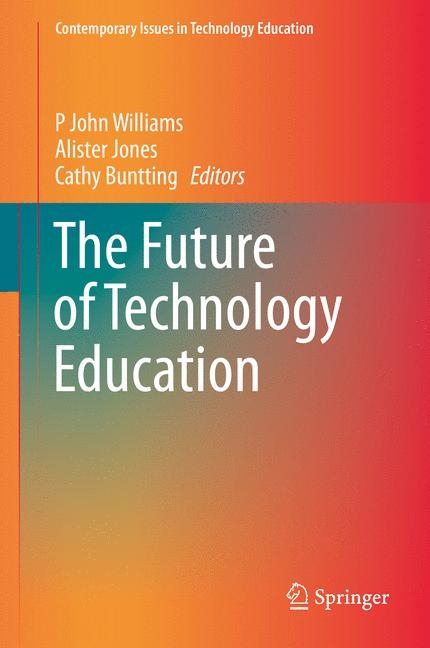
The Future of Technology Education (eBook)
XII, 281 Seiten
Springer Singapore (Verlag)
978-981-287-170-1 (ISBN)
Twenty-five years ago there was increasing optimism in policy, curriculum and research about the contribution that technology education might make to increased technological literacy in schools and the wider population. That optimism continues, although the status of technology as a learning area remains fragile in many places.
This edited book is offered as a platform from which to continue discussions about how technology education might progress into the future, and how the potential of technology education to be truly relevant and valued in school learning can be achieved.
The book results from a collaboration between leading academics in the field, the wider group of authors having had input into each of the chapters. Through the development of a deep understanding of technology, based on a thoughtful philosophy, pathways are discussed to facilitate student learning opportunities in technology education. Consideration is given to the purpose(s) of technology education and how this plays out in curriculum, pedagogies, and assessment. Key dimensions, including design, critique, students' cultural capital are also explored, as are the role and place of political persuasion, professional organisations, and research that connects with practice.
The discussion in the book leads to a conclusion that technology education has both an ethical and moral responsibility to support imaginings that sustain people and communities in harmony and for the well being of the broader ecological and social environment.
The editors work together at the University of Waikato in New Zealand.
John Williams is a professor and Director of the Technology, Environmental, Mathematics and Science Education Research Centre at the University of Waikato in New Zealand, where he teaches and supervises research students in technology education. His current research interests include mentoring beginning teachers, PCK, and electronic assessment of performance. In 2011 he was elected to the International Technology and Engineering Education Association's Academy of Fellows for prominence in the profession.
Alister Jones is a Research Professor and Deputy Vice-Chancellor of the University of Waikato. Prior to this he was Dean of Education and the Director of the Wilf Malcolm Institute of Educational Research and the Centre for Science and Technology Education Research. He contributed significantly to the development of the technology curriculum in New Zealand, and has published extensively in technology and science education as well as general education. He is Director of a number of companies, including Cognition Education Limited, and Managing Director of the Australasian Science Education Research Association Limited.
Cathy Buntting has a background in biochemistry and biotechnology research and teaching and a PhD in education. She holds a senior research position within the University of Waikato, New Zealand, and currently manages the internationally recognised Biotechnology and Science Learning Hubs. Her research interests focus on how digital technologies can transform science and technology teaching and learning, and on the development of science and technology education policy.
Twenty-five years ago there was increasing optimism in policy, curriculum and research about the contribution that technology education might make to increased technological literacy in schools and the wider population. That optimism continues, although the status of technology as a learning area remains fragile in many places. This edited book is offered as a platform from which to continue discussions about how technology education might progress into the future, and how the potential of technology education to be truly relevant and valued in school learning can be achieved. The book results from a collaboration between leading academics in the field, the wider group of authors having had input into each of the chapters. Through the development of a deep understanding of technology, based on a thoughtful philosophy, pathways are discussed to facilitate student learning opportunities in technology education. Consideration is given to the purpose(s) of technology education and how this plays out in curriculum, pedagogies, and assessment. Key dimensions, including design, critique, students' cultural capital are also explored, as are the role and place of political persuasion, professional organisations, and research that connects with practice. The discussion in the book leads to a conclusion that technology education has both an ethical and moral responsibility to support imaginings that sustain people and communities in harmony and for the well being of the broader ecological and social environment.
The editors work together at the University of Waikato in New Zealand. John Williams is a professor and Director of the Technology, Environmental, Mathematics and Science Education Research Centre at the University of Waikato in New Zealand, where he teaches and supervises research students in technology education. His current research interests include mentoring beginning teachers, PCK, and electronic assessment of performance. In 2011 he was elected to the International Technology and Engineering Education Association’s Academy of Fellows for prominence in the profession. Alister Jones is a Research Professor and Deputy Vice-Chancellor of the University of Waikato. Prior to this he was Dean of Education and the Director of the Wilf Malcolm Institute of Educational Research and the Centre for Science and Technology Education Research. He contributed significantly to the development of the technology curriculum in New Zealand, and has published extensively in technology and science education as well as general education. He is Director of a number of companies, including Cognition Education Limited, and Managing Director of the Australasian Science Education Research Association Limited. Cathy Buntting has a background in biochemistry and biotechnology research and teaching and a PhD in education. She holds a senior research position within the University of Waikato, New Zealand, and currently manages the internationally recognised Biotechnology and Science Learning Hubs. Her research interests focus on how digital technologies can transform science and technology teaching and learning, and on the development of science and technology education policy.
Chapter 1The more things change, the more (some) things stay the sameCathy Buntting, John Williams, Alister Jones Chapter 2‘Seeing’ and ‘interpreting’ the Human-Technology phenomenon Steve KeirlChapter 3 Theorising technology education from a cultural-historical perspective: Foundations and future imaginingsMarilyn Fleer Chapter 4Indigenous technology in Technology Education curricula and teachingMishack T Gumbo Chapter 5The Pedagogical Ecology of Technology Education: An Agenda for Future Research and Development David MioduserChapter 6 Conversations to Support Learning in Technology EducationWendy Fox-Turnbull Chapter 7 Assessment: feedback from our pasts, feedforward for our futuresKay StablesChapter 8Developing a technology curriculumDavid Barlex Chapter 9Developing a Deeper Understanding of Design in Technology Education.David Spendlove Chapter 10The Alignment of Technology with Other School SubjectsCathy Buntting and Alister JonesChapter 11 Vocational and General Technology EducationJohn Williams Chapter 12Technology Education and Developing CountriesFrank Banks and Vanwyk ChikasandaChapter 13 Politics and PolicyKendall N. Starkweather Chapter 14Research Challenges for the Future Marc J. de Vries Chapter 15Much remains to be doneAlister Jones, Cathy Buntting, John Williams
| Erscheint lt. Verlag | 17.11.2014 |
|---|---|
| Reihe/Serie | Contemporary Issues in Technology Education | Contemporary Issues in Technology Education |
| Zusatzinfo | XII, 281 p. 11 illus., 4 illus. in color. |
| Verlagsort | Singapore |
| Sprache | englisch |
| Themenwelt | Schulbuch / Wörterbuch |
| Geisteswissenschaften | |
| Sozialwissenschaften ► Pädagogik ► Erwachsenenbildung | |
| Sozialwissenschaften ► Pädagogik ► Vorschulpädagogik | |
| Schlagworte | cultural-historical theory • Design and technology • Education futures • Education Policy • Education research • Indigenous knowledge • Kay Stables • Pedagogical ecology • Pedagogy and technology • School assessment • Scientific, technical, engineering and mathematics education • Teaching Technology • technology assessment • Technology curriculum • Technology Education • Technology education and developing countries • Technology Education curricula |
| ISBN-10 | 981-287-170-5 / 9812871705 |
| ISBN-13 | 978-981-287-170-1 / 9789812871701 |
| Informationen gemäß Produktsicherheitsverordnung (GPSR) | |
| Haben Sie eine Frage zum Produkt? |
 PDF (Wasserzeichen)
DRM: Digitales Wasserzeichen
Dieses eBook enthält ein digitales Wasserzeichen und ist damit für Sie personalisiert. Bei einer missbräuchlichen Weitergabe des eBooks an Dritte ist eine Rückverfolgung an die Quelle möglich.
Dateiformat: PDF (Portable Document Format)
Mit einem festen Seitenlayout eignet sich die PDF besonders für Fachbücher mit Spalten, Tabellen und Abbildungen. Eine PDF kann auf fast allen Geräten angezeigt werden, ist aber für kleine Displays (Smartphone, eReader) nur eingeschränkt geeignet.
Systemvoraussetzungen:
PC/Mac: Mit einem PC oder Mac können Sie dieses eBook lesen. Sie benötigen dafür einen PDF-Viewer - z.B. den Adobe Reader oder Adobe Digital Editions.
eReader: Dieses eBook kann mit (fast) allen eBook-Readern gelesen werden. Mit dem amazon-Kindle ist es aber nicht kompatibel.
Smartphone/Tablet: Egal ob Apple oder Android, dieses eBook können Sie lesen. Sie benötigen dafür einen PDF-Viewer - z.B. die kostenlose Adobe Digital Editions-App.
Buying eBooks from abroad
For tax law reasons we can sell eBooks just within Germany and Switzerland. Regrettably we cannot fulfill eBook-orders from other countries.
aus dem Bereich