


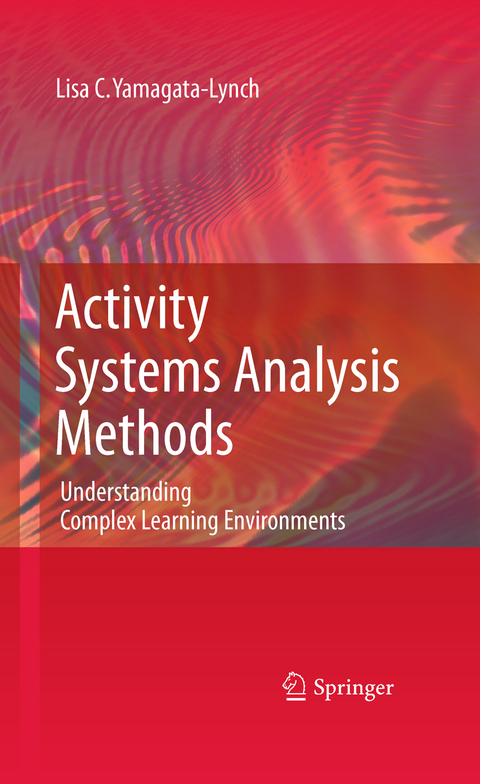
Activity Systems Analysis Methods
Understanding Complex Learning Environments
Seiten
2014
|
2010 ed.
Springer-Verlag New York Inc.
978-1-4899-9190-4 (ISBN)
Springer-Verlag New York Inc.
978-1-4899-9190-4 (ISBN)
In the last two decades, there has been growing interest in pursuing theoretical paradigms that capture complex learning situations. Cultural Historical Activity Theory (CHAT) is one of several theoretical frameworks that became very popular among educational researchers because it conceptualizes individuals and their environment as a holistic unit of analysis. It assumes a non-dualistic ontology and acknowledges the complexities involved in human activity in natural settings. Recently, reputable journals such as the American Psychologist, Educational Psychologist, and Educational Researcher that are targeted for a wide-range of audience have included articles on CHAT. In many of such articles, CHAT has been referred to as social constructivism, sociocultural theory, or activity theory.
Activity systems analysis is one of the popular methods among CHAT researchers for mapping complex human interactions from qualitative data. However, understanding the methods involved in activity systems analysis is a challenging task for many researchers. This difficulty derives from several reasons. First the original texts of CHAT are in Russian and there have been numerous authors who report on the difficulties of reconciling translation problems of the works of original authors’ such as Vygotsky and Leontiev. Second, in North America activity systems analysis has deviated from the Russian scholars’ intentions and Engeström’s original work using the triangle model to identify tensions to overcome and bring about sociopolitical change in participant practices. Third, to this date there are numerous publications on the theoretical background of activity theory and studies reporting the results of using activity systems analysis for unpacking qualitative data sets, but there have been no methodological publications on how researchers engage in activity systems analysis. Thus, there is a dearth of literature in both book and journal publications that guide researchers on themethodological issues involving activity systems analysis.
Activity systems analysis is one of the popular methods among CHAT researchers for mapping complex human interactions from qualitative data. However, understanding the methods involved in activity systems analysis is a challenging task for many researchers. This difficulty derives from several reasons. First the original texts of CHAT are in Russian and there have been numerous authors who report on the difficulties of reconciling translation problems of the works of original authors’ such as Vygotsky and Leontiev. Second, in North America activity systems analysis has deviated from the Russian scholars’ intentions and Engeström’s original work using the triangle model to identify tensions to overcome and bring about sociopolitical change in participant practices. Third, to this date there are numerous publications on the theoretical background of activity theory and studies reporting the results of using activity systems analysis for unpacking qualitative data sets, but there have been no methodological publications on how researchers engage in activity systems analysis. Thus, there is a dearth of literature in both book and journal publications that guide researchers on themethodological issues involving activity systems analysis.
Activity Systems Analysis and Its Value.- Understanding Cultural Historical Activity Theory.- Activity Systems Analysis Critics.- Examples of Activity Systems Analysis Used in Research for Various Purposes.- Qualitative Research in Activity Systems Analysis.- In-Depth Examples of Activity Systems Analysis Research.- Concluding Remarks.
| Erscheint lt. Verlag | 17.10.2014 |
|---|---|
| Zusatzinfo | XVI, 148 p. |
| Verlagsort | New York |
| Sprache | englisch |
| Maße | 155 x 235 mm |
| Themenwelt | Schulbuch / Wörterbuch ► Unterrichtsvorbereitung ► Unterrichts-Handreichungen |
| Geisteswissenschaften ► Psychologie ► Allgemeine Psychologie | |
| Geisteswissenschaften ► Psychologie ► Pädagogische Psychologie | |
| Sozialwissenschaften ► Pädagogik ► Bildungstheorie | |
| Sozialwissenschaften ► Pädagogik ► Schulpädagogik / Grundschule | |
| ISBN-10 | 1-4899-9190-5 / 1489991905 |
| ISBN-13 | 978-1-4899-9190-4 / 9781489991904 |
| Zustand | Neuware |
| Informationen gemäß Produktsicherheitsverordnung (GPSR) | |
| Haben Sie eine Frage zum Produkt? |
Mehr entdecken
aus dem Bereich



aus dem Bereich
praxiserprobte Arbeitshilfen für Mentorinnen und Mentoren
Buch (2025)
Raabe (Verlag)
CHF 48,85
Flugsimulation mit Microsoft Flight Simulator, X-Plane, AeroflyFS und …
Buch | Softcover (2024)
Springer Fachmedien Wiesbaden (Verlag)
CHF 41,95


