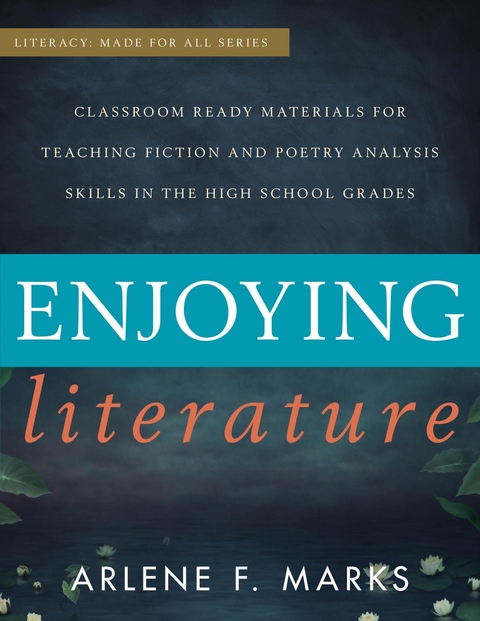
Enjoying Literature (eBook)
270 Seiten
Rowman & Littlefield Publishers (Verlag)
978-1-4758-0740-0 (ISBN)
Arlene Marks began both writing and teaching at an early age: she loved playing school with younger neighborhood children on weekday afternoons, passing on what she had learned in school that day. Still passionate about education, she is now a multi-published author, editor, and teacher of English, literacy and writing with more than twenty years of experience in the high school classroom.
IntroductionImplementing the programAims and Objectives of the programA. STUDYING FICTION Introduction/Aims and ObjectivesAssignment 1: Examine the Themes of the StoryStudents look at the superficial and underlying themes in the story and how they are purposefully delivered by the characters, plot, setting and writing style of the author.Reproducibles/Media:SFR 1 -- Theme Is Everywhere (chart)SFR 1A -- Theme Is Everywhere (exemplar chart filled out)Assignment 2: Appreciate the Realism of the StoryStudents examine the interplay of plot logic, character consistency and setting description that combine to draw the reader into a story.Reproducibles/Media:SFR 2 -- Elements of Realism Chart 1SFR 3 -- Elements of Realism Chart 2Assignment 3: Chart the Dramatic Conflict of the StoryStudents review the elements of dramatic conflict and discover its importance in creating an emotionally satisfactory short story.Reproducibles/Media:SFR 4 -- Three Types of ConflictSFR 5 -- Real and Stated GoalsAssignment 4: Explore the Structure of the StoryStudents analyze the scene structure and plot structure of a short story, and learn how an author uses these to speed up or slow down the pace of a story.Reproducibles/Media:SFR 6 -- Story Outline ChartSFR 7 -- Scene Structure ChartSFR 8 -- Scene Development ChartSFR 7A -- Scene Structure Chart: Exemplar filled inAssignment 5: Experience the Sensory Detail (Imagery) of the StoryStudents identify the various types of sensory detail and learn what makes imagery an effective storytelling tool.Reproducibles/Media:SFR 9 -- Focused Imagery Creates SubtextAssignment 6: Evaluate the Simile and Metaphor of the StoryStudents focus on these two types of figurative language and the contribution they make to the impact of a story. Reproducibles/Media:SFR 10 -- Is It a Simile?SFR 11 -- Simile Chart 1SFR 12 -- Simile Chart 2SFR 13 -- Metaphor ChartAssignment 7: Note the Use of Language in the StoryStudents learn about the importance of word choices in story writing, to emphasize mood and define characters. Students also practice using a dictionary and thesaurus to expand their vocabulary.Reproducibles/Media:SFR 14 -- Language Reveals CharacterSFR 15 -- Word Connotations WorksheetAssignment 8: Analyze the Main Characters of the StoryStudents examine the role and nature of the protagonist and antagonist of a story and learn about the Dimensions needed in order to bring these characters to life for the reader.Reproducibles/Media:SFR 16 -- Dimensions of Life ChartSFR 17 -- Basic and Secondary Motivations ChartAssignment 9: Appreciate the Humor in the StoryStudents analyze the techniques that create humor in a story and the role of humor in effective storytelling.Reproducibles/Media:SFR 18 -- Three Kinds of HumorAssignment 10: Explore the Setting of the StoryStudents look at the techniques used by authors to create interesting settings, and the importance of setting details to the mood of a story. Reproducibles/Media:SFR 19 -- Details Reveal SettingSFR 20 -- Setting Reveals CharacterAssignment 11: Rate the Opening of the StoryStudents identify the characteristics of a well-written story opening and practice evaluating the effectiveness of the first scene of a variety of story types.Reproducibles/Media:SFR 21 -- What We Learn ChartAssignment 12: Evaluate the StoryStudents determine the characteristics of a well-written story and practice using these criteria to evaluate short stories. Reproducibles/Media:SFR 22 -- Story Evaluation SheetAssignment 13: Write a Literary ResponseStudents practice writing three different kinds of responses to fiction: dialectical, personal and analytical.Reproducibles/Media:SFR 23 -- Writing A ResponseSFR 24 -- Writing an Analytical ResponseSFR 25 -- Proofread with a Partner – Dialectical ResponseSFR 26 -- Proofread with a Partner – Personal Response SFR 27 -- Proofread with a Partner – Analytical ResponseSFR 28 -- Marking Checklist – Dialectical ResponseSFR 29 -- Marking Checklist – Personal ResponseSFR 30 -- Marking Checklist – Analytical ResponseB. LITERARY CRITICISM 101Introduction/Aims and ObjectivesAn introduction to the critical analysis of literature. Beneficial for all grade levels, butespecially recommended for Grade 12.Reproducibles/Media:LCR 1 -- Critical Viewpoints #1 – FormalistLCR 2 -- Critical Viewpoints #2 – MythopoeicLCR 3 -- Critical Viewpoints #3 – Neo-MarxistLCR 4 -- Critical Viewpoints #4 – Gender-BasedLCR 5 -- Critical Viewpoints #5 – DeconstructionistLCR 6 -- Critical Viewpoints #6 – PsychologicalLCR 7 -- Critical Viewpoints Overview ChartLCR 8 -- Writing the Analytical ResponseLCR 9 – Clauses Determine Sentence PatternsLCR 10 -- Syntactical Effects handoutLCR 11 -- Syntax Practice chartLCR 12 – How to Answer a Literary QuestionLCR 13 – The Science of Literary AnalysisLCR 14 – The Science of Critical AnalysisLCR 14A – The Science of Critical Analysis: Exemplar filled inLCR 15 -- In-Class Analytical Response Assignment SheetLCR 16 -- In-Class Response Assessment Sheet C. WRITING THE LITERARY ESSAY Introduction/Aims and ObjectivesSkill 1: Developing a TopicUnpacking a topic and brainstorming to arrive at a thesis question.Skill 2: Organizing the InformationFrom chart to first-draft thesis statement.Skill 3: Testing a Thesis...to arrive at a final draft thesis statement.Skill 4: Generating ArgumentsPulling arguments out of a thesis statement by asking, "Why do I say that?"Skill 5: Building ArgumentationConstructing compelling arguments using elaboration, examples and supporting quotations. First drafting the body of an essay.Skill 6: Writing the Introduction and ConclusionBuilding a powerful opening and conclusion for a literary essay.Reproducibles/Media:WLR 1 -- Integrating Quotations into Your Literary EssaySkill 7: Revision, Editing and ProofreadingCompleting the writing process and preparing the submission package.Reproducibles/Media:WLR 2 -- Proofread with a Partner ChecklistWLR 3 -- Literary Essay Assessment RubricD. STUDYING POETRY Introduction/Aims and ObjectivesPart 1: Build Your ToolkitStudents familiarize themselves with literary terminology as they describe and discuss poetry at three levels of analytical complexity.Assignment 1: Define PoetryIdentifying the characteristics that make a piece of writing poetical.Reproducibles/Media:SPR 1 – Prose and Poetry SPR 2 – Levels Of Analysis – Poetry SPR 3 – A Glossary Of Poetical/Literary Terms SPR 7 – Poetry Terminology QuizAssignment 2: Analyze on the Technical LevelAn introduction to poetical devices that determine how the poem looks and sounds.Reproducibles/Media:SPR 4 – Answering An Effectiveness Question (Technical) Assignment 3: Analyze on the Associative LevelAn introduction to poetical devices that compare and contrast the poem's content with the real world.Reproducibles/Media:SPR 5 – Answering an Effectiveness Question (Associative)Assignment 4: Analyze on the Thematic LevelAn introduction to poetical devices that focus on what the reader brings to the reading of the poem.Reproducibles/Media:SPR 6 – Answering an Effectiveness Question (Thematic)Assignment 5: Practice Close Reading of PoetryHow each word of a poem contributes to its depth of meaning and its impact on the reader.Assignment 6: Practice Analyzing PoetryHow to answer effectiveness questions about examples from a poem.Extension Activity: Analyzing the Poetry of a Shakespearean PlayReproducibles/Media: SPR 8 – Levels of Analysis – EffectivenessSPR 9 – Technical Devices in A Midsummer Night's DreamSPR 10 – Associative Devices in A Midsummer Night's DreamSPR 11 – Thematic Devices in A Midsummer Night's DreamSummative Product: Write a Sight TestReproducibles/Media:SPR 12 – Tips for Writing a Test SPR 13 – Poetry Sight Test – "On the Sonnet" SPR 14 – Poetry Sight Test – "The Scarecrow" SPR 15 – Poetry Sight Test – "I See Before Me the Gladiator Lie" Summative Product: Answer an Effectiveness QuestionReproducibles/Media: SPR 16 – Answering an Effectiveness Question Editing ChecklistSPR 17 – Answering an Effectiveness Question Assessment SheetPart 2: Analyzing Narrative PoetryStudents practice using correct terminology as they consider and respond to questions on all three levels of analysis. Assignment 1: The Story in the PoemIdentifying and appreciating the narrative structure of the poem.Reproducibles/Media:SFR 4 – Three Types Of Conflict ChartSFR 6 – Story Outline Chart Assignment 2: Identify a FocusFormulating a focus question to be answered by the analysis of the poem.Reproducibles/Media:SPR 2 – Levels of Analysis – PoetryAssignment 3: Perform a Close ReadingReading carefully to identify examples of poetical devices on all three levels of analysis.Assignment 4: Analyze the PoemAnswering the focus question by selecting and analyzing the strongest examples from the poem. Reproducibles/Media:SPR 8 – Levels of Analysis – EffectivenessAssignment 5: Summative ProductsA menu of assignments for each grade level.Teaching "David" by Earle BirneyHow the author adapted the preceding Assignments for her Grade 9, 10, 11 and 12 classes.Reproducibles/Media:SPR 18 – The HeroSPR 19 – "David" WorksheetSPR 20 – Group Poetry Assignments ("David")Part 3: Analyzing Lyric Poetry: The SonnetStudents practice using correct literary terminology to consider and respond to questions on all three levels of analysis. Assignment 1: Introduction to the SonnetThe characteristics of the sonnet form of lyric poetry.Assignment 2: Close Reading and Analysis of a SonnetAppreciating the lyrical qualities of the sonnet form.Reproducibles/Media:SPR 2 – Levels Of Analysis – Poetry SPR 8 – Levels Of Analysis -- Effectiveness SPR 4 to 6 – Answering An Effectiveness Question (3 levels)Summative ProductsA menu of assignments for each grade level.Studying Lyric Poetry: Creative/Writing ChallengesEnrichment activities for creative students.Part 4: Analyzing Dramatic PoetryStudents practice using correct terminology as they discuss the dramatic aspects of the poem and consider and respond to questions on all three levels of analysisAssignment 1: Introduction to Dramatic PoetryThe characteristics of the dramatic form of poetry.Assignment 2: Perform a Close ReadingAppreciating the poetical qualities of the poem.Assignment 3: Analyze the PoemDetermining how the poetical and dramatic aspects of the poem reinforce each other to reveal the speaker.Reproducibles/Media:SPR 2 – Levels Of Analysis – Poetry SPR 8 – Levels Of Analysis -- Effectiveness SPR 4 to 6 – Answering An Effectiveness Question (3 levels)Summative ProductsA menu of assignments for each grade level.Teaching "Ulysses" by Alfred Lord TennysonHow the author adapted the preceding Assignments for her Grade 9, 10, 11 and 12 classes.Reproducibles/Media:SPR 21 – Ulysses by Alfred Lord TennysonPart 5: Writing a Literary Response As students practice writing three different kinds of responses to poetry they will be honing both their writing and their critical thinking skills.Assignment 1: Write a Dialectical Response to a PoemTwo columns on a sheet of paper, point form personal response to selected words or lines.Assignment 2: Write a Personal Response to a PoemA short personal essay inspired by a work of poetry.Reproducibles/Media:SPR 22 – Writing a ResponseAssignment 3: Write an Analytical Response to a PoemA short essay examining the effectiveness of a poet's choices.Reproducibles/Media:SPR 23 – Writing an Analytical ResponseCompleting The Final Draft, All ResponsesPracticing the writing process to arrive at a finished product.Reproducibles/Media:SPR 24 – Proofread with a Partner – Dialectical ResponseSPR 25 – Proofread with a Partner – Personal Response SPR 26 – Proofread with a Partner – Analytical ResponseSPR 27 – Assessment Checklist – Dialectical ResponseSPR 28 – Assessment Checklist – Personal ResponseSPR 29 – Assessment Checklist – Analytical ResponsePart 6: Practicing Timed WritingStudents learn and practice techniques that will help them do their best when answering essay-response questions on English examinations.Assignment 1: Lay the FoundationsA primer on syntax and diction.Reproducibles/Media:SPR 30– Introduction to SyntaxLCR 9 – Clauses Determine Sentence PatternsSPR 31 – Phrases Enhance Sentence MeaningSPR 32 – Syntactical Effects in Poetry SPR 33 – Diction: The Art of Carefully Choosing Words Assignment 2: Practice Unpacking PromptsClosely reading a question to determine how to respond.Reproducibles/Media:SPR 34 – Analyzing Tone in Literature SPR 35 – How to Read a Literary Question Assignment 3: Develop a Supporting ExampleFully analyzing a selected quotation in the body of a written response.Reproducibles/Media:SPR 2 – Levels of Analysis – PoetrySPR 8 – Levels Of Analysis – EffectivenessAssignment 4: Organize an Essay Length Response (DFAR)A tested and efficient pattern for a written response to an effectiveness prompt.Assignment 5: Write a Timed Response in 40 minutes or lessA proven effective way to help students prepare for final/AP exams.Reproducibles/Media:SPR 36 to 39 – Timed Writing Formative Assessment SheetsSPR 40 – Tips For Success in Timed Writing Exercises
| Erscheint lt. Verlag | 4.6.2014 |
|---|---|
| Reihe/Serie | Literacy: Made for All |
| Sprache | englisch |
| Themenwelt | Schulbuch / Wörterbuch ► Schulbuch / Allgemeinbildende Schulen |
| Geisteswissenschaften | |
| Sozialwissenschaften ► Pädagogik ► Schulpädagogik / Sekundarstufe I+II | |
| ISBN-10 | 1-4758-0740-6 / 1475807406 |
| ISBN-13 | 978-1-4758-0740-0 / 9781475807400 |
| Informationen gemäß Produktsicherheitsverordnung (GPSR) | |
| Haben Sie eine Frage zum Produkt? |
 EPUB (Adobe DRM)
Kopierschutz: Adobe-DRM
Adobe-DRM ist ein Kopierschutz, der das eBook vor Mißbrauch schützen soll. Dabei wird das eBook bereits beim Download auf Ihre persönliche Adobe-ID autorisiert. Lesen können Sie das eBook dann nur auf den Geräten, welche ebenfalls auf Ihre Adobe-ID registriert sind.
Details zum Adobe-DRM
Dateiformat: EPUB (Electronic Publication)
EPUB ist ein offener Standard für eBooks und eignet sich besonders zur Darstellung von Belletristik und Sachbüchern. Der Fließtext wird dynamisch an die Display- und Schriftgröße angepasst. Auch für mobile Lesegeräte ist EPUB daher gut geeignet.
Systemvoraussetzungen:
PC/Mac: Mit einem PC oder Mac können Sie dieses eBook lesen. Sie benötigen eine
eReader: Dieses eBook kann mit (fast) allen eBook-Readern gelesen werden. Mit dem amazon-Kindle ist es aber nicht kompatibel.
Smartphone/Tablet: Egal ob Apple oder Android, dieses eBook können Sie lesen. Sie benötigen eine
Geräteliste und zusätzliche Hinweise
Buying eBooks from abroad
For tax law reasons we can sell eBooks just within Germany and Switzerland. Regrettably we cannot fulfill eBook-orders from other countries.
aus dem Bereich