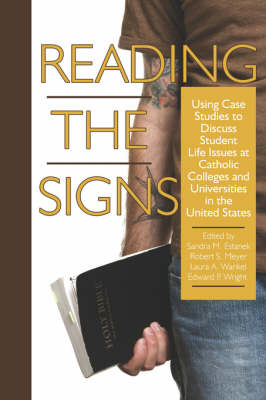
The purpose of this book is to provide student affairs professionals who work at Catholic colleges and universities a tool for reflection and dialogue on difficult issues they face in their campuses. It is intended to be used in staff development sessions, in training sessions with student leaders and resident assistants, and in master's level student affairs preparation programs at Catholic colleges and universities. This book is the next step in a series of projects that began in the early 1990s after the publication by the Vatican of the apostolic constitution. This book is a collection of case studies that focus on particular issues related to Catholic identity that are faced by student affairs professionals who work at Catholic colleges and universities. By its very nature, the focus on the difficult issues we face is a limitation. The editors in no way wish to imply that Catholic identity is only about problems. Previous research and experience clearly indicates those who work at Catholic institutions understand and embrace the opportunities that this environment provides for them. But as Schaller and Boyle (2006) indicated, there is a need for dialogue around the difficult issues that we face. The editors believe that a book of case studies is particularly helpful because it allows a staff to discuss problems at fictionalized universities and then ask themselves, 'What would we do here?' The editors solicited cases using a mailing list provided by the ASACCU, thus, the cases included in this book represent the real concerns of those practicing in the field. Some of the cases that are included are true stories of situations that actually happened, some are fictional, and some are hybrid stories based on actual events but changed to illustrate an issue. To protect the privacy of those who were kind enough to share their difficult issues with their colleagues, the names of case contributors are listed at the beginning of the book in alphabetical order, rather than being listed with the cases they contributed.
The purpose of this book is to provide student affairs professionals who work at Catholic colleges and universities a tool for reflection and dialogue on difficult issues they face in their campuses. It is intended to be used in staff development sessions, in training sessions with student leaders and resident assistants, and in master's level student affairs preparation programs at Catholic colleges and universities. This book is the next step in a series of projects that began in the early 1990s after the publication by the Vatican of the apostolic constitution. This book is a collection of case studies that focus on particular issues related to Catholic identity that are faced by student affairs professionals who work at Catholic colleges and universities. By its very nature, the focus on the difficult issues we face is a limitation. The editors in no way wish to imply that Catholic identity is only about problems. Previous research and experience clearly indicates those who work at Catholic institutions understand and embrace the opportunities that this environment provides for them. But as Schaller and Boyle (2006) indicated,there is a need for dialogue around the difficult issues that we face. The editors believe that a book of case studies is particularly helpful because it allows a staff to discuss problems at fictionalized universities and then ask themselves, "e;What would we do here?"e; The editors solicited cases using a mailing list provided by the ASACCU; thus, the cases included in this book represent the real concerns of those practicing in the field. Some of the cases that are included are true stories of situations that actually happened, some are fictional, and some are hybrid stories based on actual events but changed to illustrate an issue. To protect the privacy of those who were kind enough to share their difficult issues with their colleagues, the names of case contributors are listed at the beginning of the book in alphabetical order, rather than being listed with the cases they contributed.
| Erscheint lt. Verlag | 24.6.2008 |
|---|---|
| Sprache | englisch |
| Themenwelt | Schulbuch / Wörterbuch ► Lexikon / Chroniken |
| Geisteswissenschaften ► Religion / Theologie ► Christentum | |
| Sozialwissenschaften ► Pädagogik ► Didaktik | |
| Sozialwissenschaften ► Pädagogik ► Erwachsenenbildung | |
| ISBN-10 | 1-60752-940-8 / 1607529408 |
| ISBN-13 | 978-1-60752-940-8 / 9781607529408 |
| Informationen gemäß Produktsicherheitsverordnung (GPSR) | |
| Haben Sie eine Frage zum Produkt? |
 PDF (Adobe DRM)
Größe: 4,9 MB
Kopierschutz: Adobe-DRM
Adobe-DRM ist ein Kopierschutz, der das eBook vor Mißbrauch schützen soll. Dabei wird das eBook bereits beim Download auf Ihre persönliche Adobe-ID autorisiert. Lesen können Sie das eBook dann nur auf den Geräten, welche ebenfalls auf Ihre Adobe-ID registriert sind.
Details zum Adobe-DRM
Dateiformat: PDF (Portable Document Format)
Mit einem festen Seitenlayout eignet sich die PDF besonders für Fachbücher mit Spalten, Tabellen und Abbildungen. Eine PDF kann auf fast allen Geräten angezeigt werden, ist aber für kleine Displays (Smartphone, eReader) nur eingeschränkt geeignet.
Systemvoraussetzungen:
PC/Mac: Mit einem PC oder Mac können Sie dieses eBook lesen. Sie benötigen eine
eReader: Dieses eBook kann mit (fast) allen eBook-Readern gelesen werden. Mit dem amazon-Kindle ist es aber nicht kompatibel.
Smartphone/Tablet: Egal ob Apple oder Android, dieses eBook können Sie lesen. Sie benötigen eine
Geräteliste und zusätzliche Hinweise
Buying eBooks from abroad
For tax law reasons we can sell eBooks just within Germany and Switzerland. Regrettably we cannot fulfill eBook-orders from other countries.
 EPUB (Adobe DRM)
Kopierschutz: Adobe-DRM
Adobe-DRM ist ein Kopierschutz, der das eBook vor Mißbrauch schützen soll. Dabei wird das eBook bereits beim Download auf Ihre persönliche Adobe-ID autorisiert. Lesen können Sie das eBook dann nur auf den Geräten, welche ebenfalls auf Ihre Adobe-ID registriert sind.
Details zum Adobe-DRM
Dateiformat: EPUB (Electronic Publication)
EPUB ist ein offener Standard für eBooks und eignet sich besonders zur Darstellung von Belletristik und Sachbüchern. Der Fließtext wird dynamisch an die Display- und Schriftgröße angepasst. Auch für mobile Lesegeräte ist EPUB daher gut geeignet.
Systemvoraussetzungen:
PC/Mac: Mit einem PC oder Mac können Sie dieses eBook lesen. Sie benötigen eine
eReader: Dieses eBook kann mit (fast) allen eBook-Readern gelesen werden. Mit dem amazon-Kindle ist es aber nicht kompatibel.
Smartphone/Tablet: Egal ob Apple oder Android, dieses eBook können Sie lesen. Sie benötigen eine
Geräteliste und zusätzliche Hinweise
Buying eBooks from abroad
For tax law reasons we can sell eBooks just within Germany and Switzerland. Regrettably we cannot fulfill eBook-orders from other countries.
aus dem Bereich