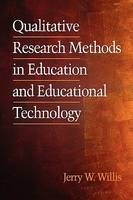
Qualitative Research Methods in Education and Educational Technology was written for students and scholars interested in exploring the many qualitative methods developed over the last 50 years in the social sciences. The book does not stop, however, at the boundaries of the social sciences. Social scientists now consume and use research methods from many fields. The rich resources of research methods and theories from both the humanities and philosophy are also covered in this book. It explains why postpositivist quantitative research should not be "e;the only game in town"e; and provides solid theoretical foundations, beginning with the positions of Plato and Aristotle, for broadening our horizons about what warrants our attention. Using Aristotle's concept of phronesis the author shows why methods such as narrative research and storytelling, hermeneutic inquiry, literary theory, philosophical inquiry, and much more have important applications in education and educational technology. On those foundations, the author also builds a framework for doing many types of research - from participatory action research to content analysis, to postmodern case studies, to empowerment research and philosophical inquiry. He accomplishes this through a combination of original text, summaries of exemplary research in education and educational technology, and suggested readings that are annotated and introduced at the end of each chapter. Many of these readings are available online and they extend the discussion of research methods or serve as exemplars of a particular type of educational technology research. There are open ended and conceptual questions for each reading, and developing your own answers to them is one way you can extend your depth of understanding about qualitative research methods in education and educational technology.
| Erscheint lt. Verlag | 28.10.2008 |
|---|---|
| Sprache | englisch |
| Themenwelt | Schulbuch / Wörterbuch ► Lexikon / Chroniken |
| Schulbuch / Wörterbuch ► Unterrichtsvorbereitung ► Unterrichts-Handreichungen | |
| Geisteswissenschaften | |
| Sozialwissenschaften ► Pädagogik | |
| ISBN-10 | 1-60752-936-X / 160752936X |
| ISBN-13 | 978-1-60752-936-1 / 9781607529361 |
| Informationen gemäß Produktsicherheitsverordnung (GPSR) | |
| Haben Sie eine Frage zum Produkt? |
 PDF (Adobe DRM)
Größe: 16,1 MB
Kopierschutz: Adobe-DRM
Adobe-DRM ist ein Kopierschutz, der das eBook vor Mißbrauch schützen soll. Dabei wird das eBook bereits beim Download auf Ihre persönliche Adobe-ID autorisiert. Lesen können Sie das eBook dann nur auf den Geräten, welche ebenfalls auf Ihre Adobe-ID registriert sind.
Details zum Adobe-DRM
Dateiformat: PDF (Portable Document Format)
Mit einem festen Seitenlayout eignet sich die PDF besonders für Fachbücher mit Spalten, Tabellen und Abbildungen. Eine PDF kann auf fast allen Geräten angezeigt werden, ist aber für kleine Displays (Smartphone, eReader) nur eingeschränkt geeignet.
Systemvoraussetzungen:
PC/Mac: Mit einem PC oder Mac können Sie dieses eBook lesen. Sie benötigen eine
eReader: Dieses eBook kann mit (fast) allen eBook-Readern gelesen werden. Mit dem amazon-Kindle ist es aber nicht kompatibel.
Smartphone/Tablet: Egal ob Apple oder Android, dieses eBook können Sie lesen. Sie benötigen eine
Geräteliste und zusätzliche Hinweise
Buying eBooks from abroad
For tax law reasons we can sell eBooks just within Germany and Switzerland. Regrettably we cannot fulfill eBook-orders from other countries.
 EPUB (Adobe DRM)
Kopierschutz: Adobe-DRM
Adobe-DRM ist ein Kopierschutz, der das eBook vor Mißbrauch schützen soll. Dabei wird das eBook bereits beim Download auf Ihre persönliche Adobe-ID autorisiert. Lesen können Sie das eBook dann nur auf den Geräten, welche ebenfalls auf Ihre Adobe-ID registriert sind.
Details zum Adobe-DRM
Dateiformat: EPUB (Electronic Publication)
EPUB ist ein offener Standard für eBooks und eignet sich besonders zur Darstellung von Belletristik und Sachbüchern. Der Fließtext wird dynamisch an die Display- und Schriftgröße angepasst. Auch für mobile Lesegeräte ist EPUB daher gut geeignet.
Systemvoraussetzungen:
PC/Mac: Mit einem PC oder Mac können Sie dieses eBook lesen. Sie benötigen eine
eReader: Dieses eBook kann mit (fast) allen eBook-Readern gelesen werden. Mit dem amazon-Kindle ist es aber nicht kompatibel.
Smartphone/Tablet: Egal ob Apple oder Android, dieses eBook können Sie lesen. Sie benötigen eine
Geräteliste und zusätzliche Hinweise
Buying eBooks from abroad
For tax law reasons we can sell eBooks just within Germany and Switzerland. Regrettably we cannot fulfill eBook-orders from other countries.
aus dem Bereich