


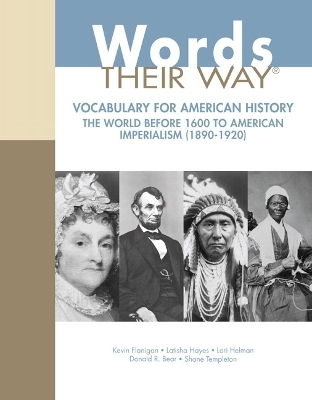
Words Their Way
Pearson (Verlag)
978-0-13-279015-4 (ISBN)
- Titel z.Zt. nicht lieferbar
- Versandkostenfrei
- Auch auf Rechnung
- Artikel merken
Kevin Flanigan is a professor in the Literacy Department at West Chester University of Pennsylvania. He works in the WCU Reading Center, where he and master’s students work with children who struggle to read and write. A former middle grades classroom teacher and reading specialist/coach, he researches and writes about developmental word knowledge and students who struggle with literacy and works with schools to implement effective literacy instruction. Kevin has authored or co-authored articles in The Reading Teacher, The Journal of Adolescent and Adult Literacy, and the Journal of Literacy Research, and is lead author of Words Their Way With Struggling Readers: Word Study for Reading, Vocabulary, and Spelling Instruction, Grades 4 — 12, and co-author of Vocabulary Their Way (2nd edition), and Developing Word Recognition. Latisha Hayes has taught students with reading disabilities in the primary through middle grades as a special educator and reading specialist. Now a clinical assistant professor at the University of Virginia, she teaches courses on the diagnosis of and intervention for reading difficulties. She works with preservice and inservice teachers at the McGuffey Reading Center, where students across the grades receive diagnostic and tutoring services. Latisha’s interests have focused on the support of struggling readers through university-based programs and partnerships. Her work has been published in Reading Research Quarterly, Literacy Research and Instruction, Communication Disorders Quarterly, and the Handbook of Reading Disability Research; she is co-author of Words Their Way with Struggling Readers, 4-12, Vocabulary Their Way (2nd edition), and lead author of Developing Word Recognition (2014, Guilford Press) with Kevin Flanigan. Lori Helman is Associate Professor at the University of Minnesota in the Department of Curriculum and Instruction, and Director of the Minnesota Center for Reading Research. She specializes in literacy education and teacher leadership. Formerly a bilingual classroom teacher for 16 years, Lori was also a coordinator of beginning teacher development and literacy coordinator of her school district. She has expertise in working with students from culturally and linguistically diverse backgrounds, and is bilingual in Spanish. Her research focuses on students’ language and literacy development, including students who are learning English as a new language. She has a deep knowledge of the theory and practical application of vocabulary and word study. Lori is co-author of Vocabulary Their Way, 2nd Edition and lead author of Words Their Way with English Learners: Word Study for Phonics, Vocabulary, and Spelling Instruction as well as other books in the series that help teachers build on the resources of multilingual students. She has also published texts and articles on various aspects of literacy development and instruction, and their applications to diverse learners and teacher education. Donald R. Bear is a professor in literacy education at Iowa State University where he teaches doctoral, master’s, and preservice teachers, and directs the Duffelmeyer Reading Clinic. He is also professor emeritus from the University of Nevada, Reno. Donald is involved in studies that examine literacy learning, particularly studies of orthographic development in different and second languages. His research explores the specific sequence students follow across the synchrony of literacy learning from beginning concept of word in prekindergarten to how morphology underlies academic vocabulary learning. He is an author and co-author of numerous articles, book chapters, and 12 books, including Words Their Way, 6th edition, Vocabulary Their Way (2nd edition), Words Their Way with English Learners, and Words Their Way with Struggling Readers, 4 — 12. He is an author on several instructional programs used throughout the United States. Donald is also involved in innovative professional development grants, and his work in assessment and word study is used widely. He has received several awards for teaching and service, and is currently a board member of the International Reading Association. Shane Templeton is Foundation Professor Emeritus of Literacy Studies at the University of Nevada, Reno. A former classroom teacher at the primary and secondary levels, his research has focused on developmental word knowledge in elementary, middle, and high school students, exploring primarily the relationships between spelling, morphology, and vocabulary. He is widely published in a number of research and practitioner journals, and is author and co-author of several books including Vocabulary Their Way; Word Study with Middle and Secondary Students; Words Their Way with Struggling Readers, 4-12; and, with Kristin Gehsmann, Teaching Reading and Writing: The Developmental Approach. With Darrell Morris, he co-authored the chapter on “Spelling” in the Handbook of Reading Research, Volume 3; he is author of the entry on “Spelling Instruction” in the Encyclopedia of Education (2nd ed., 2003), and the chapters on Spelling in the Handbook of Research on Teaching the English Language Arts (2nd ed, 2003; 3rd ed., 2011). Since 1987, Shane has been a member of the Usage Panel of the American Heritage Dictionary. Disciplinary Specialist Jeff Anderson has spent his adult life focused on the goal of serving others, whether that is teaching his students how to be responsible, engaged citizens, or shaping public policy. Jeff has taught Social Studies in the Austin, MN School District for 24 years. In that time he has taught almost anything and everything in the Social Studies curriculum. Jeff’s background is US History and Political Science. In addition to teaching, Jeff served in the Minnesota House of Representatives in the early 2000’s and has served on the Minnesota Board of Teaching. He is currently working on his Masters in Political Science.
Brief Table of Contents
Introduction Part 1: The Crucial Role of Vocabulary Knowledge in American History
Introduction Part 2: American History Units - Organization and Core Activities and Strategies
American History Units
Appendices
References
Index
Detailed Table of Contents
Introduction Part 1: The Crucial Role of Vocabulary Knowledge in American History
Purpose and Content of Vocabulary Their Way with American History
Three Essential Types of Vocabulary Knowledge
Principles of Vocabulary Instruction
Vocabulary Support for English Learners
Students Who Experience Literacy Challenges
Introduction Part 2: American History Units - Organization and Core Activities and Strategies
Domain-Specific Vocabulary
Domain-Specific Vocabulary Step 1: Frontloading Key Vocabulary and Critical Concepts
Taking a Stand
Anticipation Guides
Content DR-TA
Concept Maps
Word-to-World Connections
Domain-Specific Vocabulary Step 2: Thinking Like a Historian – Finding the "Big Picture" in History
Seeing the Big Picture in American History
Paired Review
Concepts Sorts
Domain-Specific Vocabulary Step 3: Connecting Vocabulary in Context
Text frames
Focus questions with academic vocabulary banks
Capsule Vocabulary
RAFT Papers
Domain-Specific Vocabulary Step 4: Assessing Vocabulary
Admit/Exit Slips
Learning Logs
Vocabulary Self-Assessment
Other In-Depth Vocabulary Assessments
Generative Vocabulary
Exploring the Roots of English
Analyzing Words
Root Breakdown
Generating Words
Root Webs
Root Trees
Root Walls
Assessing Generative Vocabulary
Matching affixes/roots
Generating affixes/roots
American History Units
Unit 1 - The World Before 1600: The Causes and Consequences of European Exploration
Unit 2 - Life in the European Colonies of America (1620’s-1763)
Unit 3 – Seeds of Rebellion and the Revolutionary War in American (1763 – 1777)
Unit 4 - Creating and Forging a New Republic (1777 – 1815)
Unit 5 - Developing a National Identity (1815-1860)
Unit 6 – A Nation Divided: The Road to the Civil War (1820-1861)
Unit 7 – The Course of the Civil War (1861-1865)
Unit 8 – Reconstruction: Rebuilding the Nation (1865-1877)
Unit 9 - The American West: Cultures Converge on the Frontier (1860 – 1900)
Unit 10 - The Second Industrial Revolution (1880 – 1900)
Unit 11 - Immigration to the United States: The Hopes and Hardships of Immigrants (mid-1800’s – early 1900’s)
Unit 12 - American Imperialism (1890 – 1920)
Appendices
Appendix A – Big Picture Graphic Organizers
Appendix B – Generative Assessments
Appendix C – Additional Activity Templates and Resources
References
Index
| Erscheint lt. Verlag | 13.7.2016 |
|---|---|
| Reihe/Serie | Words Their Way Series |
| Sprache | englisch |
| Maße | 215 x 275 mm |
| Gewicht | 388 g |
| Themenwelt | Schulbuch / Wörterbuch ► Unterrichtsvorbereitung |
| Geisteswissenschaften ► Sprach- / Literaturwissenschaft ► Sprachwissenschaft | |
| Sozialwissenschaften ► Pädagogik ► Schulpädagogik / Grundschule | |
| ISBN-10 | 0-13-279015-7 / 0132790157 |
| ISBN-13 | 978-0-13-279015-4 / 9780132790154 |
| Zustand | Neuware |
| Informationen gemäß Produktsicherheitsverordnung (GPSR) | |
| Haben Sie eine Frage zum Produkt? |
aus dem Bereich


