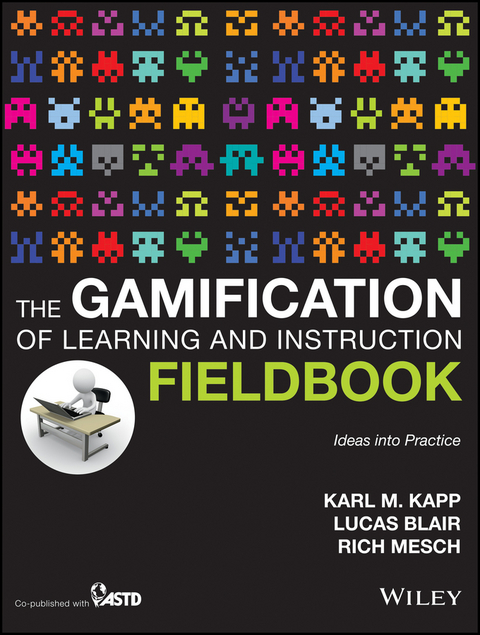
The Gamification of Learning and Instruction Fieldbook (eBook)
480 Seiten
John Wiley & Sons (Verlag)
978-1-118-67724-7 (ISBN)
Learning and Instruction,
this Fieldbook provides a step-by-step approach to
implementing the concepts from
the Gamification book with examples, tips, tricks,
and worksheets to help a learning professional or faculty member
put the ideas into practice. The Online Workbook, designed largely
for students using the original book as a textbook, includes
quizzes, worksheets and fill-in-the-blank areas that will help a
student to better understand the ideas, concepts and elements of
incorporating gamification into learning.
THE AUTHORS Karl M. Kapp is a professor of Instructional Technology in Bloomsburg University's Department of Instructional Technology in Bloomsburg, Pennsylvania and the assistant director of Bloomsburg University's acclaimed Institute for Interactive Technologies. He has authored or co-authored five books on the convergence of learning and technology, The Gamification of Learning and Instruction, Integrated Learning for ERP Success, Winning e-Learning Proposals, Gadgets, Games and Gizmos for Learning and Learning in 3D. Follow Karl on his widely-read "Kapp Notes" blog. http://karlkapp.com/kapp-notes Lucas Blair is a game designer and educator. He founded Little Bird Games, a serious game development company, in 2011 after receiving his PhD in Modeling and Simulation from the University of Central Florida. Rich Mesch is the Senior Director of Customer Engagement at Performance Development Group of Malvern, PA. He has been working in the field of experiential and contextualized learning for over 25 years with dozens of top global organizations.
Website Contents xvi
Figures, Tables, and Exhibits xvii
Foreword xxv
About the Authors xxix
About the Contributors xxxiii
Chapter 1 How to Read and Use This Fieldbook 1
SECTION I: Getting Started
Chapter 2 Why Games, Gamification, and Simulations for Learning? 13
Chapter 3 Game, Gamification, or Simulation: Which Is Best, When, Why? 35
Chapter 4 Critical Questions for Creating an Interactive Learning Event 67
SECTION II: Basic Elements
Chapter 5 Foundational Elements 89
Chapter 6 The Importance of Narrative/Context/Story 103
Chapter 7 Making the Case 117
Chapter 8 Managing the Process 141
By Jim Kiggens
Chapter Questions 141
SECTION III: Design Considerations
Chapter 9 Where Do Find Ideas 179
Chapter 10 Games 199
Chapter 11 Gamification 219
Chapter 12 Simulations 249
SECTION IV: Development
Chapter 13 Technology Tools 273
By Helmut Doll
Chapter 14 Storyboarding 287
By Kevin Thorn
SECTION V: Case Studies
Chapter 15 The Knowledge Guru 305
By Sharon Boller
Chapter 16 A Board Game: MPE 319
By Robert Bell
Chapter 17 Mobile Gamification: Mobile Cricket U 333
By Robert Gadd
Chapter 18 Serious Game: Learning to Negotiate 347
By Bryan Austin
Chapter 19 Structural Gamification for On-Boarding Employees 359
By Mohit Garg
Chapter 20 Medical Simulation 371
By Kevin R. Glover
Chapter 21 Financial Game-Based Learning 391
By Andrew Hughes
Chapter 22 Sales Training Game: An Avaya Case 399
By Anders Gronstedt
Background 399
Glossary 405
Notes 417
Index 423
About ASTD 441
| Erscheint lt. Verlag | 11.10.2013 |
|---|---|
| Sprache | englisch |
| Themenwelt | Schulbuch / Wörterbuch ► Unterrichtsvorbereitung ► Unterrichts-Handreichungen |
| Sozialwissenschaften ► Pädagogik | |
| Wirtschaft ► Betriebswirtschaft / Management ► Personalwesen | |
| Schlagworte | Business & Management • Personalentwicklung • Training & Development • Training u. Personalentwicklung • Wirtschaft u. Management |
| ISBN-10 | 1-118-67724-2 / 1118677242 |
| ISBN-13 | 978-1-118-67724-7 / 9781118677247 |
| Informationen gemäß Produktsicherheitsverordnung (GPSR) | |
| Haben Sie eine Frage zum Produkt? |
 EPUB (Adobe DRM)
Kopierschutz: Adobe-DRM
Adobe-DRM ist ein Kopierschutz, der das eBook vor Mißbrauch schützen soll. Dabei wird das eBook bereits beim Download auf Ihre persönliche Adobe-ID autorisiert. Lesen können Sie das eBook dann nur auf den Geräten, welche ebenfalls auf Ihre Adobe-ID registriert sind.
Details zum Adobe-DRM
Dateiformat: EPUB (Electronic Publication)
EPUB ist ein offener Standard für eBooks und eignet sich besonders zur Darstellung von Belletristik und Sachbüchern. Der Fließtext wird dynamisch an die Display- und Schriftgröße angepasst. Auch für mobile Lesegeräte ist EPUB daher gut geeignet.
Systemvoraussetzungen:
PC/Mac: Mit einem PC oder Mac können Sie dieses eBook lesen. Sie benötigen eine
eReader: Dieses eBook kann mit (fast) allen eBook-Readern gelesen werden. Mit dem amazon-Kindle ist es aber nicht kompatibel.
Smartphone/Tablet: Egal ob Apple oder Android, dieses eBook können Sie lesen. Sie benötigen eine
Geräteliste und zusätzliche Hinweise
Buying eBooks from abroad
For tax law reasons we can sell eBooks just within Germany and Switzerland. Regrettably we cannot fulfill eBook-orders from other countries.
aus dem Bereich