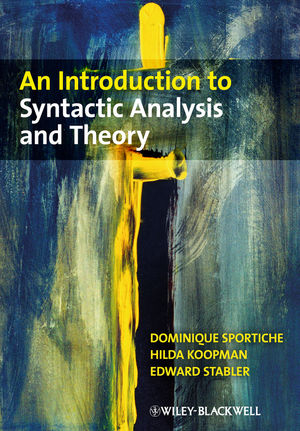
An Introduction to Syntactic Analysis and Theory (eBook)
John Wiley & Sons (Verlag)
978-1-118-47047-3 (ISBN)
An Introduction to Syntactic Analysis and Theory offers beginning students a comprehensive overview of and introduction to our current understanding of the rules and principles that govern the syntax of natural languages.
- Includes numerous pedagogical features such as 'practice' boxes and sidebars, designed to facilitate understanding of both the 'hows' and the 'whys' of sentence structure
- Guides readers through syntactic and morphological structures in a progressive manner
- Takes the mystery out of one of the most crucial aspects of the workings of language - the principles and processes behind the structure of sentences
- Ideal for students with minimal knowledge of current syntactic research, it progresses in theoretical difficulty from basic ideas and theories to more complex and advanced, up to date concepts in syntactic theory
Dominique Sportiche is Professor of Linguistics at the University of California, Los Angeles, École Normale Supérieure in Paris, and Institut Jean Nicod at the Paris Institut d'Étude de la Cognition. Specializing in theoretical syntax, he has published widely on the syntax and the properties of the syntax/semantics interface of English and French.
Hilda Koopman is Professor of Linguistics at the University of California, Los Angeles. Her theoretical interests include theoretical syntax and morphology and comparative syntax. She has published on a wide range of topics covering many diverse languages. Her work is often based on original fieldwork.
Edward Stabler is Professor of Linguistics at the University of California, Los Angeles. His specialty is in computational models of human syntactic analysis and learning, and he has published on a wide range of topics in mathematical and computational linguistics.
An Introduction to Syntactic Analysis and Theory offers beginning students a comprehensive overview of and introduction to our current understanding of the rules and principles that govern the syntax of natural languages. Includes numerous pedagogical features such as 'practice' boxes and sidebars, designed to facilitate understanding of both the 'hows' and the 'whys' of sentence structure Guides readers through syntactic and morphological structures in a progressive manner Takes the mystery out of one of the most crucial aspects of the workings of language the principles and processes behind the structure of sentences Ideal for students with minimal knowledge of current syntactic research, it progresses in theoretical difficulty from basic ideas and theories to more complex and advanced, up to date concepts in syntactic theory
Dominique Sportiche is Professor of Linguistics at the University of California, Los Angeles, École Normale Supérieure in Paris, and Institut Jean Nicod at the Paris Institut d'Étude de la Cognition. Specializing in theoretical syntax, he has published widely on the syntax and the properties of the syntax/semantics interface of English and French. Hilda Koopman is Professor of Linguistics at the University of California, Los Angeles. Her theoretical interests include theoretical syntax and morphology and comparative syntax. She has published on a wide range of topics covering many diverse languages. Her work is often based on original fieldwork. Edward Stabler is Professor of Linguistics at the University of California, Los Angeles. His specialty is in computational models of human syntactic analysis and learning, and he has published on a wide range of topics in mathematical and computational linguistics.
"Three outstanding linguists have combined forces to give
us an exceptionally clear step-by-step empirically rich and
exercise-rich introduction to the question of how to scientifically
study human language morphology and syntax."
Richard S. Kayne, New York University
"This is the most thorough and sophisticated introduction to
syntax and morphology that I have seen. The authors present the
most solid results of the research of the last fifty years, as well
as the arguments and the scientific methodology that have been
instrumental in achieving them: a unique feature of this
introduction, which brings the reader to a very deep level of
understanding without assuming any prior knowledge."
Guglielmo Cinque, Ca' Foscari University
"This terrific textbook presents in depth analyses of
linguistic phenomena accompanied by wonderfully crafted problem
sets and very useful conceptual comments on the connection between
the study of language and other areas of scientific
inquiry."
Danny Fox, Massachusetts Institute of Technology
| Erscheint lt. Verlag | 30.9.2013 |
|---|---|
| Sprache | englisch |
| Themenwelt | Schulbuch / Wörterbuch ► Lektüren / Interpretationen |
| Schulbuch / Wörterbuch ► Wörterbuch / Fremdsprachen | |
| Geisteswissenschaften ► Sprach- / Literaturwissenschaft ► Sprachwissenschaft | |
| Schlagworte | accessible • Current • Guides • History • Introduction • Knowledge • language • Linguistics • Minimal • Pace • Principles • progressive manner • Readers • Research • Several • Sprachwissenschaften • Structure • Structures • syntactic • Syntax • theory • unparalleled |
| ISBN-10 | 1-118-47047-8 / 1118470478 |
| ISBN-13 | 978-1-118-47047-3 / 9781118470473 |
| Informationen gemäß Produktsicherheitsverordnung (GPSR) | |
| Haben Sie eine Frage zum Produkt? |
 EPUB (Adobe DRM)
Kopierschutz: Adobe-DRM
Adobe-DRM ist ein Kopierschutz, der das eBook vor Mißbrauch schützen soll. Dabei wird das eBook bereits beim Download auf Ihre persönliche Adobe-ID autorisiert. Lesen können Sie das eBook dann nur auf den Geräten, welche ebenfalls auf Ihre Adobe-ID registriert sind.
Details zum Adobe-DRM
Dateiformat: EPUB (Electronic Publication)
EPUB ist ein offener Standard für eBooks und eignet sich besonders zur Darstellung von Belletristik und Sachbüchern. Der Fließtext wird dynamisch an die Display- und Schriftgröße angepasst. Auch für mobile Lesegeräte ist EPUB daher gut geeignet.
Systemvoraussetzungen:
PC/Mac: Mit einem PC oder Mac können Sie dieses eBook lesen. Sie benötigen eine
eReader: Dieses eBook kann mit (fast) allen eBook-Readern gelesen werden. Mit dem amazon-Kindle ist es aber nicht kompatibel.
Smartphone/Tablet: Egal ob Apple oder Android, dieses eBook können Sie lesen. Sie benötigen eine
Geräteliste und zusätzliche Hinweise
Buying eBooks from abroad
For tax law reasons we can sell eBooks just within Germany and Switzerland. Regrettably we cannot fulfill eBook-orders from other countries.
aus dem Bereich