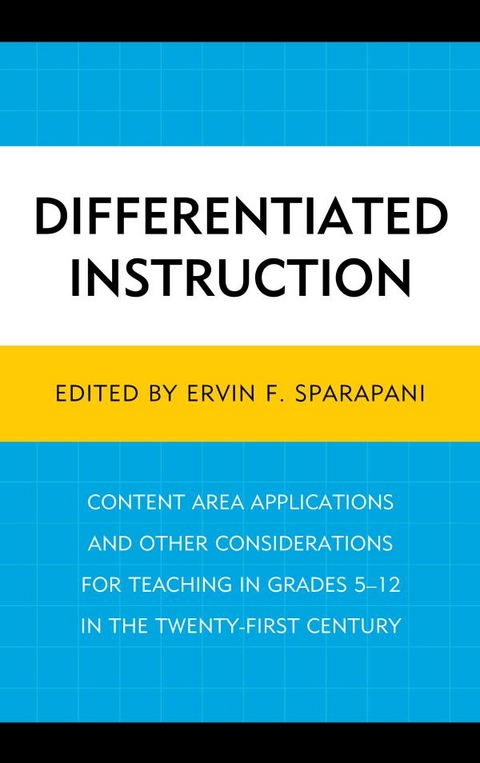
Differentiated Instruction (eBook)
Ervin F. Sparapani is a teacher educator in the Department of Middle/Secondary Education at Saginaw Valley State University. His main goal has always been to provide schools with teacher leaders who understand the uniqueness of learners and who can engage that uniqueness in enjoyable and challenging tasks.
List of FiguresList of TablesForeword by Pamela L. Ross McClainAcknowledgments Introduction, by Ervin F. SparapaniPart I: About Differentiated Instruction1. The Nature of Instruction, by Ervin F. Sparapani 2. About Differentiated Instruction, by Ervin F. Sparapani, Ryan H. Walker, and Marie E. Van Tiflin 3. Standards and Benchmarks and Differentiated Instruction: Integrating Approaches to Teaching and Learning, by Nicole M. Rogers and Barbara Garii.4. Assessment: A Guiding Force for Differentiation, by Byung-In Seo and Deborah L. SmithPart II: Differentiated Instruction and Content Area Applications5. Differentiating Instruction and Teaching the Middle School and High School English Language Arts, by Shannon Pietras 6. Differentiating Instruction for Teaching Middle School and High School Mathematics, by Gary Malburg and David K. Pugalee7. Differentiating Instruction and Teaching Middle School and High School Science, by Jonathon A. Gould and Betsy Diegel 8. Differentiated Instruction and Inquiry-Based Learning in Middle School and High School Social Studies, by C. Rodney Williams 9. Differentiating Instruction and Teaching the Middle School and High School Arts, by Carolyn J. Shaeffer and Scott R. KirstPart III: Differentiated Instruction and Other Considerations for Grades 5-1210. Differentiating Instruction and Teaching for Higher-Level Thinking: The Thinking/Learning (T/L) System, by Ervin F. Sparapani and Patricia L. Calahan11. Using Technology to Differentiate Instruction, by Amy M. Cooper and C. Rodney Williams12. Response to Intervention (RTI): A System to Meet the Needs of All Students in Grades 5-12, by Deborah L. Smith 13. Dropouts and Differentiation: Toward Understanding and Prevention, by Brian J. Smith 14. Differentiated Instruction: Strategies for Students with Moderate and Severe Disabilities, by Dorothy Squatrito MillarIndex
| Erscheint lt. Verlag | 15.8.2013 |
|---|---|
| Zusatzinfo | 41 Illustrations including: - 8 Charts; - 21 Tables; - 12 Graphs. |
| Sprache | englisch |
| Themenwelt | Schulbuch / Wörterbuch ► Schulbuch / Allgemeinbildende Schulen |
| Geisteswissenschaften ► Psychologie ► Pädagogische Psychologie | |
| Sozialwissenschaften ► Pädagogik ► Didaktik | |
| Sozialwissenschaften ► Pädagogik ► Schulpädagogik / Sekundarstufe I+II | |
| Schlagworte | Differentiated curriculum • individual learning • Language Arts • Mathematics • Progressive education |
| ISBN-10 | 0-7618-6085-1 / 0761860851 |
| ISBN-13 | 978-0-7618-6085-3 / 9780761860853 |
| Informationen gemäß Produktsicherheitsverordnung (GPSR) | |
| Haben Sie eine Frage zum Produkt? |
 EPUB (Adobe DRM)
Kopierschutz: Adobe-DRM
Adobe-DRM ist ein Kopierschutz, der das eBook vor Mißbrauch schützen soll. Dabei wird das eBook bereits beim Download auf Ihre persönliche Adobe-ID autorisiert. Lesen können Sie das eBook dann nur auf den Geräten, welche ebenfalls auf Ihre Adobe-ID registriert sind.
Details zum Adobe-DRM
Dateiformat: EPUB (Electronic Publication)
EPUB ist ein offener Standard für eBooks und eignet sich besonders zur Darstellung von Belletristik und Sachbüchern. Der Fließtext wird dynamisch an die Display- und Schriftgröße angepasst. Auch für mobile Lesegeräte ist EPUB daher gut geeignet.
Systemvoraussetzungen:
PC/Mac: Mit einem PC oder Mac können Sie dieses eBook lesen. Sie benötigen eine
eReader: Dieses eBook kann mit (fast) allen eBook-Readern gelesen werden. Mit dem amazon-Kindle ist es aber nicht kompatibel.
Smartphone/Tablet: Egal ob Apple oder Android, dieses eBook können Sie lesen. Sie benötigen eine
Geräteliste und zusätzliche Hinweise
Buying eBooks from abroad
For tax law reasons we can sell eBooks just within Germany and Switzerland. Regrettably we cannot fulfill eBook-orders from other countries.
aus dem Bereich