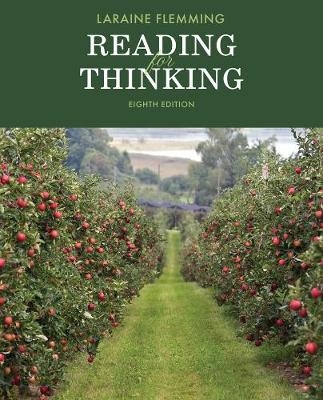
Reading for Thinking
Wadsworth Publishing Co Inc (Verlag)
978-1-285-43046-1 (ISBN)
- Titel erscheint in neuer Auflage
- Artikel merken
Through a winning combination of easy-to-understand explanations, high-interest readings, and a carefully designed chapter sequence, Laraine Flemming's READING FOR THINKING takes the mystery out of critical reading for developmental students. Following a comprehensive review of essential learning and comprehension strategies such as evaluating websites, identifying main ideas, and using organizational patterns to aid remembering, Flemming shows how critical reading is a natural part of comprehending an author's message. Chapter by chapter, students expand their definition of comprehension to include evaluating a writer's purpose, recognizing tone, separating fact from opinion, and determining the degree of bias, while also learning how to summarize and synthesize different points of view on the same topic. In addition to marginal annotations modeling the skilled reader's response, a host of new readings, a new vocabulary feature, and brand new material about reading on the Web, the eighth edition of READING FOR THINKING expands the use of writing assignments to help students identify the strategies writers use to effectively communicate their ideas to readers.
After receiving her B.S. at Southern Connecticut State University, where she was certified as a teacher of secondary reading, Laraine Flemming went on to earn an M.A. in English literature at Boston College and a Ph.D. in American literature at the State University of New York in Buffalo. During her career, Flemming has taught students from elementary to graduate school covering subjects as varied as reading and writing, American literature, time management, speed reading, study skills and most recently, ESL writing and reading. Flemming's journey as a textbook author began while she served as the Director of the Reading and Writing Center at what was then Dean Junior College. Faced with the need for a reading textbook that combined numerous exercises with genuinely thought-provoking readings, Flemming decided to write her own. You can contact Laraine Flemming by emailing her at laflemm@comcast.net or by visiting her website at www.laflemm.com.
Preface.
1. Acquiring the Keys to Academic Success.
Make Sure You Have a Study Method for Completing Textbook Assignments. SQ3R Is Worth the Effort. Using a Different System. S: Survey. Q: Questions. R-1: Read. R-2: Recall. R-3: Review. Write While You Read. Symbols for Underlining and Annotating. Paraphrase to Check Comprehension. Paraphrase in Marginal Notes. Pointers on Paraphrasing While Reading. Use the Web to Build Background Knowledge. Looking for Background Knowledge on the Web. Selecting the Right Sites to View. Creating Effective Search Terms. Pointers for Picking a Website. Warning Signs That Signal Untrustworthy Websites. Think Twice About Using Wikipedia. Writing and Reading on the Web. Use Hypertext Strategically. Taking Stock: Short-Term Memory --Do You Know the Magic Number? Test 1: Recognizing an Accurate Paraphrase. Test 2: Recognizing an Accurate Paraphrase. Test 3: Paraphrasing with Accuracy.
2. Vocabulary Building for College.
Master the Specialized Vocabulary in Your Courses. Look for Words that Get Extra Attention. Look for Ordinary Words That Double as Specialized Vocabulary. Use the Glossary for Troublesome Definitions. Use Online Dictionaries. Build Up Your General Academic Vocabulary. Pay Attention to Any Words Followed by Definitions. Notice Word Repetition. Learn New Words by Creating Your Own Recall Clues. Linking Words to Images. Use Antonyms as Recall Clues. Use Context Clues. Contrast Clues. Restatement Clues. Example Clues. General Knowledge Clues. Learn Common Word Parts. Make Allusions Part of Your Vocabulary Building. Allusions Vary with Your Audience. Allusions with Staying Power. Learning Common Allusions. Taking Stock: The Science of Romantic Love. Test 1: Reviewing New Vocabulary. Test 2: Reviewing New Vocabulary. Test 3: Using Context Clues. Test 4: Understanding Common Cultural Allusions.
3. Reviewing Paragraph Essentials.
Recognizing the Topic. Inferring the Topic. From Topics to Main Ideas. Recognizing Main Ideas in Paragraphs. Topic Sentence Locations. Introductory Sentences Team Up with Reversal Transitions. Addition Transitions Send a Different Message. Two More Key Topic Sentence Locations in Textbooks. Topic Sentences Arriving at the End. Question-and-Answer Topic Sentences. Word Check I. The Function of Supporting Details. Purpose and Audience Influence Supporting Details. Knowing the Difference Between Major and Minor Details. Minor Details Can Be Meaningful. Using Category Words to Identify Major Details. Word Check II. Taking Stock: What Causes Right or Left. Test 1: Reviewing New Vocabulary. Test 2: Reviewing New Vocabulary. Test 3: Recognizing Topics and Topic Sentences. Test 4: Understanding the Function of Supporting Details. Test 5: Recognizing and Paraphrasing Topic Sentences. Test 6: Reviewing New Vocabulary.
4. Identifying and Learning From Organizational Patterns.
Pattern 1: Definition. Typical Topic Sentences. Pattern 2: Process. Verbal Clues to the Pattern. Typical Topic Sentences. Flow Charts. Pattern 3: Sequence of Dates and Events. Transition Clues. Typical Topic Sentences. Pattern 4: Simple Listing. Typical Topic Sentence Clues to the Pattern. Pattern 5: Classification. Typical Topic Sentences. Pattern 6: Comparison and Contrast. Typical Topic Sentences. Transitions. Pattern 7: Cause and Effect. Typical Topic Sentences. Common Transitions and Verbs. Common Connectives. Chains of Cause and Effect. When Patterns Combine. Word Check. Taking Stock: Why Should We Care About the American Alligator? Test 1: Recognizing Organizational Patterns. Test 2: Recognizing Organizational Patterns. Test 3: Recognizing Organizational Patterns. Test 4: Reviewing New Vocabulary.
5. Understanding, Outlining, and Summarizing Longer Readings.
Understanding Longer Readings. The Main Idea Controls More Than a Paragraph. Several Sentences May be Needed to Express the Main Idea. Ideas Can Get Bigger. Introductions Can Get Longer. The Author May Conclude Rather than Begin with the Main
| Verlagsort | Belmont, CA |
|---|---|
| Sprache | englisch |
| Maße | 74 x 11 mm |
| Gewicht | 1130 g |
| Themenwelt | Schulbuch / Wörterbuch ► Wörterbuch / Fremdsprachen |
| Geisteswissenschaften ► Psychologie | |
| Geisteswissenschaften ► Sprach- / Literaturwissenschaft ► Literaturwissenschaft | |
| Geisteswissenschaften ► Sprach- / Literaturwissenschaft ► Sprachwissenschaft | |
| Sozialwissenschaften ► Pädagogik | |
| ISBN-10 | 1-285-43046-8 / 1285430468 |
| ISBN-13 | 978-1-285-43046-1 / 9781285430461 |
| Zustand | Neuware |
| Informationen gemäß Produktsicherheitsverordnung (GPSR) | |
| Haben Sie eine Frage zum Produkt? |
aus dem Bereich