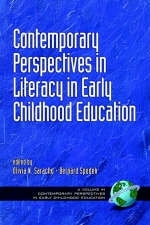
This volume identifies and critically analyzes research studies related to the critical skills, environments, and adult interactions that contribute to young children's literacy development. The volume reminisces on the reformation that has emerged in the language and literacy education of young children. Prior to the 1960's, few studies were available on pre?first?grade literacy. Then studies began to emerge in the 1960's focusing on the reading readiness paradigm and on the conventional assumption that literacy development was only introduce and when children experienced formal reading instruction in school (Sulzby & Teale, 1986). Fortunately, Durkin (1966) found that there were children reading before first grade and determined that the reading readiness paradigm was theoretically and pragmatically incongruous. Others followed Durkin's footsteps. Sulzby and Teale (1986) identify the following concepts about young children's acquisition of literacy learning: 1. Literacy development originates well before children are introduced to formal instruction. 2. The notion that reading precedes writing or that writing precedes reading is a fallacy. 3. Literacy blooms in 'real?life' settings and by performing real?life activities that are used to 'get things done.' 4. The purposes of literacy for young children are as important in learning about writing and reading as are the dimensions of literacy. 5. Children's cognitive development is important to their acquisition of literacy during the years from birth to six. 6. Children learn written language when they actively engage in their world. Competent teachers throughout the United States suggest that prior to attending school, children have acquired a distinctive culture, collection of experiences, and group of abilities (Vacca & Vacca, 2000). Many prekindergarten children have been in a group setting for three and four years such as a child care setting where teachers and caregivers teach them reading and writing.
This volume identifies and critically analyzes research studies related to the critical skills, environments, and adult interactions that contribute to young children's literacy development. The volume reminisces on the reformation that has emerged in the language and literacy education of young children. Prior to the 1960's, few studies were available on pre?first?grade literacy. Then studies began to emerge in the 1960's focusing on the reading readiness paradigm and on the conventional assumption that literacy development was only introduce and when children experienced formal reading instruction in school (Sulzby & Teale, 1986). Fortunately, Durkin (1966) found that there were children reading before first grade and determined that the reading readiness paradigm was theoretically and pragmatically incongruous. Others followed Durkin's footsteps. Sulzby and Teale (1986) identify the following concepts about young children's acquisition of literacy learning:1. Literacy development originates well before children are introduced to formal instruction. 2. The notion that reading precedes writing or that writing precedes reading is a fallacy. 3. Literacy blooms in "e;real?life"e; settings and by performing real?life activities that are used to "e;get things done."e; 4. The purposes of literacy for young children are as important in learning about writing and reading as are the dimensions of literacy. 5. Children's cognitive development is important to their acquisition of literacy during the years from birth to six. 6. Children learn written language when they actively engage in their world. Competent teachers throughout the United States suggest that prior to attending school, children have acquired a distinctive culture, collection of experiences, and group of abilities (Vacca & Vacca, 2000). Many prekindergarten children have been in a group setting for three and four years such as a child care setting where teachers and caregivers teach them reading and writing.
| Erscheint lt. Verlag | 24.6.2002 |
|---|---|
| Sprache | englisch |
| Themenwelt | Schulbuch / Wörterbuch ► Lexikon / Chroniken |
| Geisteswissenschaften | |
| Sozialwissenschaften ► Pädagogik ► Vorschulpädagogik | |
| ISBN-10 | 1-60752-528-3 / 1607525283 |
| ISBN-13 | 978-1-60752-528-8 / 9781607525288 |
| Informationen gemäß Produktsicherheitsverordnung (GPSR) | |
| Haben Sie eine Frage zum Produkt? |
 PDF (Adobe DRM)
Größe: 2,0 MB
Kopierschutz: Adobe-DRM
Adobe-DRM ist ein Kopierschutz, der das eBook vor Mißbrauch schützen soll. Dabei wird das eBook bereits beim Download auf Ihre persönliche Adobe-ID autorisiert. Lesen können Sie das eBook dann nur auf den Geräten, welche ebenfalls auf Ihre Adobe-ID registriert sind.
Details zum Adobe-DRM
Dateiformat: PDF (Portable Document Format)
Mit einem festen Seitenlayout eignet sich die PDF besonders für Fachbücher mit Spalten, Tabellen und Abbildungen. Eine PDF kann auf fast allen Geräten angezeigt werden, ist aber für kleine Displays (Smartphone, eReader) nur eingeschränkt geeignet.
Systemvoraussetzungen:
PC/Mac: Mit einem PC oder Mac können Sie dieses eBook lesen. Sie benötigen eine
eReader: Dieses eBook kann mit (fast) allen eBook-Readern gelesen werden. Mit dem amazon-Kindle ist es aber nicht kompatibel.
Smartphone/Tablet: Egal ob Apple oder Android, dieses eBook können Sie lesen. Sie benötigen eine
Geräteliste und zusätzliche Hinweise
Buying eBooks from abroad
For tax law reasons we can sell eBooks just within Germany and Switzerland. Regrettably we cannot fulfill eBook-orders from other countries.
 EPUB (Adobe DRM)
Kopierschutz: Adobe-DRM
Adobe-DRM ist ein Kopierschutz, der das eBook vor Mißbrauch schützen soll. Dabei wird das eBook bereits beim Download auf Ihre persönliche Adobe-ID autorisiert. Lesen können Sie das eBook dann nur auf den Geräten, welche ebenfalls auf Ihre Adobe-ID registriert sind.
Details zum Adobe-DRM
Dateiformat: EPUB (Electronic Publication)
EPUB ist ein offener Standard für eBooks und eignet sich besonders zur Darstellung von Belletristik und Sachbüchern. Der Fließtext wird dynamisch an die Display- und Schriftgröße angepasst. Auch für mobile Lesegeräte ist EPUB daher gut geeignet.
Systemvoraussetzungen:
PC/Mac: Mit einem PC oder Mac können Sie dieses eBook lesen. Sie benötigen eine
eReader: Dieses eBook kann mit (fast) allen eBook-Readern gelesen werden. Mit dem amazon-Kindle ist es aber nicht kompatibel.
Smartphone/Tablet: Egal ob Apple oder Android, dieses eBook können Sie lesen. Sie benötigen eine
Geräteliste und zusätzliche Hinweise
Buying eBooks from abroad
For tax law reasons we can sell eBooks just within Germany and Switzerland. Regrettably we cannot fulfill eBook-orders from other countries.
aus dem Bereich