


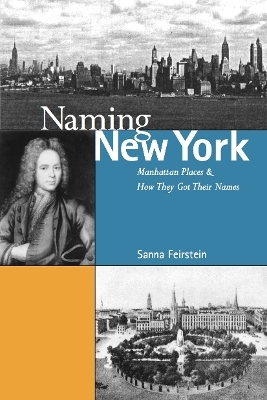
Naming New York
Manhattan Places and How They Got Their Names
Seiten
2001
New York University Press (Verlag)
978-0-8147-2711-9 (ISBN)
New York University Press (Verlag)
978-0-8147-2711-9 (ISBN)
New York is the oldest continually occupied city in America, with hundreds of place names offering a guide to the city's history. This book traces the origins of the names of Manhattan's streets, avenues, parks and corners, from it's life as a Dutch trading port to a modern, multicultural city.
A comprehensive compilation and explanation of Manhattan's streets, alleys, avenues, plazas, parks and corners
New York is the oldest continually occupied city in America, yet its rich history is largely obscured by development. New Yorkers are surrounded by hundreds of place names, from those that survive from Manhattan's earliest days as a Dutch trading post to those that reflect the city's rich colonial, African and immigrant heritage. They provide a veritable encyclopedia of the city's history. Buildings may come and go, but place names are surprisingly durable. Naming New York is a comprehensive compilation and explanation of the names of Manhattan's streets, alleys, avenues, plazas, parks and corners. It surveys names currently in use and includes the oldest and the newest honorific "add-on" names, from Astor Place to Yitzak Rabin Way.
Whether you're a history or trivia buff, tourist, or just fascinated by place names, learning about the origins of these mostly unexamined sources enriches one's experience of the city, and transforms a simple neighborhood errand into a trip through time.
For example:
Bowery: In the 17th century, Dutch farms known as "bowerij" were laid out in this section of Manhattan along the path of an old Indian trail. Known since that time as the Bowery, the thoroughfare became the first section of the Post Road from New York City to Boston.
Houston Street: For William Houstoun, 1757-1812, of a prominent Georgia family, who married a daughter of Manhattan landowner Nicholas Bayard III. The Georgia provenance of the name accounts for its pronunciation and spelling both of which distinguish it from the Texas city.
Wall Street: Follows the line of the city wall that the Dutch erected in 1653 across the northern perimeter of New Amsterdam to protect against attack from the British in New England.
A comprehensive compilation and explanation of Manhattan's streets, alleys, avenues, plazas, parks and corners
New York is the oldest continually occupied city in America, yet its rich history is largely obscured by development. New Yorkers are surrounded by hundreds of place names, from those that survive from Manhattan's earliest days as a Dutch trading post to those that reflect the city's rich colonial, African and immigrant heritage. They provide a veritable encyclopedia of the city's history. Buildings may come and go, but place names are surprisingly durable. Naming New York is a comprehensive compilation and explanation of the names of Manhattan's streets, alleys, avenues, plazas, parks and corners. It surveys names currently in use and includes the oldest and the newest honorific "add-on" names, from Astor Place to Yitzak Rabin Way.
Whether you're a history or trivia buff, tourist, or just fascinated by place names, learning about the origins of these mostly unexamined sources enriches one's experience of the city, and transforms a simple neighborhood errand into a trip through time.
For example:
Bowery: In the 17th century, Dutch farms known as "bowerij" were laid out in this section of Manhattan along the path of an old Indian trail. Known since that time as the Bowery, the thoroughfare became the first section of the Post Road from New York City to Boston.
Houston Street: For William Houstoun, 1757-1812, of a prominent Georgia family, who married a daughter of Manhattan landowner Nicholas Bayard III. The Georgia provenance of the name accounts for its pronunciation and spelling both of which distinguish it from the Texas city.
Wall Street: Follows the line of the city wall that the Dutch erected in 1653 across the northern perimeter of New Amsterdam to protect against attack from the British in New England.
Sanna Feirstein is a docent at the New-York Historical Society.
| Erscheint lt. Verlag | 1.4.2001 |
|---|---|
| Verlagsort | New York |
| Sprache | englisch |
| Maße | 153 x 229 mm |
| Themenwelt | Sachbuch/Ratgeber ► Geschichte / Politik ► Regional- / Landesgeschichte |
| Schulbuch / Wörterbuch ► Lexikon / Chroniken | |
| Geschichte ► Allgemeine Geschichte ► Neuzeit (bis 1918) | |
| Geisteswissenschaften ► Geschichte ► Regional- / Ländergeschichte | |
| ISBN-10 | 0-8147-2711-5 / 0814727115 |
| ISBN-13 | 978-0-8147-2711-9 / 9780814727119 |
| Zustand | Neuware |
| Informationen gemäß Produktsicherheitsverordnung (GPSR) | |
| Haben Sie eine Frage zum Produkt? |
Mehr entdecken
aus dem Bereich


aus dem Bereich
Geschichte einer wilden Handlung
Buch | Hardcover (2024)
C.H.Beck (Verlag)
CHF 47,60


