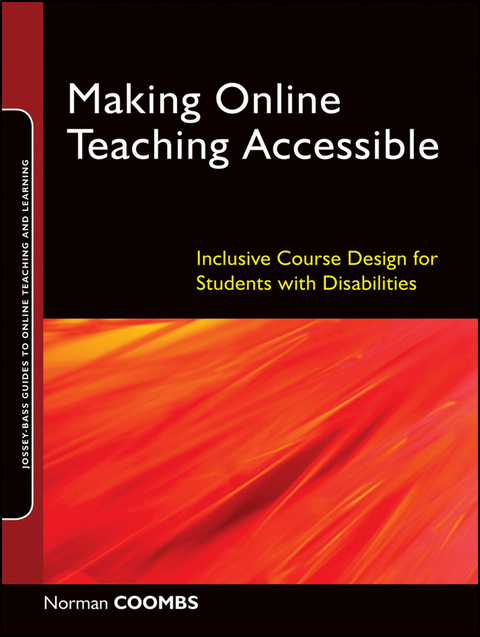
Making Online Teaching Accessible (eBook)
192 Seiten
John Wiley & Sons (Verlag)
978-0-470-89244-2 (ISBN)
instructional designers, and content developers a comprehensive
resource for designing online courses and delivering course content
that is accessible for all students including those with visual and
audio disabilities.
Grounded in the theories of learner-centered teaching and
successful course design, Making Online Teaching Accessible
outlines the key legislation, decisions, and guidelines that govern
online learning. The book also demystifies assistive technologies
and includes step-by-step guidance for creating accessible online
content using popular programs like Microsoft Office and Adobe
Acrobat, as well as multimedia tools.
Including a wealth of helpful tips and suggestions for
effectively communicating with disabled students, the book contains
practical advice on purchasing accessible course management
systems, developing solutions for inaccessibility issues, and
creating training materials for faculty and staff to make online
learning truly accessible.
"This valuable how-to book is a critical tool for all
instructional designers and faculty who teach online. Coombs' many
years as a pioneer of online teaching show in his deep knowledge of
the principles that can allow the reader to apply these lessons to
any learning management system (LMS)."
--Sally M. Johnstone, provost and vice president
academic affairs, Winona State University, Minnesota; former
executive director of WCET at WICHE
"As more and more of our social and professional lives come to
be mediated by technology, online accessibility is a fundamental
right, not a luxury. This book is a must-read for anyone concerned
with maximizing access to learning."
--Richard N. Katz, former vice president and founding
director, EDUCAUSE Center for Applied Research
"This valuable book reflects Coombs' unique experience and
commitment to the best teaching, learning, and accessibility
options for all kinds of students and teachers."
--Steven W. Gilbert, founder and president, The TLT
Group-Teaching, Learning, and Technology Group
Norman Coombs is CEO of EASI (Equal Access to Software and Information) and professor emeritus at the Rochester Institute of Technology where he pioneered RIT's distance learning program in the early 1980s. Coombs is coauthor of Information Access and Adaptive Technology.
List of Figures, Tables, and Exhibits.
Preface.
ONE Creating a Level Learning Space.
How People with Disabilities Use Computers.
Universal Design and Online Learning.
Legislation, Decisions, and Guidelines Governing Online
Learning.
Decisions tThe Department of Education's Office for Civil
Rights.
Review of OCR Decisions and Online Learning.
Take-Aways from This Chapter.
TWO Online Learning and Students with Disabilities.
Accessibility of the Online Learning Infrastructure.
Creating Accessible Online Course Content.
The Students' Part of the Equation.
Take-Aways from This Chapter.
THREE Creating Accessible Content in Word and Excel.
An Introduction to Structuring Documents in Word.
Creating Well-Structured Documents.
Selecting Style Attributes to Enhance Accessibility.
Creating a Table of Contents.
Making Images in Word Accessible.
Take-Aways from This Chapter.
FOUR Creating Accessible Presentations with
PowerPoint.
Powerpoint and Universal Design.
Designing Accessible Powerpoint Presentations.
Creating Narrated Slide Shows.
Take-Aways from This Chapter.
FIVE Delivering Accessible Content.
A Word about File Types.
Distributing Accessible Word Documents.
PDF Documents.
Distributing Excel Spreadsheets.
Distributing Accessible Powerpoint Content.
Online Accessibility Checkers.
Take-Aways from This Chapter.
SIX Science, Technology, Engineering, and Math.
Historical Issues with Math Accessibility.
Authoring Accessible Electronic Math Documents.
Issues with Technical Graphics.
Providing Accessible Graphics.
Take-Aways from This Chapter.
SEVEN Making Multimedia Accessible.
The Role of Multimedia in Online Learning.
Creating a Transcript.
Adding Synchronized Captions to a Video.
Accessibility for Real-Time Audio or Video.
Take-Aways from This Chapter.
EIGHT Supporting Accessible Online Learning.
Appendix A: Section 508 Web Standards.
Appendix B: WebAIM Summary of W3C WAI WCAG2.
Appendix C: American Foundation for the Blind's Distance
Learning. Survey.
References.
Resources.
| Erscheint lt. Verlag | 13.9.2010 |
|---|---|
| Reihe/Serie | Online Teaching and Learning Series (OTL) | Online Teaching and Learning Series (OTL) |
| Sprache | englisch |
| Themenwelt | Schulbuch / Wörterbuch ► Unterrichtsvorbereitung ► Unterrichts-Handreichungen |
| Geisteswissenschaften | |
| Sozialwissenschaften ► Pädagogik ► Bildungstheorie | |
| Sozialwissenschaften ► Pädagogik ► Erwachsenenbildung | |
| Sozialwissenschaften ► Pädagogik ► Sonder-, Heil- und Förderpädagogik | |
| Schlagworte | Bildungswesen • Education • Onlinestudium • Online Teaching and Learning |
| ISBN-10 | 0-470-89244-7 / 0470892447 |
| ISBN-13 | 978-0-470-89244-2 / 9780470892442 |
| Informationen gemäß Produktsicherheitsverordnung (GPSR) | |
| Haben Sie eine Frage zum Produkt? |
 EPUB (Adobe DRM)
Kopierschutz: Adobe-DRM
Adobe-DRM ist ein Kopierschutz, der das eBook vor Mißbrauch schützen soll. Dabei wird das eBook bereits beim Download auf Ihre persönliche Adobe-ID autorisiert. Lesen können Sie das eBook dann nur auf den Geräten, welche ebenfalls auf Ihre Adobe-ID registriert sind.
Details zum Adobe-DRM
Dateiformat: EPUB (Electronic Publication)
EPUB ist ein offener Standard für eBooks und eignet sich besonders zur Darstellung von Belletristik und Sachbüchern. Der Fließtext wird dynamisch an die Display- und Schriftgröße angepasst. Auch für mobile Lesegeräte ist EPUB daher gut geeignet.
Systemvoraussetzungen:
PC/Mac: Mit einem PC oder Mac können Sie dieses eBook lesen. Sie benötigen eine
eReader: Dieses eBook kann mit (fast) allen eBook-Readern gelesen werden. Mit dem amazon-Kindle ist es aber nicht kompatibel.
Smartphone/Tablet: Egal ob Apple oder Android, dieses eBook können Sie lesen. Sie benötigen eine
Geräteliste und zusätzliche Hinweise
Buying eBooks from abroad
For tax law reasons we can sell eBooks just within Germany and Switzerland. Regrettably we cannot fulfill eBook-orders from other countries.
aus dem Bereich