


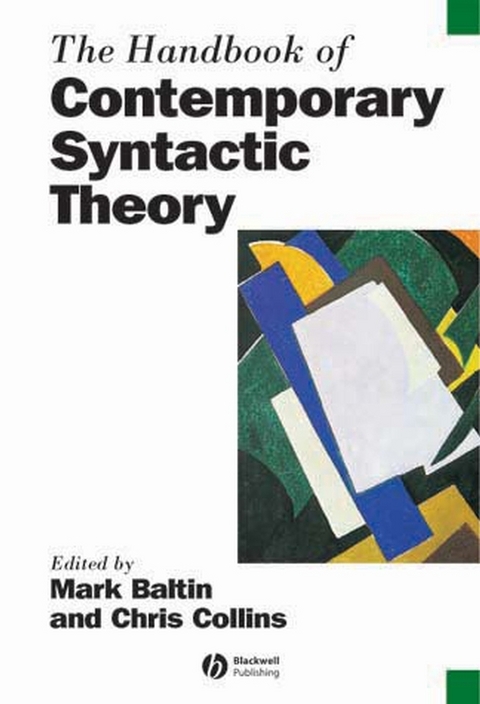
- Contains 23 articles written by an international assembly of specialists in the field.
- The lucidly written articles grant accessibility to crucial areas of syntactic theory.
- Contrasting theories are represented.
- Contains an informative introduction and extensive bibliography which serves as a reference tool for both students and professional linguists.
Mark Baltin is Professor of Linguistics at New York University where he has been teaching since receiving his Ph.D. from MIT in 1978. He has published widely on movement and ellipsis, and served on the NSF Advisory Panel for Linguistics from 1996 to 1999. He is the editor, with Anthony S. Kroch, of Alternative Conceptions of Phrase-Structure (1989).
Chris Collins served in the Peace Corps before enrolling in MIT's graduate program in linguistics. He is currently Assistant Professor of Linguistics at Cornell University and has published widely in the syntax of various African languages and general syntactic theory. He is the author of Local Economy (1997).
This volume provides a comprehensive view of the current issues in contemporary syntactic theory. Written by an international assembly of leading specialists in the field, these 2 original articles serve as a useful reference for various areas of grammar. Contains 23 articles written by an international assembly of specialists in the field. The lucidly written articles grant accessibility to crucial areas of syntactic theory. Contrasting theories are represented. Contains an informative introduction and extensive bibliography which serves as a reference tool for both students and professional linguists.
Mark Baltin is Professor of Linguistics at New York University where he has been teaching since receiving his Ph.D. from MIT in 1978. He has published widely on movement and ellipsis, and served on the NSF Advisory Panel for Linguistics from 1996 to 1999. He is the editor, with Anthony S. Kroch, of Alternative Conceptions of Phrase-Structure (1989). Chris Collins served in the Peace Corps before enrolling in MIT's graduate program in linguistics. He is currently Assistant Professor of Linguistics at Cornell University and has published widely in the syntax of various African languages and general syntactic theory. He is the author of Local Economy (1997).
Contributors.
Introduction.
Part I: Derivation Versus Representation:.
1. Explaining Morphosyntactic Competition: Joan Bresnan
(Stanford University).
2. Economy Conditions in Syntax: Chris Collins (Cornell
University).
3. Derivation and Representation in Modern Transformational
Syntax: Howard Lasnik (University of Connecticut).
4. Relativized Minimality Effects: Luigi Rizzi (Université
de Geneve).
Part II: Movement:.
5. Head Movement: Ian Roberts (University of Stuttgart).
6. Object Shift and Scrambling: Höskuldur Thráinsson
(University of Iceland).
7. Wh-in-situ Languages: Akira Watanabe (University of
Tokyo).
8. A-Movements: Mark Baltin (New York University).
Part III: Argument Structure and Phrase Structure:.
9. Thematic Relations in Syntax: Jeffrey S. Gruber (independent
scholar).
10. Predication: John Bowers (Cornell University).
11. Case: Hiroyuki Ura.
12. Phrase Structure: Naoki Fukui (University of
California).
13. The Natures of Nonconfigurationality: Mark C. Baker (McGill
University).
14. What VP Ellipsis Can Do, and What it Can't, but not
Why: Kyle Johnson (University of Massachusetts at Amherst).
Part IV: Functional Projections:.
15. Agreement Projections: Adriana Belletti (Universitá di
Siena).
16. Sentential Negation: Raffaella Zanuttini (Georgetown
University).
17. The DP Hypothesis: Identifying Clausal Properties in the
Nominal Domain: Judy B. Bernstein (Syracuse University).
18. The Structure of DPs: Some Principles, Parameters and
Problems: Giuseppe Longobardi (University of Trieste).
Part V: Interface With Interpretation:.
19. The Syntax of Scope: Anna Szabolcsi (New York
University).
20. Deconstructing Binding: Eric Reuland and Martin Everaert
(both Utrecht Institute of Linguistics).
21. Syntactic Reconstruction Effects: Andrew Barss (University
of Arizona).
Part VI: External Evaluation of Syntax:.
22. Syntactic Change: Anthony S. Kroch (University of
Pennsylvania).
23. Setting Syntactic Parameters: Janet Dean Fodor (City
University of New York).
Bibliography.
Index.
"The Handbook of Contemporary Syntactic Theory is an
extraordinary accomplishment. Baltin and Collins have succeeded in
assembling a sizeable number of the world's leading syntacticians,
each of whom has produced a readable overview of the issues in his
or her area of specialization. It is to the credit of the editors
that this book is valuable both as a reference work and as a
critical evaluation of current thinking. All linguists, not just
syntacticians, stand to benefit from having a copy within reach."
Frederick J. Newmeyer, University of Washington
"Here is yet another impressive addition to Blackwell's series
of Handbooks in Linguistics" Canadian Journal of
Linguistics
| Erscheint lt. Verlag | 15.4.2008 |
|---|---|
| Reihe/Serie | Blackwell Handbooks in Linguistics |
| Blackwell Handbooks in Linguistics | Blackwell Handbooks in Linguistics |
| Sprache | englisch |
| Themenwelt | Schulbuch / Wörterbuch ► Wörterbuch / Fremdsprachen |
| Geisteswissenschaften ► Sprach- / Literaturwissenschaft ► Anglistik / Amerikanistik | |
| Geisteswissenschaften ► Sprach- / Literaturwissenschaft ► Sprachwissenschaft | |
| Schlagworte | Areas • Articles • Assembly • Chapters • Comprehensive • Contemporary • Current • Field • grammar • include • international • Issues • leading • Linguistics • Original • Philosophie • Philosophy • Philosophy of Language • Reference • specialists • Sprachphilosophie • Sprachwissenschaften • syntactic • Syntax • theory • useful • various • View • Volume |
| ISBN-13 | 9780470756355 / 9780470756355 |
| Informationen gemäß Produktsicherheitsverordnung (GPSR) | |
| Haben Sie eine Frage zum Produkt? |
 PDF (Adobe DRM)
Kopierschutz: Adobe-DRM
Adobe-DRM ist ein Kopierschutz, der das eBook vor Mißbrauch schützen soll. Dabei wird das eBook bereits beim Download auf Ihre persönliche Adobe-ID autorisiert. Lesen können Sie das eBook dann nur auf den Geräten, welche ebenfalls auf Ihre Adobe-ID registriert sind.
Details zum Adobe-DRM
Dateiformat: PDF (Portable Document Format)
Mit einem festen Seitenlayout eignet sich die PDF besonders für Fachbücher mit Spalten, Tabellen und Abbildungen. Eine PDF kann auf fast allen Geräten angezeigt werden, ist aber für kleine Displays (Smartphone, eReader) nur eingeschränkt geeignet.
Systemvoraussetzungen:
PC/Mac: Mit einem PC oder Mac können Sie dieses eBook lesen. Sie benötigen eine
eReader: Dieses eBook kann mit (fast) allen eBook-Readern gelesen werden. Mit dem amazon-Kindle ist es aber nicht kompatibel.
Smartphone/Tablet: Egal ob Apple oder Android, dieses eBook können Sie lesen. Sie benötigen eine
Geräteliste und zusätzliche Hinweise
Buying eBooks from abroad
For tax law reasons we can sell eBooks just within Germany and Switzerland. Regrettably we cannot fulfill eBook-orders from other countries.
aus dem Bereich


