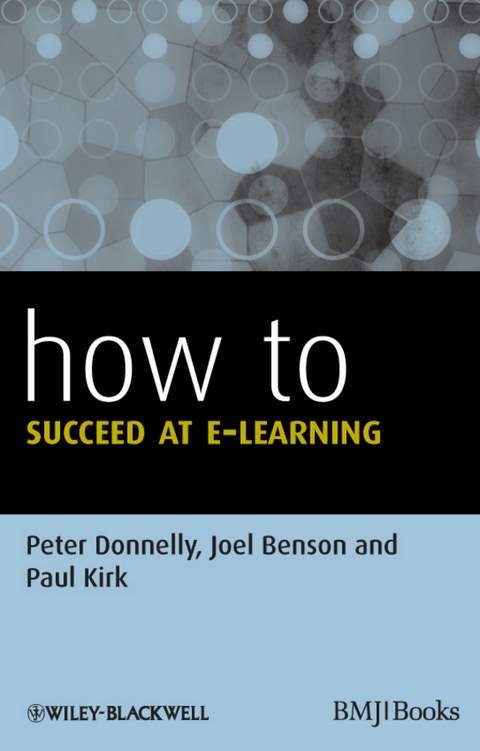
How to Succeed at E-learning (eBook)
John Wiley & Sons (Verlag)
978-1-118-30848-6 (ISBN)
A basic guide to getting the best from e-learning for medical students, teachers and all healthcare professionals
How to Succeed at e-Learning answers the needs of all healthcare professionals either starting or continuing their studies but not knowing where to begin with e-learning. It is a valuable guide for learners in undergraduate and postgraduate medicine as well as related health professionals and essential for teachers of medicine who are beginning to transfer from print to electronic teaching and need to understand effective methods of presentation.
A basic guide to getting the best from e-learning for medical students, teachers and all healthcare professionals How to Succeed at e-Learning answers the needs of all healthcare professionals either starting or continuing their studies but not knowing where to begin with e-learning. It is a valuable guide for learners in undergraduate and postgraduate medicine as well as related health professionals and essential for teachers of medicine who are beginning to transfer from print to electronic teaching and need to understand effective methods of presentation.
Peter Donnelly MB, BCh, BAO, FRCPysch, BA (Open), Deputy Dean, Wales Deanery, Cardiff University, Cardiff, UK Paul Kirk BSc (Hons), MSc, PGCert Ed., E.Learning Unit Development Manager, Wales Deanery, Cardiff University, Cardiff, UK Joel Benson BA (Hons), PGC (ODL), Electronic Resources Officer, Wales Deanery, Cardiff University, Cardiff, UK
How to Succeed at E-learning 5
Contents 7
Acknowledgements 11
Chapter 1: Introduction 13
1.1 Overview of the book 13
1.2 Basic issues 13
1.3 Challenges as drivers 14
1.4 The start of technology in learning 14
Reference 16
Chapter 2: E-learning . . . what is it? 17
2.1 Definitions 17
2.2 Advantages of e-learning 36
References 38
Chapter 3: Evidence e-learning works 41
3.1 Systematic reviews 41
3.2 Examples of subject-specific studies (categorised by profession) 45
3.3 Summary of findings 48
3.4 Conclusion 49
References 49
Chapter 4: Using e-learning to teach 53
4.1 Requirement 54
4.2 Exploration 66
4.3 The course 75
4.4 The assessment 78
4.5 Choosing a platform 79
4.6 Summary 80
References 80
Chapter 5: Access to e-learning 83
5.1 The basics: f?iles and folders 83
5.2 Security 84
5.3 The book and the browser 85
5.4 Collaborative research 88
References 92
Chapter 6: Examples of technology in use 95
6.1 A Taste of Medicine 95
6.2 Examples of innovative e-learning from developing countries 97
6.3 Examples from developed countries 104
References 105
Chapter 7: E-learning qualifications 107
7.1 What to look for in an online course 108
7.2 Clinical courses 110
7.3 Leadership courses 118
7.4 Management courses 121
7.5 General information on internationally available online MBAs 125
7.6 Mentoring courses 126
7.7 Legal courses 129
References 132
Chapter 8: Research 135
8.1 Just in time, just enough and on the move 135
8.2 What is virtual reality (VR)? 136
8.3 Virtual reality systems in medicine 137
8.4 VR in obstetrics and gynaecology 137
8.5 Life-size patient simulators 139
8.6 Other simulation examples 140
8.7 Whole-heart modelling 141
8.8 Telling stories: understanding real-life genetics 141
8.9 Second Life VR 141
References 145
Chapter 9: Looking towards the future 147
9.1 The recent past 147
9.2 Why is ‘computing power’ important and how is it defined? 149
9.3 Past trends informing future trends 149
9.4 Experiments involving neurosurgical implants 151
9.5 Ongoing development in mobile technology 152
9.6 Summary 153
References 153
Chapter 10: Conclusion 155
Index 159
| Erscheint lt. Verlag | 7.12.2012 |
|---|---|
| Reihe/Serie | HOW - How To | How To |
| Sprache | englisch |
| Themenwelt | Schulbuch / Wörterbuch ► Unterrichtsvorbereitung ► Unterrichts-Handreichungen |
| Medizin / Pharmazie ► Allgemeines / Lexika | |
| Medizin / Pharmazie ► Studium | |
| Sozialwissenschaften ► Pädagogik | |
| Schlagworte | accessible • author • BASIC • Best • concise • Curricula • Education • E-Learning • Electronic • Essential • Examples • Experience • Expert • Guide • healthcare professionals • learners • Medical • Medical Professional Development • Medical Science • Medizin • NOVICE • Perspektiven in medizinischen Berufen • specific skills • students • Teachers • Technology • use |
| ISBN-10 | 1-118-30848-4 / 1118308484 |
| ISBN-13 | 978-1-118-30848-6 / 9781118308486 |
| Informationen gemäß Produktsicherheitsverordnung (GPSR) | |
| Haben Sie eine Frage zum Produkt? |
 PDF (Adobe DRM)
Kopierschutz: Adobe-DRM
Adobe-DRM ist ein Kopierschutz, der das eBook vor Mißbrauch schützen soll. Dabei wird das eBook bereits beim Download auf Ihre persönliche Adobe-ID autorisiert. Lesen können Sie das eBook dann nur auf den Geräten, welche ebenfalls auf Ihre Adobe-ID registriert sind.
Details zum Adobe-DRM
Dateiformat: PDF (Portable Document Format)
Mit einem festen Seitenlayout eignet sich die PDF besonders für Fachbücher mit Spalten, Tabellen und Abbildungen. Eine PDF kann auf fast allen Geräten angezeigt werden, ist aber für kleine Displays (Smartphone, eReader) nur eingeschränkt geeignet.
Systemvoraussetzungen:
PC/Mac: Mit einem PC oder Mac können Sie dieses eBook lesen. Sie benötigen eine
eReader: Dieses eBook kann mit (fast) allen eBook-Readern gelesen werden. Mit dem amazon-Kindle ist es aber nicht kompatibel.
Smartphone/Tablet: Egal ob Apple oder Android, dieses eBook können Sie lesen. Sie benötigen eine
Geräteliste und zusätzliche Hinweise
Buying eBooks from abroad
For tax law reasons we can sell eBooks just within Germany and Switzerland. Regrettably we cannot fulfill eBook-orders from other countries.
aus dem Bereich