


The Writing Revolution (eBook)
328 Seiten
John Wiley & Sons (Verlag)
9781444304688 (ISBN)
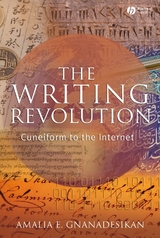
forget that writing is the original Information Technology,
created to transcend the limitations of human memory and to defy
time and space. The Writing Revolution picks apart the
development of this communication tool to show how it has conquered
the world.
* Explores how writing has liberated the world, making possible
everything from complex bureaucracy, literature, and science, to
instruction manuals and love letters
* Draws on an engaging range of examples, from the first
cuneiform clay tablet, Egyptian hieroglyphs, and Japanese
syllabaries, to the printing press and the text messaging
* Weaves together ideas from a number of fields, including
history, cultural studies and archaeology, as well as linguistics
and literature, to create an interdisciplinary volume
* Traces the origins of each of the world's major written
traditions, along with their applications, adaptations, and
cultural influences
AMALIA E. GNANADESIKAN teaches writing at Holy Family University, USA and has taught linguistics at West Chester and Rutgers universities. Her theoretical publications include works in phonology and language acquisition. Her column on language, "Postcards from Babel", appears in The Vocabula Review.
List of Illustrations vii
Preface xi
1 The First IT Revolution 1
2 Cuneiform: Forgotten Legacy of a Forgotten People 13
3 Egyptian Hieroglyphs and the Quest for Eternity 33
4 Chinese: A Love of Paperwork 56
5 Maya Glyphs: Calendars of Kings 79
6 Linear B: The Clerks of Agamemnon 95
7 Japanese: Three Scripts are Better than One 113
8 Cherokee: Sequoyah Reverse-Engineers 133
9 The Semitic Alphabet: Egypt to Manchuria in 3,400 Years
143
10 The Empire of Sanskrit 169
11 King Sejong's One-Man Renaissance 191
12 Greek Serendipity 208
13 The Age of Latin 229
14 The Alphabet Meets the Machine 249
Appendix: Figures A.1-A.7 273
Further Reading 281
Index 297
"Anyone interested in the development of writing, even without a
background in linguistics, will find the book accessible, while
linguists will appreciate the well chosen technical information
that is included in the description of each individual system."
(Language Documentation & Conservation, 2 December 2009)
"In The writing revolution: Cuneiform to the internet, an
engaging book that combines accuracy and readability better than
any other work on orthographic practices across time and space,
Amalia E. Gnanadesikan concurs with the usual view that the complex
calendrical system of the Maya's predecessors, the Olmec, was
'the intellectual stimulus' (80) for the development of
writing in Mesoamerica, which she discusses in Ch. 5, 'Maya
glyphs: Calendars of kings'." (Language, 2011)
"This informative, yet accessible and entertaining, book will be
of interest to readers with an interest in the history and
evolution of world languages, as well as to students and
instructors looking for a comprehensive and enjoyable overview of
the subject.." (Language in Society, 14 December 2009)
Writing is the most consequential technology ever invented. In this
important book Amalia Gnanadesikan combines a fascinating narrative
of human ingenuity with an up-to-date analysis of the world's
most important writing systems.
-Florian Coulmas, author of The Blackwell
Encyclopedia of Writing Systems
Gnanadesikan has written an excellent book describing the
structures of the important writing systems of the world. The
author has a gift for bringing dusty old scribes to life, showing
their relevance in the history of writing, one of the major
achievements of human beings. The writing is exceptionally clear,
making it quite accessible to those without a strong technical
knowledge of linguistics.
-Henry Rogers, author of Writing Systems: A
Linguistic Approach
This is a rare find: a work of impeccable scholarship that is
also enormously witty and entertaining.
-John J. McCarthy, University of Massachusetts
Amherst
After the invention of fire, writing has been humankind's
greatest discovery. Complete in its coverage, fascinating in
detail, and eloquently presented, this is the best single survey of
the subject in print.
-Michael Coe, author of Breaking the Maya
Code
| Erscheint lt. Verlag | 9.3.2009 |
|---|---|
| Reihe/Serie | The Language Library |
| Sprache | englisch |
| Themenwelt | Schulbuch / Wörterbuch ► Wörterbuch / Fremdsprachen |
| Geisteswissenschaften ► Sprach- / Literaturwissenschaft ► Sprachwissenschaft | |
| Schlagworte | Angewandte Linguistik • Anthropologie • Applied Linguistics • Linguistics • Schrift • Sprache • Sprachwissenschaften |
| ISBN-13 | 9781444304688 / 9781444304688 |
| Informationen gemäß Produktsicherheitsverordnung (GPSR) | |
| Haben Sie eine Frage zum Produkt? |
 PDF (Adobe DRM)
Kopierschutz: Adobe-DRM
Adobe-DRM ist ein Kopierschutz, der das eBook vor Mißbrauch schützen soll. Dabei wird das eBook bereits beim Download auf Ihre persönliche Adobe-ID autorisiert. Lesen können Sie das eBook dann nur auf den Geräten, welche ebenfalls auf Ihre Adobe-ID registriert sind.
Details zum Adobe-DRM
Dateiformat: PDF (Portable Document Format)
Mit einem festen Seitenlayout eignet sich die PDF besonders für Fachbücher mit Spalten, Tabellen und Abbildungen. Eine PDF kann auf fast allen Geräten angezeigt werden, ist aber für kleine Displays (Smartphone, eReader) nur eingeschränkt geeignet.
Systemvoraussetzungen:
PC/Mac: Mit einem PC oder Mac können Sie dieses eBook lesen. Sie benötigen eine
eReader: Dieses eBook kann mit (fast) allen eBook-Readern gelesen werden. Mit dem amazon-Kindle ist es aber nicht kompatibel.
Smartphone/Tablet: Egal ob Apple oder Android, dieses eBook können Sie lesen. Sie benötigen eine
Geräteliste und zusätzliche Hinweise
Buying eBooks from abroad
For tax law reasons we can sell eBooks just within Germany and Switzerland. Regrettably we cannot fulfill eBook-orders from other countries.
aus dem Bereich


